Erg Chigaga Guide
Is Erg Chigaga worth the extra effort compared to Merzouga?
If avoiding crowds and seeing the wildest dune landscape reachable from Marrakech matters more to you than convenience, yes. It requires a minimum of 3 days and a 4x4 for the final stretch, more logistics than Merzouga for a genuinely quieter experience.
Erg Chigaga is the Sahara trip for travellers who’ve already decided Merzouga is too crowded, or who simply want the most remote dune landscape reachable from Marrakech. It takes more planning and more days than either Merzouga or Zagora, and that extra effort is the entire point.
| Where | Beyond M’Hamid, roughly 2 hours by 4x4 past the end of the paved road |
| Cost | 3-day tours from roughly 2,000-3,000 MAD (185-280 €) per person; longer nomad routes cost more |
| Time needed | 3 days minimum; 4-6 days for trekking or nomad-caravan routes |
| Getting there | By road to M’Hamid, then mandatory 4x4 for the final desert crossing |
| Best time | October to April; summer heat is severe and camps are harder to reach comfortably |
Why Erg Chigaga is harder to reach than Merzouga or Zagora
Every route to Erg Chigaga ends the same way: the paved road runs out at M’Hamid, well south of Zagora, and from there the only way in is by 4x4 across roughly two hours of open desert track. There’s no ordinary road, no minibus route, and no way to arrive independently without a guide who knows the terrain — a meaningful difference from Merzouga, where the tarmac runs almost to the dune edge.
That logistics gap is exactly why Chigaga stays quieter than the other two destinations. Fewer operators run the route, fewer travellers make the extra time commitment, and the camps that do operate there tend to be smaller and further apart than the camp clusters around Merzouga’s Erg Chebbi.
Scale over height
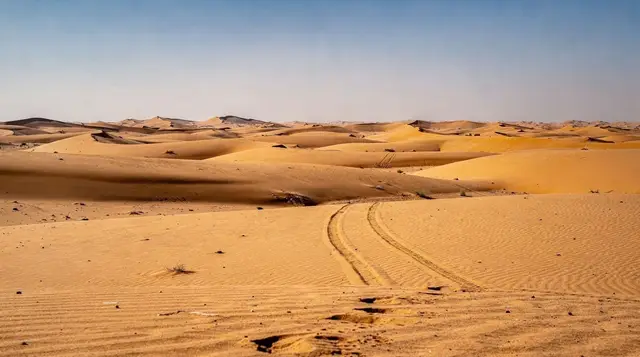
Erg Chigaga is Morocco’s largest dune field by surface area — a genuinely vast stretch of sand that dwarfs Zagora’s dunes and rivals or exceeds Erg Chebbi in scale, even if individual dune heights are broadly comparable between Chigaga and Merzouga. What sets it apart isn’t a single taller dune to photograph but the sense of scale: hours of driving or trekking with nothing but sand in every direction, and camps that feel genuinely isolated rather than one of several dotted along an access road.
A 3-day Erg Chigaga desert adventure camp is the standard entry point: a day to M’Hamid and the 4x4 crossing, a night at camp, and a day back. It’s the shortest realistic version of this trip and still requires committing a full 3 days.
Longer routes: nomad caravans and trekking
Because Chigaga sits at the edge of a genuinely large, sparsely visited erg, several operators run multi-day trekking and caravan-style routes that go well beyond an overnight camp stay. A 4-day nomad caravan route to Erg Chigaga follows old caravan trails by camel over several days, camping at different points rather than a single fixed site.
A 5-day Sahara nomad crossing to Erg Chigaga extends this further for travellers who want a genuine multi-day desert trek rather than a one-night camp visit, and a 6-day Marrakech to Erg Chigaga desert tour covers the whole round trip from Marrakech at a relaxed pace with time to explore beyond the main camp.
These longer routes suit travellers who’ve already done a standard overnight desert camp elsewhere and want something more physically involved — multiple days of camel trekking between camps, further from any road, rather than a single night with a short trek on either end. They also cost proportionally more, reflecting the extra days of guiding, camel handling, and camp logistics required to move a group across genuinely remote terrain.
What camp life at Chigaga actually feels like
Camps at Erg Chigaga are generally smaller and more spread out than the camp clusters near Merzouga, where dozens of operators run tents within sight of each other along the access road. At Chigaga, it’s common to see no other camp lights at all once night falls — genuinely the point of coming this far, but worth knowing if you’re expecting the same social, multi-camp atmosphere some travellers experience at Erg Chebbi.
Facilities skew toward the mid-range and bivouac tiers more than luxury, simply because the logistics of running a fully luxury operation — reliable power, plumbed bathrooms — get considerably harder two hours into open desert by 4x4. That’s not a downside so much as a trade-off consistent with the whole appeal of Chigaga: fewer comforts, more genuine remoteness. See Sahara desert camps explained for how Chigaga’s camp options compare tier-by-tier with Merzouga and Zagora.
Booking further ahead than usual
Because fewer operators run this route and vehicles need to be arranged specifically for the 4x4 crossing, it’s worth booking an Erg Chigaga trip further in advance than a standard Merzouga or Zagora tour — a few days at minimum, and a week or more in peak season (October to April) if you want a specific departure date. Last-minute availability is far less reliable here than on the more heavily serviced Merzouga route, where dozens of operators run daily departures.
Private tours and vehicle requirements
Because the 4x4 crossing is mandatory rather than optional, private tours make more sense here than on the Merzouga or Zagora routes, where shared minibuses cover most of the journey. A private 3-day Sahara trip to Erg Chigaga gives you your own 4x4 and driver for the full route rather than sharing a vehicle, which matters more here given the terrain and the value of a driver who knows the desert track well.
Combining Chigaga with Zagora
Most routes to Erg Chigaga pass through or near Zagora on the way south, since it sits further along the same general corridor rather than requiring a separate detour from Marrakech. Travellers who’ve read the Merzouga or Zagora comparison and decided neither fully matches what they want often land on Chigaga as the answer — it shares Zagora’s route south but pushes considerably further into genuinely remote desert.
Fitness and physical demands
The standard 3-day trip to Erg Chigaga makes no unusual physical demands beyond a normal camel trek — sitting in a 4x4 for the crossing and riding a camel to camp, much like Merzouga or Zagora. The longer nomad-caravan and trekking routes are a different matter, involving multiple days of walking or riding across genuinely remote terrain with limited services, and are worth approaching with a reasonable baseline of fitness and comfort with several consecutive days away from any real infrastructure.
Heat and sun exposure are more of a factor here than at either Merzouga or Zagora, simply because the terrain offers even less shade and the camps are further from any quick way out if someone struggles with the conditions. Anyone with health concerns that might be affected by sustained heat or physical exertion should discuss the specific itinerary with the operator before booking, particularly for the longer trekking routes.
Guides and local knowledge
Because the final stretch to Chigaga has no signposted road, the quality of the guide matters more here than on almost any other Marrakech-area excursion. Reputable operators use drivers and guides with genuine, extensive experience navigating the open desert track, often with additional local Sahrawi or Berber guides who know the terrain from growing up in the region. This local knowledge covers more than just navigation — it extends to reading weather changes, knowing where water sources exist, and managing a group safely across genuinely remote ground, all of which matters more here than on a route where getting lost simply means a wrong turn onto a paved road.
Packing and preparing for a remote camp
Because Chigaga is further from any shop or town than Merzouga, it pays to pack with more care. Layers matter, since desert evenings feel very different from the daytime, and a scarf or cover for face and neck is useful in the 4x4 when the track kicks up dust. Our desert tour packing guide covers the full list, and the same advice applies here with extra weight on sun protection, water bottles and a small torch for walking between tents after dark. Bring cash for tips and small purchases rather than counting on any card terminal, and read tipping in Morocco so you know what is customary for drivers, camel handlers and camp staff.
Reaching the start of the route from Marrakech
The first day is mostly a long road day, so it helps to arrive in Marrakech rested and with your transfers sorted. If you land late, the Marrakech airport transfer guide explains the options so you are not improvising on the morning of departure. Anyone thinking about driving part of the way themselves should read driving in Morocco first, with the reminder that the desert crossing itself is not a self-drive route. For the long haul south in general, the Marrakech to Merzouga guide describes the kind of road day you can expect, since much of the early scenery is shared before the routes part.
On the way, the road crosses the High Atlas, and many travellers use the journey as a chance to see places that are covered in their own pages. Tizi n’Tichka is the pass most itineraries cross, and Ait Ben Haddou and Ouarzazate are common stops that break up the drive. If your operator offers a stop at the kasbah, our Ait Ben Haddou guide will help you decide how long it deserves. The Draa Valley is the green corridor that leads towards the south, and Erg Chigaga has its own destination page if you want the short version before you commit.
How the days usually unfold
A typical shape for the shorter trip is a long first day on the road, a transfer onto the desert track, and an evening at camp with sunset over the dunes. The second morning is for sunrise and a slow start, then the return towards Marrakech. Longer routes simply add days of travel on foot, by camel or by 4x4 between camps, with more time to stop where the landscape is interesting. None of this is rushed on purpose, and it helps to treat the long drives as part of the experience rather than dead time: bring music, a book, and a willingness to look out of the window.
Evenings are where Chigaga shines. With no neighbouring camps and very little artificial light, the night sky is the main entertainment, along with a meal cooked at camp and music around the fire. Read what nobody tells you about the Sahara for an honest account of the cold nights, the quiet and the small discomforts, and desert dawns for why an early start on the dune is worth it.
Choosing between a group trip and a private one
Group departures can feel more sociable, but on this route they depend on enough travellers choosing the same dates, which is another reason to plan early. A private trip gives you control over pace, stops and timing, and suits couples, families and small groups who would rather not share the 4x4. If you are comparing the two approaches in general, guided tour versus independent travel lays out the trade-offs, and in the case of Chigaga the independent option is simply not realistic for the desert section. Whichever you pick, ask the operator in writing what is included on each day, which vehicle is used on the track, and what the camp setup looks like.
Deciding if it fits your Marrakech trip
Chigaga asks for a large share of a Morocco itinerary, so think about what else you want to see. If you have a week or less in total, the Marrakech Sahara 3-day itinerary gives a shorter template, and the southern circuit itinerary shows how a longer loop through the south can be put together. Travellers weighing the desert against a closer overnight should compare it with the Agafay desert guide and Agafay versus the Sahara, which explain what a near-city camp can and cannot offer. If you simply want to balance this long trip with a few days in the city, the best day trips from Marrakech is a good place to look for lighter outings once you are back.
If you’re still deciding between destinations, Merzouga or Zagora is the comparison to read first — Chigaga makes most sense once you’ve ruled those two out for your specific priorities. For what to expect at camp regardless of destination, see Sahara desert camps explained, and how to book a Sahara tour without getting burned covers the operator vetting that matters even more on a route this remote.
Sahara tours on GetYourGuide
Verified deep-linked GetYourGuide tours. Book through these links and we earn a small commission at no cost to you.
Photo: our own image of the location, not the operator’s product photo.