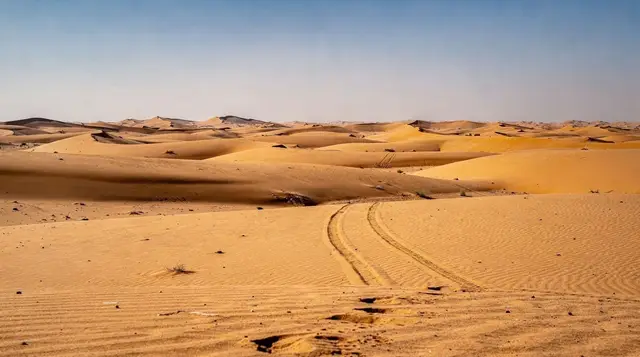
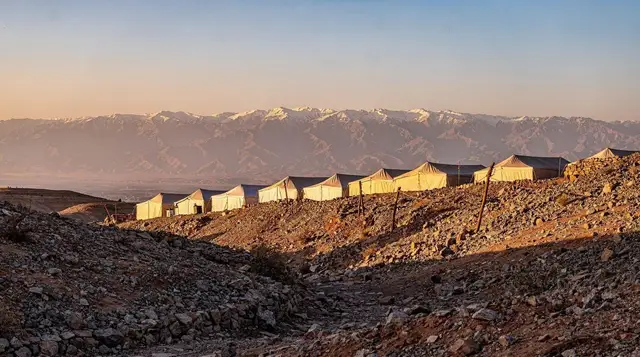
Erg Chigaga is what people mean when they say they want the Sahara without the crowds. It’s the largest and most remote great erg reachable from Marrakech — bigger than Erg Chebbi near Merzouga by some measures — and it stays that way because getting there takes real effort. There’s no paved road anywhere near it.
The route runs south past Zagora to M’Hamid, the last proper town before the desert opens up, and from there it’s roughly 60 km of open track across hammada and dunes that only a 4x4 can manage. No shared minibus makes this trip. Every operator running Erg Chigaga tours uses genuine off-road vehicles, and that alone filters out the day-trippers who fill Merzouga’s dune camps every night.
What you get in exchange is a landscape with almost nobody else in it. Camps here are smaller, often genuinely nomad-run rather than tourist-facing operations dressed up as such, and the sense of isolation is real rather than staged. It’s the closest thing to the Sahara that early travellers actually described.
| Where | ~450 km south of Marrakech, beyond M’Hamid; final stretch by 4x4 only |
| Cost | 3-day tours from around 2,500-4,000 MAD (230-370 €) per person, including 4x4 transport, camel time and one or more desert nights |
| Time needed | 3 days minimum; 4-6 days for nomad-caravan or trekking routes |
| Getting there | Overland to Zagora or M’Hamid, then 4x4 only — no ordinary vehicle reaches the erg |
| Best time | October to April; the open track is punishing in summer heat |
Why the 4x4 requirement matters
It’s worth understanding what “4x4 only” actually means for the trip, because it shapes everything about the experience. The track from M’Hamid isn’t a rough road so much as a general direction across open desert, shifting with the sand and weather. Drivers who do this route regularly know the landmarks; a rental car or a driver unfamiliar with the terrain has no business attempting it. This is one part of Morocco where booking with an experienced operator isn’t optional caution — it’s the only way in.
That same remoteness is what keeps Erg Chigaga free of the day-trip traffic that now surrounds Merzouga’s dune camps most evenings. You won’t see a line of camel treks converging on the same ridge at sunset here, because the volume of visitors simply doesn’t reach the same level, by design as much as by geography.
3-day Erg Chigaga desert adventure camp tour is the standard entry point: overland via Zagora and M’Hamid, a 4x4 crossing to the erg, one or two nights at camp, and camel time among the dunes. It asks for the same three-day minimum as Merzouga, but delivers a noticeably quieter, wilder version of the same basic experience.
Private tours and longer expeditions
Because group numbers stay naturally small on this route, private tours are relatively more common here than on the Merzouga circuit. A private 3-day Sahara trip to Erg Chigaga gives full control over pace and stops, which matters more here than almost anywhere else in Morocco given how much of the trip is spent crossing open desert by vehicle.
For travellers who want to go beyond the standard camp-and-camel format, multi-day nomad-caravan routes exist that trade speed for immersion. 4-day nomad caravan route to Erg Chigaga follows old caravan tracks with extended camel time and camps that shift location day to day, closer to how nomadic groups actually moved through this landscape than the fixed dune camps further north. A 5-day version pushes the same format further, with more trekking and fewer vehicle-bound stretches.
Combining with Zagora
Most Erg Chigaga itineraries route through Zagora on the way south, and a short 2-day add-on exists for travellers already in the area. A 2-day trip from Zagora to Erg Chigaga works well for anyone who has already reached Zagora independently and wants to push on to the wilder erg rather than turning back after Zagora’s own, smaller dunes — it’s a genuinely useful bolt-on rather than a full itinerary in its own right, and worth asking about at any tour desk in Zagora itself.
For a genuinely long expedition, a 6-day Marrakech to Erg Chigaga tour combines the desert crossing with a multi-day trek, aimed squarely at travellers who want more than a camp-and-camel overnight and have the time to spend on it. Expect long driving days at both ends of the trip, bracketing several days of genuinely slow, on-foot desert travel that’s closer to how the route was crossed before vehicles reached this far south at all.
What to expect physically
Days involve real 4x4 driving over uneven terrain, which is more tiring than it sounds and not well suited to anyone prone to motion sickness. Camel treks here tend to run longer than the standard 45 minutes at Merzouga, sometimes stretching to two hours or more between camp and the furthest dune ridges. Facilities at nomad-style camps are simpler than the increasingly polished luxury camps near Merzouga — expect basic but adequate rather than five-star.
Mobile signal disappears entirely for most of the crossing beyond M’Hamid, which is worth knowing in advance rather than discovering when you try to send a photo home. Tell anyone expecting to hear from you that you’ll be unreachable for two to three days, and download offline maps or entertainment before you leave rather than relying on a connection that won’t exist once the paved road ends.
Cost and what’s actually included
Prices for Erg Chigaga tours sit noticeably above equivalent Merzouga packages, largely because of the fuel, vehicle wear and driver expertise the 4x4 crossing demands. Most quoted prices include transport from Marrakech, all meals from the first dinner to the last breakfast, camel time, and one or more nights at camp — but it’s worth confirming explicitly whether the price covers the full Marrakech-to-Marrakech loop or only the Zagora-to-erg-to-Zagora segment, since some listings quote the shorter leg to look more competitive. Bottled water is usually included given how far the route runs from any shop, but it’s sensible to carry a personal supply as backup regardless of what’s promised.
Packing and preparing for the crossing
Nights in the open desert are a different proposition from days, and the gap between the two is wider here than in most places travellers visit from Marrakech. The desert tour packing guide covers the full list, but the principles are simple: layers you can add and remove, closed shoes that cope with soft sand, a scarf or buff for wind, sun protection, and a small bag for the camp so the main luggage can stay in the vehicle. If you are travelling in the cooler months, which is when this route makes most sense, bring warmer clothing than you think you need for the evening and early morning.
Because there is no signal and no shop once the paved road ends, anything you forget stays forgotten. Medication, a charged power bank, a torch and spare batteries for your camera all earn their place in the bag. Keep valuables and documents with you rather than in the vehicle, and keep fine sand out of electronics with a sealed pouch.
How Erg Chigaga compares with the other desert options
The Sahara is not one experience, and it helps to place Erg Chigaga among the alternatives before committing several days to it. Agafay is a stony desert close to the city, easy to reach in an afternoon and well suited to travellers with little time, though it is not a sand-dune landscape. Merzouga offers the classic tall dunes of Erg Chebbi with more infrastructure, more camps and a wider choice of comfort levels. Erg Chigaga sits at the other end of the scale: further, simpler and quieter.
If you are still working out which one fits your trip, the Sahara desert camp guide explains what different camp styles actually offer, and what nobody tells you about the Sahara is an honest read on the less glamorous side of a desert night. For a reflective account of why people make the journey at all, the desert dawns essay is worth reading before you book.
A rhythm for the days
A trip to Erg Chigaga is shaped by the road more than by any list of sights. The first day is mostly travel, crossing the mountains and descending towards the oasis country in the south. The second day brings the real change: the last town, the end of the tarmac, and then the open track that leads to the dunes. Time in the erg itself is slow by design. Walking up a ridge before sunset, sitting out the heat of the day in the shade of the camp, eating around the fire and watching the stars come out are the point of the trip, not filler between activities.
The return leg repeats the long driving, which is why the shortest itineraries can feel rushed. Adding a night, or choosing one of the longer caravan formats mentioned above, gives you more unhurried time in the dunes and less of the trip spent in the vehicle. The Marrakech Sahara itinerary for three days shows how a compact version fits together, while the southern circuit itinerary suits anyone who wants to link the desert with the kasbah towns and valleys on the way.
Stops worth making on the way south
The journey is long enough that the places you pass matter. Ait Ben Haddou and Ouarzazate sit on the classic route over the High Atlas, and a good itinerary uses them as a break from the road rather than rushing past. The Tizi n’Tichka pass is the dramatic opening to the trip, with the landscape changing as you cross from the mountains to the pre-desert. If you would rather travel independently as far as Zagora and join a tour from there, the driving in Morocco guide is a useful reality check on the distances and road conditions involved.
Booking with confidence
Most of the questions travellers have about Erg Chigaga come down to the same few points: who is driving, where you sleep, and what is included. The Sahara tour booking guide walks through how to compare listings, and the Marrakech to Merzouga guide is helpful if you want to see how the more mainstream route is organised for comparison. Whichever you choose, read the itinerary line by line, check how many nights are spent in the desert itself, and ask the operator to describe the camp in plain terms. A clear, specific answer is a good sign; vague promises are not.
Choosing an operator
Given how much of an Erg Chigaga trip depends on the vehicle and driver, operator choice matters more here than on almost any other route out of Marrakech. Look specifically for operators who mention 4x4 vehicles and experienced desert drivers by name in their listing, rather than generic “off-road” language that could describe anything. Reviews that mention the M’Hamid crossing specifically are more useful than generic five-star ratings, since they confirm the operator has actually run this particular route rather than a more standard Zagora or Merzouga trip under a similar-sounding name.
It’s also worth asking in advance what happens if weather makes the crossing genuinely unsafe — sandstorms occasionally close the track for a day at a time, and a reputable operator will have a contingency plan, whether that’s a delayed departure or an alternative camp closer to M’Hamid, rather than pushing through regardless.
For the full detail on routes and operators, see the Erg Chigaga guide. If you’re weighing this against the more accessible options, Merzouga or Zagora is the place to start, and Agafay or the real Sahara helps if you’re not yet sure a full Sahara trip is worth it at all. Zagora and the Draa Valley both sit directly on the route south and are easy to combine with an Erg Chigaga trip.