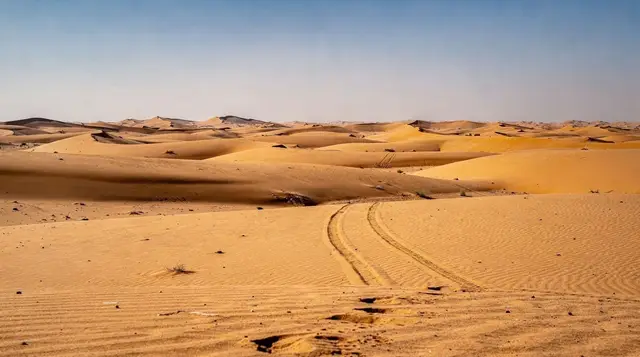
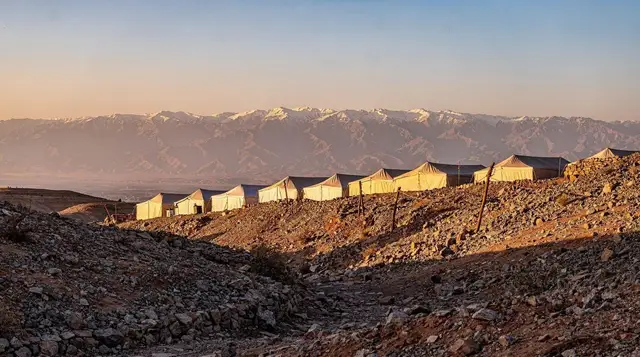
Ouarzazate sits where the High Atlas ends and the desert begins, a wide, dusty town built almost entirely around two things: a kasbah that once guarded the caravan routes, and a film industry that has used the surrounding red hills as a stand-in for everywhere from ancient Rome to Tibet. It’s not a pretty town in the way Ait Ben Haddou is pretty — the centre is a long, functional avenue of banks, tour offices and carpet shops — but the two or three things worth stopping for are genuinely worth stopping for.
Most visitors pass through as a base for the day trip to Ait Ben Haddou, 30km west, or as the last proper town before the road drops into the Draa or Dades valleys towards Merzouga and Zagora. That’s a fair use of it. Treat it as a gateway with a couple of good mornings in it, not a destination to linger in for a week.
| Where | 204km / roughly 4 hours from Marrakech via the N9 and the Tizi n’Tichka pass |
| Cost | Kasbah Taourirt entry around 20 MAD (under €2); film studio tours from 80-120 MAD (€7-11) |
| Time needed | Half a day for the kasbah and one studio; a night if combining with Fint oasis |
| Getting there | Grand taxi, shared minibus or a private/guided transfer from Marrakech; no train |
| Best time | March-May, October-November; avoid midday in July-August |
Getting there over the Tizi n’Tichka
The N9 from Marrakech to Ouarzazate has been widened and resurfaced over recent years, and it’s a genuinely safer road than it used to be — better barriers, better surface, fewer of the blind hairpins that gave the old Tizi n’Tichka its reputation. That doesn’t make it fast. Budget four hours door to door even with the improvements: the road climbs to 2,260m over the pass itself, and there’s no shortcut around the switchbacks on either side. Stopping for mint tea at one of the roadside viewpoints on the way up is normal and worthwhile; stopping at every single “cooperative” that flags you down is how a four-hour drive becomes a six-hour one.
If you’re not driving yourself, grand taxis run the route shared or on a private-hire basis, and most riads can arrange a driver. Buses exist but take considerably longer with more stops. For a first visit, a guided day trip that includes both the pass and Ait Ben Haddou on the way back is the easiest way to see the route without worrying about timing or parking.
If you are still deciding how the south fits into your plans, the High Atlas region you cross on the way here is part of the appeal, and the Draa Valley is the natural continuation for anyone heading further on. A more general overview of the options sits in the guide to the best day trips from Marrakech.
Who Ouarzazate suits, and who it does not
Ouarzazate rewards a particular kind of traveller. If you like architecture made of earth, if you enjoy the strange mix of real history and film-set artifice, or if you simply want a sensible place to break a long journey, it works well. If your priority is atmospheric medina lanes, lively evenings or a polished resort stay, you will probably find it flat. The town is spread out, distances between sights are longer than they look on a map, and the feel is administrative rather than romantic.
That is not a criticism so much as a way of setting expectations. Travellers who arrive expecting another Marrakech medina are usually disappointed in the first hour and pleasantly surprised by the second morning, once they have seen the kasbah light up in the early sun and understood why directors keep returning. Those who go in treating it as a practical stopover with two or three good stops tend to leave happy.
Choosing between a day trip and a night
The core decision is whether to see Ouarzazate on a long day out of Marrakech or to sleep here. A day trip is achievable, and the Ouarzazate day trip guide lays out how the hours are typically spent. The trade-off is that most of the day ends up inside a vehicle, and the sights themselves are squeezed into whatever time remains.
Sleeping a night changes the rhythm. You can reach the kasbah when it is quiet, spend a slow morning at a studio, and still make Ait Ben Haddou before the tour groups thin out in the afternoon. If you are continuing east or south, the night is not an extra at all, because it breaks the drive into two comfortable halves. The Marrakech to Merzouga guide explains how that longer route is usually split, and Ouarzazate is the obvious place to do it.
Kasbah Taourirt
Kasbah Taourirt was the seat of the Glaoui family, the Berber dynasty that controlled this end of the trans-Saharan trade routes and, for a period under the French protectorate, effectively ran southern Morocco. What’s standing today is only a fraction of what existed — most of the mudbrick complex has collapsed or been left to erode — but a restored section is open to visitors, with carved cedar ceilings, painted plaster and a warren of narrow stairwells that give a real sense of scale even in ruin. Give it 45 minutes to an hour.
It’s a useful comparison point if you’re also visiting Telouet, the Glaoui family’s other, more remote kasbah in the mountains — Taourirt is easier to reach and better preserved, Telouet is wilder and less visited.
A practical tip: go early or late in the day, when the mudbrick takes on a warmer colour and the narrow stairwells are less crowded. The rooms are small, so a slow pace and a willingness to look up at the ceilings repay the effort. A local guide at the entrance can explain the Glaoui story in more detail than any sign, and it makes the visit feel less like walking through empty rooms. For a more complete picture of how these fortified settlements worked, read the Ait Ben Haddou guide alongside this page.
The film studios and the cinema museum
Ouarzazate calls itself the Hollywood of Africa with a straight face, and the claim isn’t empty marketing. Atlas Film Studios and the smaller CLA studios nearby have supplied sets and desert light for decades of productions, and the region’s landscapes — kasbahs, dunes, bare hills — have stood in for Egypt, Tibet, ancient Rome and Jerusalem. Productions filmed in and around Ouarzazate and Ait Ben Haddou include Lawrence of Arabia, Gladiator, Kingdom of Heaven and, more recently, Game of Thrones.
a combined Ait Ben Haddou and Atlas Studios day trip covers both properly in one outing, which is the efficient way to do it if you only have one day. The sets themselves are a mix of genuinely impressive full-scale builds — an Egyptian temple facade, a recreated ancient city gate — and plywood-and-plaster backdrops that only work from one camera angle. Guides know which is which and will tell you, which is part of what makes the tour worth the modest entry fee. The Museum of Cinema, near the studios, is smaller and more of a curiosity than a highlight: old props, photographs and a handful of costumes, good for twenty minutes if you’re already there.
The oasis of Fint
About 15km south of town, the Fint oasis is a narrow green ribbon of palms and small Berber hamlets along a seasonal river, walled in by bare rock hills. It’s a lower-key, more rural counterpart to the palmeraies further along the route at Skoura, and it sees a fraction of the visitors. There’s no formal entry fee or ticket office — you’re walking through a place people actually live and farm, so go with a guide or driver who knows the families, keep to paths, and ask before photographing anyone. A half-day trip combining Fint, Ait Ben Haddou and one studio is a sensible way to see it without a dedicated extra day.
Because the walk is gentle and the setting is quiet, Fint also suits anyone who has had enough of tour-bus stops. Think of it as a change of pace rather than a headline sight: shade, running water in season, the sound of the palms, and a glimpse of everyday village life. Bring a hat, carry water, and treat the paths and irrigation channels with the same respect you would show in anyone’s garden.
Getting around once you are here
The town is built for cars rather than walkers. The kasbah, the studios and the main avenue are not close enough to comfortably combine on foot, so most visitors rely on a petit taxi for short hops or a driver for the full day. Agree the arrangement before setting off, as you would anywhere in Morocco, and the Morocco driving guide is worth reading if you are hiring a car and planning to continue south. For general advice on negotiating fares and avoiding confusion, the Marrakech taxi guide applies equally well here, even though the town is a different size.
If you are travelling between cities without a car, the notes on trains and buses in Morocco explain what is realistic. There is no rail link, so overland travel here always means road transport.
Bringing it together with other stops
Ouarzazate pairs naturally with its neighbours. A route that links Ait Ben Haddou, Skoura and the Dades Valley forms a classic southern loop, and the dedicated southern circuit itinerary shows how it can be stretched across a week. Shorter on time? The two-day Atlas itinerary gives a lighter taste of the mountains, while the three-day Sahara itinerary treats Ouarzazate as a stopping point on the way to the dunes.
Anyone comparing options for the desert itself may also like the comparison of Merzouga and Zagora, since the choice often decides which road you take out of town. And if you are weighing up whether a guided departure beats doing it alone, the notes on guided tours versus independent travel cover the main considerations.
Where Ouarzazate fits in a longer trip
Ouarzazate is the hinge point for almost every southern route out of Marrakech. West is Ait Ben Haddou and the direct road back over the pass; east is the “route of a thousand kasbahs” through Skoura, the Dades Valley and Todra Gorge towards Tinghir; south is the long haul down through Zagora or on to Merzouga and Erg Chebbi.
If you’re planning a multi-day loop rather than a single day trip, this is where you’d base yourself for a night before splitting east or south. A combined Skoura, Kasbah Amridil and Dades Gorges tour covers the eastern leg in a single well-organised day if you don’t want to self-drive it.
For sunrise views over the town and the surrounding hills without a full desert trip, a hot air balloon flight with breakfast is a genuinely good option here — the terrain is more varied than the flat plains around Marrakech, and flights run early enough not to eat into the rest of your day.
Dressing and packing for the south
The landscape here is open and exposed, so sun protection matters more than at a riad in the medina. Light, loose layers work well, since mornings can feel cool while afternoons are harsh, and closed shoes help on uneven kasbah floors and dusty oasis paths. The what to wear in Marrakech advice carries over, and the desert tour packing guide is useful if Ouarzazate is the first leg of a longer journey. Pick your season carefully using the best time to visit Marrakech notes, bearing in mind that the south runs hotter than the city in summer.
Practicalities
Ouarzazate has more mid-range hotel capacity than anywhere else in the south, from simple guesthouses on the main avenue to a scattering of larger resort-style properties on the edge of town, so it’s rarely necessary to book far ahead outside peak season. There are ATMs, fuel stations and proper supermarkets — useful if you’re stocking up before continuing towards Zagora or Merzouga, where facilities thin out fast. Restaurants cluster along Avenue Mohammed V, mostly tagine-and-couscous places aimed squarely at the tour-bus trade; food is reliable rather than memorable. If you’re self-driving onward, fill the tank here regardless of your onward plans — it’s the last large town for a while in most directions.