Guided Tour or Going It Alone
Do I need a guide to visit Marrakech?
No, the medina works well independently with an offline map once you get your bearings. A licensed guide earns their fee on your first souk walk and for major monuments, and organised tours are genuinely more practical for the Atlas and the Sahara.
Whether to book a guide or go it alone isn’t a single decision for a Marrakech trip — it’s several smaller ones, and the right answer changes depending on whether you’re talking about the medina, a monument, or a two-day drive into the Atlas. The honest version: the medina works well independently once you’ve got your bearings, a guide earns their fee on day one and at major sites, and anything involving a long drive is almost always easier and cheaper as an organised tour than arranged yourself.
| Medina walking | Works well independently after an initial orientation |
| Monuments | A guide adds real context; independent entry also works |
| Atlas/Sahara day trips | Organised tours are simpler and usually cheaper than arranging it yourself |
| Cost of a guide | Roughly 300-600 MAD (28-55€) for a half-day, official rates |
| Risk of going alone | Getting lost or targeted by unofficial “guides,” not physical danger |
Guided tour vs independent at a glance
| Guided tour | Independent | |
|---|---|---|
| Medina souks | Faster orientation, fewer wrong turns | Doable with an offline map after day one |
| Major monuments | Added history and context | Entry tickets alone work fine if you research beforehand |
| Atlas Mountains day trip | Transport and driver included, simpler | Requires arranging a driver or rental car yourself |
| Sahara multi-day trip | Standard and usually cheaper than DIY | Rarely done independently; logistics are heavy |
| Cost | Fixed price, no negotiation needed | Potentially cheaper but time-intensive to arrange |
| Best for | First-timers, long-distance trips, monuments | Confident walkers, repeat visitors, flexible schedules |
Where independent exploration genuinely works
The medina is more approachable solo than its reputation suggests, provided you download an offline map before you arrive and accept that getting turned around a few times on day one is normal, not a sign you’re doing something wrong. Landmarks like the Koutoubia minaret and Jemaa el-Fna work as reliable orientation points to navigate back toward, and most derbs eventually spit you out onto a road you recognise. The Marrakech souks guide and the self-guided medina walking route are both built specifically for travellers doing exactly this.
Major monuments with entry tickets — the Bahia Palace, the Saadian Tombs, Ben Youssef Madrasa — are all straightforward to visit independently, with signage and audio guides usually enough to cover the basics for visitors who’ve done a little reading beforehand.
Where a guide earns its fee
Two situations make a guide genuinely worth paying for. The first is your very first walk through the souks, when unfamiliarity with the layout costs real time and patience — a private walking tour in Marrakech on day one builds a mental map that pays off for the rest of your stay, even if you go fully independent afterward. The second is deep historical or cultural context that a plaque or an audio guide simply doesn’t provide — a full-day guided medina history and culture tour is built around exactly this, weaving several sites together with the stories behind them.
A licensed guide is also the most reliable way to avoid Marrakech’s persistent unofficial “guides,” who approach confused-looking tourists near the souks with unsolicited offers. Booking through your riad, hotel or a recognised operator sidesteps this entirely, since a legitimate guide works from a badge and a set rate rather than a street-corner pitch. The Marrakech scams guide covers this and other common hassle in more detail.
Why long-distance trips are different
The calculus shifts once you’re talking about the Atlas Mountains or the Sahara rather than the medina. Arranging your own driver, fuel, and overnight desert camp booking independently is possible but rarely cheaper than a bundled tour, and it adds real planning overhead for a marginal saving at best. A premium day trip to Ait Ben Haddou and the Atlas Studios bundles transport, a knowledgeable driver-guide, and the film-studio access into a single price that’s difficult to beat by arranging the pieces yourself, and the same logic applies to a multi-day Sahara excursion, where the driving alone makes independent arrangement impractical for most visitors.
This is also where safety and logistics genuinely favour the organised option: mountain roads and unmarked desert camp locations are harder to navigate independently than a city medina, and a guide who knows the route removes a real source of stress from what should be an enjoyable few days.
Making the independent route work
Going alone is less about courage than preparation. Before you land, download an offline map, save your riad’s address and a few landmarks, and read up on the places you plan to visit. Our first-timer’s guide to Marrakech covers the basics of arrival and orientation, and getting around Marrakech explains how to combine walking with taxis so you are not trying to cover everything on foot. If you do take a cab, the Marrakech taxi guide is worth a read first, because agreeing on the fare or the meter before you set off removes one of the most common sources of friction for independent visitors.
It also helps to decide in advance how you will handle approaches in the street. A calm, friendly refusal and a steady pace usually end an exchange quickly. Stopping to look at your phone in the middle of a busy derb, on the other hand, tends to invite offers of help. Step into a doorway or a café to check your map, and you will find the medina much less tiring. The Marrakech safety guide goes through this in more detail, and solo female travel in Marrakech is useful if you are travelling alone and want practical, honest advice on moving around confidently.
Choosing by interest, not just by budget
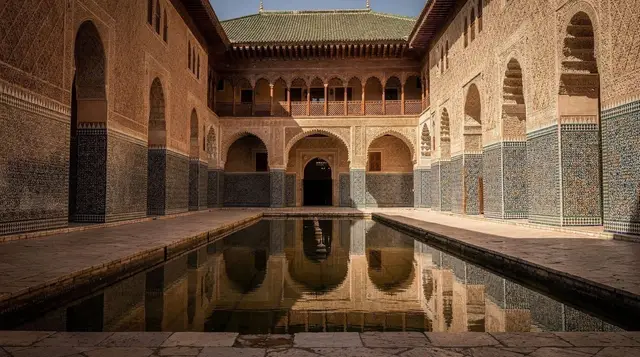
The best answer often depends on what you came to see. If your priority is architecture and history, a guide adds the most at places where the stories are layered, such as the Bahia Palace and the Ben Youssef Madrasa. Both reward some background reading, but a knowledgeable guide can point out details in the carving, the courtyards and the layout that you would otherwise walk past without noticing.
If your priority is shopping, the calculation is different. A guide can introduce you to the main areas of the souks and explain what you are looking at, but you will still need to negotiate yourself, and a guide who steers you towards particular shops may not be working in your interest. Treat any recommendation with the same curiosity you would bring to an independent browse, and read the Marrakech shopping guide beforehand so you know what to look for.
If your priority is food, independent wandering is hard to beat. The stalls and cafés around the main square reward a hungry, unhurried approach, and the Jemaa el-Fna guide and Marrakech food guide will help you choose where to eat without needing anyone to hold your hand. A cooking class is another way to get local guidance on your own terms, and the Marrakech cooking class guide explains what to expect.
Beyond the city: when a driver-guide is the practical choice
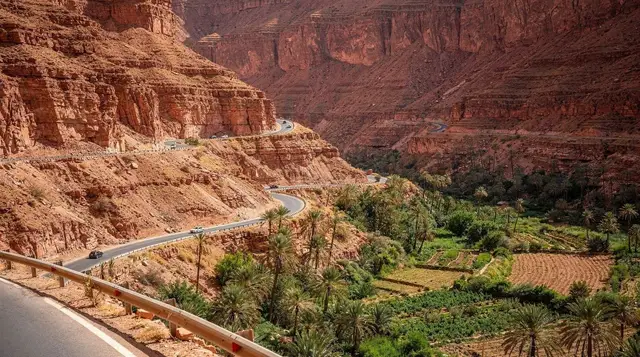
Day trips are where independent travellers most often reconsider. The best day trips from Marrakech range from the mountains to the coast, and while some can be done by public transport, the ones that matter most for scenery usually involve several stops that a single driver-guide can link together far more easily. The Atlas Mountains day trip guide and the Ait Ben Haddou guide show how much ground a well-planned trip can cover without you having to think about parking, directions or timing.
For longer journeys, the Sahara tour booking guide explains what to check before you commit, and driving in Morocco is worth reading if you are still tempted to rent a car and do it yourself. Some travellers enjoy the freedom of a rental, and for them it can work well, but it asks more of you in navigation, patience and planning than a city visit does. Most visitors who read about the practicalities decide that the guided option leaves them with more energy for the experience itself.
How to get the most from a guide
Whichever format you pick, a few habits make a guided outing better. Tell your guide at the start what you care about, whether that is history, photography, crafts or simply getting your bearings, so the route can be shaped around you rather than around a standard script. Ask questions freely, because a good guide enjoys them. Agree the rate, the length and the meeting point beforehand, and confirm what is and is not included so there are no surprises at the end of the walk.
Be gently sceptical about detours. A stop at a workshop or a shop can be genuinely interesting, but you are under no obligation to buy anything, and a good guide will respect that. If you would like to learn how craftspeople work rather than just buy their products, the artisan workshops guide suggests ways to do it on your own terms.
Finally, remember that a guide is a person with their own pace and style. If the fit is not right after the first hour, you can say so politely and adjust. This is one more reason a half-day booking is a sensible first step: it gives you a low-commitment way to find out whether you enjoy being guided at all, and what you want to do differently on the days that follow. When you are ready to plan the days around it, our two-day and three-day Marrakech itineraries show how guided and independent time can sit side by side, and the Marrakech medina page gives an overview of the area you will spend most of your time in.
Cost comparison in real numbers
A licensed private guide for a half-day medina walk typically runs 300-600 MAD (28-55€), a fixed rate agreed in advance rather than something to haggle over on the day. Group tours cost less per person — often 150-350 MAD (14-32€) for a shared walking tour — while sacrificing some flexibility in pace and questions answered. Independent exploration costs nothing beyond entry tickets to specific sites, typically 70-150 MAD (6-14€) each for the major palaces and monuments, but the time saved by a guide’s local knowledge is worth factoring in alongside the raw price difference.
For long-distance trips, the maths tips further toward organised tours. Arranging a private driver, fuel and a pre-booked desert camp independently for a 3-day Sahara trip typically costs as much as or more than a bundled group tour covering the same route, once you account for the driver’s return journey and the premium independent travellers often pay at unfamiliar camps without an operator’s negotiated rate.
A middle path that works well
Language is worth weighing too, independent of budget. Travellers with no French or Arabic often find a guide more valuable than the cost alone would suggest, simply because a huge amount of medina navigation and small negotiations happen through spoken exchanges that an app or phrasebook handles poorly in the moment. If you’re comfortable with basic French, independent exploration becomes noticeably easier, since most shopkeepers, taxi drivers and hotel staff in Marrakech speak at least functional French even where their English is limited.
For travellers who want some independence without going fully solo, a half-day guided orientation followed by independent exploration is a strong compromise. A half-day guided medina walking tour on your first morning, followed by solo wandering for the rest of your stay, captures most of a guide’s value — the orientation, the context, the scam-avoidance — without committing to a guided format for every single day.
This hybrid approach also works well trip-by-trip rather than as a single blanket decision. You might go guided for your first city tour and a long-distance excursion, then spend the rest of the trip exploring independently once you’ve built confidence in the layout. Treating the guided-versus-independent question as a series of small choices, rather than one decision that has to apply to the entire itinerary, tends to produce the most satisfying result and the best value for whatever budget you’re working with.
If you’re weighing how much of your itinerary to book guided versus independent, the Marrakech for first-timers guide is a good starting point, and haggling in the souks is worth reading regardless of which approach you choose, since it applies to both guided and independent shopping alike.
Popular Marrakech experiences on GetYourGuide
Verified deep-linked GetYourGuide tours. Book through these links and we earn a small commission at no cost to you.
Photo: our own image of the location, not the operator’s product photo.