Getting Around Marrakech
What's the best way to get around Marrakech?
Walk inside the medina — it's genuinely faster than a vehicle through the narrow derbs — and take a petit taxi for anything between the medina and Gueliz, Hivernage or the Palmeraie. Buses cover the same routes cheaper but slower, and a calèche is a novelty ride, not a practical transport option.
Marrakech splits fairly cleanly into two transport zones: the medina, which is walked, and everywhere else, which is reached by taxi, bus or the occasional calèche. Understanding that split early avoids the common mistake of trying to hail a taxi to somewhere ten minutes’ walk inside the walls, or trying to walk from Gueliz to the Palmeraie in the midday heat.
| Where | Medina, Gueliz, Hivernage, the Palmeraie and Menara/Agdal |
| Cost | Walking free; petit taxi 20-50 MAD; bus 4 MAD flat; calèche ~150 MAD/hour |
| Time needed | Most cross-city trips take 10-25 minutes by taxi |
| Getting there | Taxis and buses connect the medina gates to the newer districts |
| Best time | Daytime for buses and calèches; taxis run all hours, with a night surcharge |
Walking the medina
The medina is the heart of the old city, and almost everything a first-time visitor wants to see sits within it or just outside its gates. If you are still deciding where to base yourself, the comparison in medina vs Gueliz explains how that choice changes the way you move around each day, and staying in a riad covers what the last stretch on foot to your door is usually like.
Inside the medina walls, walking isn’t just the cheapest option, it’s usually the fastest one too. The derbs are too narrow for cars, and even a scooter threading through can’t outpace a pedestrian over any real distance once you factor in the dead ends and doubling back that come with medina navigation. Pavement is uneven cobblestone throughout, which is worth knowing if you’re managing a stroller, a rolling suitcase or simply want comfortable shoes — sandals are a poor choice here.
Because the medina’s layout is genuinely disorienting on a first visit, a guided walk on day one saves real time and frustration later in the trip. A guided medina walking tour with hotel pickup builds a working mental map of the souks, the main squares and the gates in a few hours, which makes independent wandering afterwards far less stressful. Families often prefer a version paced specifically for children: a family-guided medina city tour with hotel pickup covers similar ground at a gentler pace.
A few habits make walking easier. Head for the big landmarks first: Jemaa el-Fna works as a fixed reference point, and the Koutoubia minaret, described in the Koutoubia mosque guide, is visible from many angles and helps you regain your bearings when the lanes twist. If you want a structured route rather than improvising, the medina walking route lays out a sensible order, and the souks guide explains how the market lanes are grouped. Be wary of strangers who offer to lead you somewhere “closed” or “this way”: the scams guide describes how those approaches usually work, and a polite refusal while you keep walking is normally enough.
Pace yourself, too. Wandering without a destination is part of the pleasure here, but it is tiring in the heat, so build in stops for mint tea, shade and water, and keep a screenshot of your riad’s location handy in case you lose your way and need to ask for directions or a porter.
Taxis: petit and grand
A petit taxi — beige, seats three passengers, intra-city routes only — is the workhorse for getting between the medina and Gueliz, Hivernage or the Palmeraie. The meter theoretically starts around 7 MAD, though in practice many drivers quote a flat fare instead; either agree a price before the car moves or insist on the meter running, and expect a roughly 50% surcharge after 8pm.
Typical intra-city fares run 20-50 MAD. Grand taxis, also beige, handle longer routes out of the city — to Essaouira, Ouarzazate or Atlas villages — and are usually shared among up to six passengers, priced per seat, though you can buy every seat for a private ride. See the taxi guide for the fuller rundown on fares, negotiating and common taxi-specific scams.
A few practical points help whichever kind of taxi you take. Carry small notes, since drivers often claim not to have change. Say the name of the district or a well-known landmark rather than a street address, because many addresses in the older quarters mean little to a driver. Pick-up points near the medina gates are the easiest places to find a cab, and your riad or hotel can usually call one for you if you prefer not to negotiate on the street. For the specific case of arriving by plane, the airport transfer guide compares the options, and the safety guide offers wider advice on staying comfortable while you travel around the city.
Buses, tuk-tuks and other options
The ALSA city bus network runs a flat 4 MAD fare and covers useful routes like Gueliz-medina-Menara reasonably reliably, which makes it a fine choice if you’re already near a stop and not in a hurry. It’s slower than a taxi and less practical with shopping bags or luggage, but there’s nothing wrong with it for a straightforward point-to-point trip on a budget.
Tuk-tuks have become a more novel way to see the city’s main sights without the walking, particularly useful if mobility is a concern or you simply want an open-air alternative to a car. A private tuk-tuk tour covering some of the city’s lesser-visited corners works well as a half-day activity rather than pure point-to-point transport, and it’s a pleasant way to cover ground that would otherwise mean a long, hot walk.
Electric scooters and e-bikes serve a similar function for visitors who want to cover more ground independently: a guided electric scooter tour through the medina and an e-bike tour covering the wider city both work as guided sightseeing rather than something you’d rent solo, given how chaotic independent scooter riding through the souks can get for a first-time visitor.
If you are curious about cycling, the mountain biking guide covers the more adventurous end of two-wheeled travel around the region, and the adventure sports guide places scooters and bikes alongside the other active options. Travelling with children changes the calculation again, and Marrakech with kids discusses how to pace days so that little legs are not overworked.
Calèches: scenic, not practical
Horse-drawn calèches wait at Jemaa el-Fna with an official posted tariff of roughly 150 MAD an hour. They’re a genuinely pleasant way to loop past the Menara gardens or the ramparts at a slow pace, and worth doing once for the experience, but they’re not competitive with a taxi on time or price for actually getting somewhere on a schedule. Agree the route and duration with the driver before setting off, since the posted tariff is per hour, not per destination.
Getting to the Palmeraie and outer districts
The Palmeraie sits further out than Gueliz or Hivernage, and while a petit taxi will make the trip, fares run noticeably higher than an intra-medina hop — expect to agree a price rather than rely on the meter for this distance, and budget more like 60-100 MAD depending on exactly where you’re headed within the palm grove.
Some riads and hotels in the Palmeraie run their own shuttle service into the medina a few times a day, worth asking about if you’re staying out there, since it can work out cheaper and more convenient than repeated taxi trips. The Menara and Agdal gardens, closer in than the Palmeraie but still a bit removed from the old city centre, are an easy petit taxi hop or a longer but manageable walk from Gueliz if you don’t mind the heat.
Gueliz and Hivernage have their own character, and the Gueliz and Hivernage pages explain what you will find there, which helps you judge whether a taxi ride across town is worth making for a given meal or errand. The Majorelle garden guide is a good example of a sight that sits outside the medina and is most easily reached by petit taxi.
A typical week’s transport pattern
Most visitors settle into a rhythm within a day or two: walking for anything inside the medina, a petit taxi for the handful of crossings into Gueliz or Hivernage each day — a dinner reservation, a specific shop, a hammam appointment — and one or two longer taxi or transfer trips for day excursions to the Palmeraie, Menara or beyond. Very few visitors end up needing the bus regularly once they’ve settled in, though it remains a sound backup for a single long, direct route on a quiet day. Keeping a small stash of coins and small notes for taxis throughout the trip, rather than running out and needing to break a large bill mid-journey, avoids one of the more common daily frictions.
Planning your days geographically saves the most time. Group the sights that sit close together, such as the palaces and tombs in the southern part of the medina, into a single walking morning, and keep the trips to newer districts for a separate half-day so you only cross town once. The two-day and three-day itineraries show how that grouping works in practice, and the first-time guide gives broader context for a first visit. Longer excursions, such as the best day trips from Marrakech, are usually easier to arrange as a pre-booked transfer or tour than by improvising on the day.
Mobility considerations
The medina’s cobblestones, steps at building entrances, and narrow, crowded lanes make it a genuinely difficult environment for a wheelchair user or anyone with limited mobility, and there’s no realistic workaround beyond choosing accommodation and activities carefully. Gueliz and Hivernage are considerably more manageable, with flatter, wider pavements and modern buildings more likely to have ramps or lifts.
If mobility is a concern, it’s worth messaging any riad directly to ask about step-free access from the street to the room, since even ground-floor rooms in older buildings often sit behind a raised threshold or a short flight of stairs at the entrance. A tuk-tuk or calèche can cover some sightseeing that would otherwise require walking, though neither solves the issue of navigating inside the souks themselves.
Staying comfortable while you move around
Marrakech can be hot, dusty and busy, and the way you dress and pack affects how easy getting around feels. Comfortable closed shoes with a good sole matter more than anything else, a light layer helps in shade and evening air, and a small day bag worn in front of you is easier to manage in crowded lanes than a large rucksack. Carry water, and plan breaks in the middle of the day rather than pushing on through the hottest hours.
Think about time as well as distance. A short hop can take longer than expected when traffic is heavy or when you stop to look at something, so leave a margin before any fixed appointment, whether it is a restaurant booking, a tour pick-up or a train. Being a little early costs nothing, while rushing through the lanes is both tiring and a good way to take a wrong turn. Finally, keep your phone charged and your riad’s name and contact details saved, so that a porter, a taxi driver or a shopkeeper can point you the right way if you need help.
Timing your movements around prayer and Friday
Traffic and taxi availability shift slightly around the five daily prayer times, particularly the midday Friday prayer, when many shops close briefly and streets around larger mosques get busier for a short window. It’s a minor factor rather than something to actively plan around, but a taxi may take a few extra minutes to find in this window, and it’s one more reason to build a little slack into any tightly timed booking, such as a private transfer to catch a bus or flight.
Getting around Marrakech is straightforward once the medina-versus-everywhere-else split clicks: walk within the walls, take a petit taxi to cross into the newer districts, and treat the bus and calèche as situational rather than default choices. For arriving from the airport specifically, see the airport transfer guide, and for longer trips out of the city, trains and buses in Morocco picks up where this guide leaves off.
Transport passes and transfers on GetYourGuide
Verified deep-linked GetYourGuide tours. Book through these links and we earn a small commission at no cost to you.
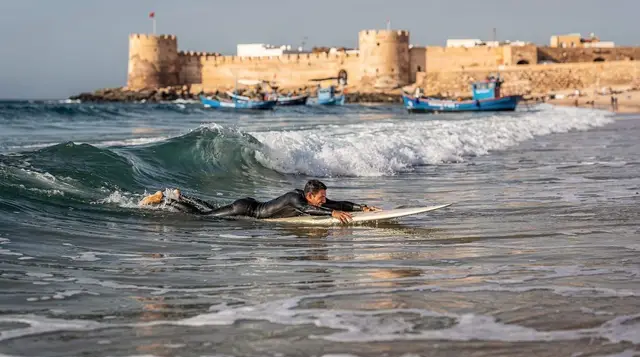
Photo: our own image of the location, not the operator’s product photo.