Marrakech souks guide
How are the Marrakech souks organised, and where should a first-time visitor start?
The souks form a loose grid north of Jemaa el-Fna, roughly organised by trade — leather, metalwork, textiles, spices, lamps — though the boundaries blur in practice. Start at Souk Semmarine, the main artery running north from the square, and branch off as something catches your eye rather than trying to see it all in order.
The Marrakech souks are not a single market but a tangle of covered and half-covered lanes packed into the northern half of the medina, roughly the size of forty football pitches. Trades cluster loosely by section — leather near Bab Debbagh, metalwork and lanterns around Souk Haddadine, dyed wool hanging overhead in Souk Sabbaghine — but the boundaries have softened over decades of tourism, and a lane selling babouches will sit next to one selling phone cases without warning.
For a first visit, the practical question isn’t “what will I see” but “how do I not waste two hours walking in circles.” The souks reward a rough mental map and a willingness to get mildly lost on purpose, rather than a printed route followed street by street. This guide covers the layout, what’s genuinely worth buying where, and the prices you should expect to pay before any haggling starts.
| Where | North of Jemaa el-Fna, bounded roughly by Bab Doukkala to the west and the Ben Youssef quarter to the east |
| Cost | Free to walk through; typical souvenir purchases run 50–800 MAD (€5–75) depending on the item |
| Time needed | 1.5–3 hours for a proper look, longer if you’re buying |
| Getting there | Enter from the northern edge of Jemaa el-Fna via Souk Semmarine; taxis stop at the medina gates, not inside |
| Best time | 9:30am–noon for fresher stock and manageable crowds |
How the souks are actually laid out
Souk Semmarine is the spine: a wide, covered lane running north from Jemaa el-Fna that most visitors enter by default. It sells a bit of everything aimed squarely at tourists — leather goods, textiles, lamps, spices in pyramids that are more photogenic than functional. About two hundred metres in, a fork splits toward Rahba Kedima, a small square that was once the slave market and now sells spices, herbs, and the odd chameleon in a cage (best avoided as a photo prop, for the animal’s sake and yours).
Beyond Rahba Kedima, the souks specialise more clearly. Souk des Teinturiers (the dyers’ souk) has wool hanging in vivid skeins overhead, dyed the traditional way with pigments like saffron and indigo, though most dyeing now happens with less romantic chemical colours. Souk Cherifia holds smaller, design-conscious boutiques with fixed or near-fixed prices — a useful benchmark for what things actually cost before you haggle elsewhere. Place des Ferblantiers and the streets toward Bab Debbagh handle metalwork and leather respectively, including the tanneries, which are a whole separate outing (see the guide to the leather and the tanneries for what to expect there and whether it’s worth the smell).
None of these boundaries are signposted, and shopkeepers will happily sell outside their section’s speciality. Treat the layout as a rough compass rather than a map with street names — get oriented, then wander.
What to actually buy, and what to skip
Leather goods (bags, poufs, babouches) are the most consistently good value if you check stitching and smell for chemical tanning versus vegetable tanning. Poufs run 150–350 MAD (€14–33) unstuffed, more if filled and shipped. Metal lanterns and lamps are genuinely well made in Marrakech and travel reasonably well if wrapped properly; expect 100–400 MAD (€9–37) for a mid-size piece depending on material. Spices sold loose by weight are usually fine, though the pyramid displays are for photos — buy from a stall with turnover, not the prettiest pile.
Rugs are the highest-stakes purchase in the souks: genuinely beautiful, genuinely variable in quality, and the category where overpaying is most common. The Moroccan rug buying guide covers what separates a real vintage Berber piece from a machine-made copy sold at vintage prices, and it’s worth reading before you’re three mint teas into a sales pitch. A guided visit like this handicrafts souk shopping experience pairs you with someone who knows which workshops sell what they claim to.
Skip anything branded (fake designer bags, “Berber” jewellery in obviously machine-cast metal) unless you’re buying it consciously as a cheap souvenir rather than a real piece — the sellers know the difference even if the price doesn’t always reflect it.
Where to slow down, and where to keep walking
Not every lane deserves the same attention. The wide covered stretches near the square are built for volume: the stalls are bright, the pitches are practised, and the goods are broadly similar from one shop to the next. That is not a reason to avoid them, since they are the easiest place to get a feel for what is on offer, but it is a reason not to buy your most important piece in the first ten minutes. Use the first stretch as a reconnaissance walk, note what catches your eye, and come back to it later once you have seen the alternatives.
The quieter lanes further in are where craft becomes visible. You hear hammering before you see the workshop, and you can watch a lamp being punched or a babouche being stitched. Stopping to watch for a few minutes is usually welcomed, and it tells you more about quality than any sales pitch. If a seller can show you how a piece is made, and the answer matches what is on the shelf, that is a good sign. If the explanation is vague, or the workshop seems to be a front for goods made elsewhere, keep walking.
For a closer look at the people behind the stalls, the guide to artisan workshops in Marrakech explains how to visit makers directly, and the guide to Moroccan pottery is useful before you start picking up ceramics, which are fragile and easy to over-pay for. Fragrant, oil-based purchases are a separate category: the argan oil guide explains what to look for before you buy a bottle from a stall that promises it is pure.
Eating, drinking and resting between lanes
The souks are tiring in a way that is easy to underestimate. Noise, heat, narrow passages and constant attention add up, and the visitors who enjoy them most are the ones who plan breaks rather than pushing through. A short stop for a glass of tea resets your patience and your negotiating mood. The mint tea guide explains the ritual, which is also worth understanding because tea offered in a shop is part hospitality and part sales technique, and accepting it does not oblige you to buy.
If you want food rather than just a break, the stalls and cafes around the main square are the obvious option, and the guide to the food stalls of Jemaa el-Fna covers how to choose well. A guided evening such as a walking dinner through the souks that stops at street food stalls is one way to see the same lanes with a different atmosphere, once the shops have thinned out and the cooking smoke takes over.
Pairing the souks with nearby sights
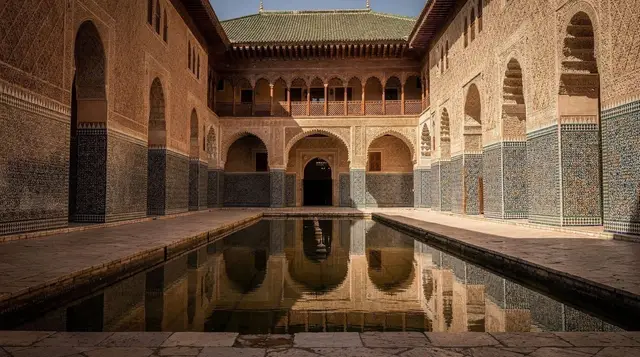
The souks sit between several of the medina’s best-known monuments, which makes them easy to combine with sightseeing. After a morning of browsing, the Ben Youssef Madrasa offers a quiet, ordered contrast to the lanes outside, and the Bahia Palace is a natural next step if you are heading south. If you would rather have someone connect the dots for you, a guided medina tour that links the palace, the madrasa and the souks is a straightforward way to do it without planning the route yourself.
Think about the order. Doing the monuments first, while energy is high, and the shopping afterwards, when you have a clearer idea of the styles you like, tends to produce better purchases. Doing it the other way round means carrying bags into places where you would rather be looking up at the ceiling.
Buying things that last, and getting them home
A few habits make the difference between a souvenir you keep and one you regret. Handle the item properly: turn it over, look at the seams, check that a lamp’s joins are clean and that a bag’s straps are anchored well. Ask where it was made, and notice whether the answer comes easily. Be honest with yourself about what you will actually use at home, because a large piece that looked perfect in the lane can look out of place on a living room wall.
Think about transport before you commit. Rugs fold, ceramics do not, and lamps need padding. Many shops offer to wrap and ship larger items, but shipping is a separate negotiation and a separate risk, so ask exactly what is included before you agree to a price. For a broader view of what to buy and how much to set aside, the Marrakech budget guide helps you decide how much of your trip money should go to shopping at all.
Making the souks work for your whole trip
The souks are best treated as a recurring part of your stay rather than a single event. A short first visit teaches you the layout, a second visit lets you buy with confidence, and a final walk on your last day lets you pick up anything you hesitated over. If your stay is short, the two-day Marrakech itinerary shows where an hour or two in the souks fits, and the medina destination page gives the wider context for the neighbourhood you are walking through.
If you are visiting for the first time and feel unsure about the whole experience, the first-time visitor guide covers the practicalities that sit around the shopping, and the guide to scams is worth a read for the one or two common tricks around the souk entrances, such as strangers who tell you a lane is closed. A calm, unhurried approach, a clear idea of what you want, and a willingness to say no politely will carry you through nearly all of it.
Getting oriented without a map
The single best navigation trick is to note your entry point and pick one direction of travel — north or east — rather than doubling back constantly. The Koutoubia minaret is visible from several open stretches near the square and works as a rough compass point south. If you get properly lost, which happens to almost everyone at least once, any shopkeeper will point you toward Jemaa el-Fna for free; it’s the one landmark every stallholder in the medina can locate. For a structured first pass that links the souks to the palaces and mosques nearby, follow the self-guided medina walking route, which threads through the main souk sections on its way to Ben Youssef and the Bahia quarter.
Phone signal inside the covered lanes is unreliable at best, which makes live map navigation less useful than it sounds — a live blue dot that jumps or freezes under the wooden roofing does more to confuse than help. A better approach is fixing a couple of landmark names in your head before you set off (Rahba Kedima, Souk Semmarine, Ben Youssef) and asking your way between them rather than trying to follow a route on screen. It’s slower, but it’s also how most residents actually navigate the same lanes, and it removes the low-grade stress of watching a map disagree with what’s in front of you.
Mornings and early afternoons differ enough to be worth planning around deliberately. Before around 11am, stallholders are still setting out fresh stock, the lanes are less crowded, and negotiating tends to be more relaxed since the day’s pace hasn’t picked up yet. By mid-afternoon, particularly in the warmer months, both the heat and the foot traffic build noticeably, and the narrowest stretches near Rahba Kedima and Souk Smata can feel genuinely congested. Neither time is wrong, but a first visit is generally easier in the morning, saving the busier afternoon atmosphere for a return trip once you already have a mental map to work from.
Haggling, briefly
Prices in the souks are set to be negotiated down, typically by a third to a half of the opening ask, though this varies by item and by how touristy the specific lane is. The full mechanics — starting offers, useful phrases, when to walk away — are covered in the dedicated haggling in the souks guide. If negotiating isn’t your idea of a good afternoon, a tour such as this souk treasure hunt with a local guide gets you the same goods with someone else doing the negotiating, usually for a small built-in fee that’s worth it for a stress-free hour or two.
A good habit is to decide in advance what you are actually hunting for. Browsing without a list is pleasant, but it makes every stall a possible purchase, and the pitches get harder to ignore. With one or two target items in mind, such as a lamp for a particular corner of your home or a pair of slippers for yourself, you can walk past the rest with a smile and save your energy for the shops that matter. It also gives you a way to compare: seeing three versions of the same thing in different lanes teaches you quickly what good quality looks like and what a reasonable ask sounds like.
Politeness goes a long way here. Greeting a shopkeeper, taking an interest in the work and thanking them when you leave without buying keeps the exchange friendly, and friendly exchanges tend to produce better prices than tense ones. Nobody expects you to buy from every stall you stop at, and a calm refusal is understood.
Whichever way you shop, budget for the total trip rather than each individual purchase — a handful of good pieces from the souks, honestly negotiated, usually cost less than one impulse buy from a fixed-price tourist shop near the square. For a wider view of prices across the whole city, not just the souks, see the Marrakech shopping guide, and for where to base yourself while you explore all this on foot, the guide to staying in a riad covers what a medina base is actually like day to day.
Medina and souk tours on GetYourGuide
Verified deep-linked GetYourGuide tours. Book through these links and we earn a small commission at no cost to you.
Photo: our own image of the location, not the operator’s product photo.