Moroccan Mint Tea Explained
Why is Moroccan mint tea poured from a height?
Pouring from height aerates the tea, builds a thin foam on top considered a sign of a well-made glass, and cools the liquid slightly before it reaches you. It's also simply theatre — a skill Moroccan hosts take visible pride in.
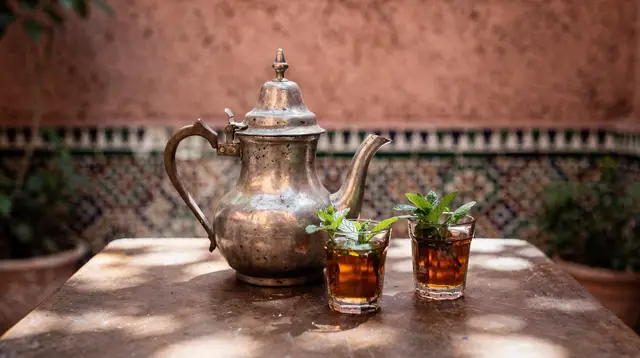
Mint tea in Marrakech isn’t really a beverage choice so much as a social ritual that will find you whether you order it or not — offered at carpet shops, in riad lobbies on arrival, at the end of a meal, and by anyone hoping to slow you down long enough for a conversation about their goods. The tea itself is straightforward: Chinese gunpowder green tea, a generous bunch of fresh spearmint, and a notable quantity of sugar, brewed together in a metal teapot rather than steeped as separate ingredients. Some hosts add a sprig of wormwood (sheeba) in winter, a bitter herb believed to help ward off colds, which changes the flavour noticeably from the standard spearmint version.
What distinguishes the ritual is the pour. A host holds the teapot high above the glass, sometimes a full arm’s length, letting the stream fall and build a thin layer of foam on the surface — a visible sign of a well-poured glass and a small piece of hospitality theatre that Moroccan hosts take genuine pride in performing well. It’s worth watching closely the first few times rather than looking away; it’s part of what’s being offered, not incidental to it. A good host will often pour a small amount into a glass, taste or examine it, then pour it back into the pot before serving properly — checking the strength and sweetness before committing to a full round.
| Where | Everywhere — riads, restaurants, souk shops, street stalls |
| Cost | Free as hospitality in most social contexts; 15-30 MAD (€1.50-3) as a standalone café order |
| Time needed | A few minutes to sit and accept a glass |
| Getting there | N/A — it will find you |
| Best time | Mid-afternoon is the traditional slot, though it’s offered at any hour |
The etiquette of being offered tea
Being offered mint tea in a shop, particularly a carpet or rug dealer’s, is a genuine piece of hospitality but also a well-understood opening move in a longer sales conversation — both things are true at once, and neither cancels the other out. Accepting a glass doesn’t obligate you to buy anything, and shopkeepers who’ve done this for years know that perfectly well; declining is equally fine and won’t cause offence if done politely. The tea itself, either way, is usually worth drinking on its own merits.
In a riad, tea on arrival is standard hospitality rather than a sales gesture of any kind, and refusing it outright can read as slightly abrupt in a culture where offering and accepting hospitality carries real social weight. A guided experience such as this traditional Moroccan tea ceremony experience goes further than a casual offering, walking through the full preparation ritual and the history behind it, which is worth booking specifically if the ceremony itself interests you beyond drinking the result. It also gives a structured opportunity to ask questions about the tradition that would feel intrusive to ask a shopkeeper mid-sale.
Sugar, sweetness and asking for less
Traditional Moroccan mint tea is sweeter than most visitors expect from a green tea, often verging on syrupy by the standards of unsweetened tea drinkers, and it’s brewed that way deliberately rather than as an afterthought — sugar was historically a marker of hospitality and status, and the sweetness has stayed as tradition even as that association has faded. Asking for tea “bla sukkar” (without sugar) or with less is entirely acceptable in restaurants and tourist-facing settings, and increasingly common enough that staff won’t be surprised by the request.
For a more immersive tasting alongside other traditional flavours, this medina tour with olive, sand and tea tasting pairs mint tea with other classic medina flavours in one guided stop, and this medina souks tour with artisans and mint tea weaves the ritual into a wider walk through the souks and craft workshops.
Regional and household variations
While the gunpowder-green-tea-and-spearmint combination is close to universal across Marrakech, small variations exist between households and regions. Some families use absinthe wormwood more heavily in winter for its warming, slightly bitter edge; others add a touch of orange blossom water for fragrance, particularly for guests. Sugar quantity also varies more between households than restaurants tend to admit — a grandmother’s tea and a café’s tea are rarely identical, and asking a host how their family prepares it, if the opportunity arises, is a genuine and welcomed way to learn more about the tradition than any guidebook description offers.
The glasses themselves are part of the ritual too, typically small, often colourfully patterned or gilded, and traditionally filled only around two-thirds full to leave room for the foam built up during pouring. Filling a glass to the brim is considered slightly careless in more traditional settings, another small detail that separates an experienced host’s pour from a rushed one.
How a glass unfolds in a shop
A tea offered in the souks usually follows a loose script. You are invited to sit, the glasses appear, and the conversation drifts toward where you are from, how long you are staying and what you have seen so far. None of it is a trap, and all of it is a way of building a small relationship before any talk of goods. If you want to enjoy the moment without feeling cornered, say early and warmly that you are only looking today. Most shopkeepers respect that, and the rest of the visit tends to be more relaxed for both sides. The haggling guide explains how to keep that tone friendly when a price discussion does begin, and the shopping guide helps you decide what is worth buying at all.
It also helps to know that tea is often poured in more than one round. Traditionally a guest is offered several glasses, each slightly different in character as the infusion deepens, and a host may take a second or third pour as a sign you are welcome to stay. Finishing the glass is a quiet way to say thank you. Leaving a little in the bottom is not rude, but handing the glass back empty and with a smile is the gesture that is best understood.
Tea in a riad, at breakfast and after dinner
A riad is where most visitors meet mint tea in its calmest form. It is served in the courtyard or on the roof terrace, often on a tray with small pastries or dried fruit, and nobody is trying to sell you anything. Breakfast in a riad usually comes with a pot of tea alongside the bread, olive oil, jam and eggs, and it is a gentle way to start a day that will otherwise be loud and crowded. If you are choosing where to stay, the riad staying guide and the riad versus hotel comparison both describe what the hospitality side of a riad stay feels like, tea included.
After dinner, a pot of tea marks the end of the meal in much the same way coffee does elsewhere. It settles the stomach, signals that nobody is rushing you, and gives the table a reason to linger. At the food stalls and cafés the pace is quicker, but the habit is the same. If you are eating your way across the city, the street food safety guide and the Jemaa el-Fna food stalls guide cover where a glass of tea fits between courses and what to look for in a clean, busy stall.
Tea beyond the shop and the table
Tea shows up in places that surprise first-time visitors. It is poured after a hammam session, during a spa treatment, at a craft workshop when you take a break from the work, and in the tents and camps of the desert, where the pot sits over a small flame while the light changes. A visit to a hammam often ends with a quiet glass in a cool room, and the hammam guide describes the full routine for those who have not tried one. In the same spirit, an experience such as a hammam session finished with a massage and a glass of mint tea shows how closely the drink is tied to rest and care rather than only to commerce.
On a desert trip, tea is part of the welcome at camp and again around the fire. The Agafay desert guide and the Sahara camp guide describe what an evening there usually looks like, and the tea ritual is often the first thing a host performs for arriving guests. In the mountains, a village family may invite you in for a glass, and the Berber village visits guide offers advice on accepting that kind of invitation with grace.
Tea, conversation and good manners
Because the drink is so tied to hospitality, a few small habits go a long way. Receive the glass with your right hand if you can, thank your host, and take a first sip with some appreciation. Compliments on the pour, the mint or the sweetness are always welcome and often lead to a longer conversation about how the family makes it. If you have a dietary reason to avoid sugar, explain it kindly rather than leaving the glass untouched, since a full glass left on the table can leave a host wondering whether something was wrong.
Children are usually offered a glass as well, which is worth bearing in mind if you travel as a family. The tea is sweet and warm, and a smaller serving or a glass left to cool is easy to ask for. The family activities guide and the guide to Marrakech with kids offer wider ideas for keeping younger travellers happy in a city that moves at its own pace.
During the fasting month the rhythm changes. Tea belongs to the evening meal and the hours that follow, and the city feels different as it comes back to life after sunset. The Ramadan in Marrakech guide explains how daily life shifts, and what that means for cafés, shops and the habit of being offered a glass.
Turning tea into a small project of your trip
If tea interests you more than most travellers, build a little of it into your days rather than leaving it to chance. Begin with a guided tasting or ceremony early in the stay, so that you have a vocabulary for what follows. Then notice the differences between a riad pot, a café glass and a shopkeeper’s offering. Ask your host’s advice on where to buy good leaves and mint, and compare notes with other travellers. A hands-on workshop is another good place to connect the drink to the crafts that surround it, since glasses, trays and teapots are all made by the same community of artisans. For a longer walk that takes in the places where all of this happens, the medina walking route is a sensible backbone.
For readers who like to understand the people behind a custom, the blog essay on Moroccan hospitality is a warm companion to this guide, and the piece on learning to cook a tagine shows how tea sits at the edge of the kitchen as well as at the table.
Buying tea to take home
Loose gunpowder green tea and dried spearmint are both sold throughout the souks, and a small tin makes a genuinely useful souvenir over the usual trinkets — expect to pay a fraction of what the same tea costs bottled or boxed in a European supermarket. Traditional Moroccan teapots and tea glasses, sold in sets, are worth buying from a dedicated metalwork or homeware stall rather than the first souvenir shop you pass, both for quality and for a fairer starting price before any haggling begins.
Making it at home
Recreating the tea afterward isn’t difficult if you’ve bought the ingredients: a generous handful of fresh mint per pot, a spoonful or two of gunpowder green tea leaves, sugar to taste, and a rinse-and-discard first infusion that Moroccan households use to remove the tea’s initial bitterness before the proper brew. Boiling water is poured over the leaves, left briefly, poured off, then poured again with the mint and sugar added for the final steep — a two-stage process that’s easy to skip but genuinely changes the result if you’re trying to match what you drank in Marrakech.
A traditional teapot helps with the pour and the theatre, but isn’t essential for the flavour itself, which comes down mostly to fresh mint and getting the ratios right through a bit of trial and error. Fresh mint specifically, rather than dried, makes the biggest difference to matching the flavour most visitors remember from Marrakech; dried mint produces a noticeably flatter result even with everything else correct, regardless of how carefully the rest of the method is followed.
A pinch of salt is sometimes added by mistake given how similar sugar and coarse salt can look in an unfamiliar kitchen, so it’s worth double-checking before pouring boiling water over the pot if you’re making it somewhere with unlabelled containers — a small but genuinely common error for first-time attempts at home.
Where tea fits into a wider food itinerary
Tea is woven through nearly every food experience in the city rather than a separate stop — see the Marrakech food guide for the wider food picture and the haggling in the souks guide for how tea offerings typically factor into a shop negotiation. For the souks themselves, where you’ll be offered tea more often than almost anywhere else in the city, see the Marrakech souks guide.
If a cooking class is on your itinerary, expect tea to bookend the session — see the cooking class guide for what else is typically included.
Food and drink tours on GetYourGuide
Verified deep-linked GetYourGuide tours. Book through these links and we earn a small commission at no cost to you.
Photo: our own image of the location, not the operator’s product photo.