Riad or Hotel
Should I stay in a riad or a hotel in Marrakech?
A riad if you want medina charm, character and walking access to the souks, and can handle stairs and a short walk from the nearest car drop-off. A hotel in Gueliz or Hivernage if you want a pool, an elevator, parking and easy vehicle access.
Where to stay shapes a Marrakech trip more than almost any other single decision, and the riad-versus-hotel question comes up on nearly every planning thread. Both can be excellent; they’re just built around different trade-offs. A riad gives you the medina itself — a converted traditional house, a central courtyard, and staff who often feel more like hosts than hotel employees. A hotel in Gueliz or Hivernage gives you the modern conveniences a riad structurally can’t: a pool, an elevator, parking, and a straightforward vehicle drop-off at the door.
| Riad strengths | Character, courtyard, medina location, personal service |
| Hotel strengths | Pool, elevator, parking, easier vehicle access |
| Riad weakness | Stairs, no elevator, sometimes cold or dark in winter |
| Hotel weakness | Less atmosphere, medina walk or taxi needed |
| Price | Overlapping ranges; character versus facilities, not consistently cheaper either way |
Riad or hotel at a glance
| Riad (medina) | Hotel (Gueliz/Hivernage) | |
|---|---|---|
| Location | Inside the medina, walk to souks and Jemaa el-Fna | Ville nouvelle, short taxi to the medina |
| Elevator | Almost never | Standard |
| Pool | Occasionally, usually small | Common, often a genuine feature |
| Parking | Rarely; nearest gate only | Usually available on-site |
| Atmosphere | Traditional, personal, courtyard-centred | Modern, consistent, hotel-standard |
| Winter heating | Variable, sometimes limited | Reliable, central heating standard |
| Best for | First-time visitors wanting immersion | Families, drivers, longer comfort-focused stays |
What staying in a riad actually involves
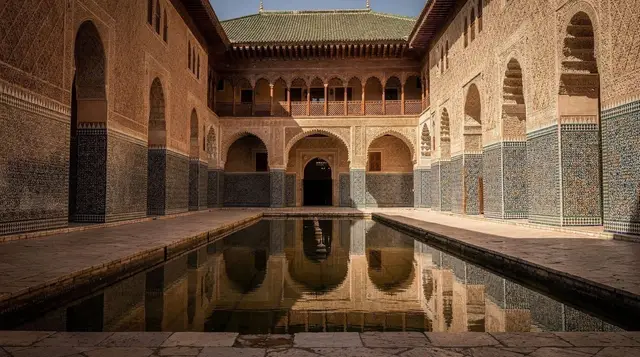
A riad is a converted traditional house, built around a central courtyard that once served as the home’s private outdoor space and now functions as the shared lounge, breakfast area and sometimes small pool. Rooms are arranged over two to four floors connected by narrow stairs — elevators are essentially nonexistent in genuine riads — and the character this creates, tiled courtyards, carved plasterwork, rooftop terraces, is the entire draw. Staff numbers are usually small, which tends to translate into more personal service than a hotel of a comparable price point offers.
The trade-offs are structural rather than optional. Because riads sit inside the medina’s pedestrian derbs, no vehicle can drive to the door — taxis stop at the nearest gate, and you walk the last few minutes, sometimes with a staff member helping carry bags. Rooms facing the interior courtyard can be darker than an exterior-facing hotel room, and as covered in the Marrakech in winter guide, many riads don’t heat well from December through February, which matters more than most first-timers expect.
What a Gueliz or Hivernage hotel gives you instead
Gueliz and Hivernage, Marrakech’s more modern districts, host most of the city’s international hotel brands and larger independent properties. These come with the facilities riads structurally can’t offer: functioning elevators, on-site parking, larger pools, and often gyms or spas built into the property rather than arranged separately. The trade-off is atmosphere and location — you’re a taxi ride rather than a walk from the medina’s souks and monuments, and the surroundings feel considerably more like an international city district than old Marrakech.
For visitors weighing where to base themselves more broadly, not just riad-versus-hotel, medina or Gueliz: where to base yourself covers the neighbourhood-level version of this same decision in more depth.
Service style differs meaningfully too. Hotel staff in Gueliz and Hivernage properties tend to operate on a more standardised, shift-based model, with a larger team covering reception, housekeeping and dining separately. Riads, with far fewer staff overall, often have the same one or two people handling check-in, breakfast and general help throughout your stay, which some travellers find warmer and more personal, and others find less consistent than a larger hotel’s more structured service.
Breakfast itself is one of the more noticeable everyday differences. Most riads include a home-style Moroccan breakfast — msemen, fresh bread, honey, olive oil, orange juice and mint tea — served in the courtyard or on the rooftop, which many travellers count among the better small pleasures of a riad stay. Hotels typically run a larger buffet breakfast with more international options, useful for picky eaters or larger families but generally less distinctive than what a riad serves. Neither is objectively better; it’s a genuine trade-off between variety and character, and it’s worth asking what a specific property serves before assuming either default applies.
A middle path: riad-style hotels
Some newer properties split the difference deliberately, building in courtyard-style architecture and traditional detailing while adding an elevator, a proper pool and modern plumbing throughout. These “riad-style hotels” tend to sit at a higher price point than either a traditional riad or a standard Gueliz hotel, but they’re worth knowing about if you want the aesthetic without the structural compromises. They’re less common than genuine riads or standard hotels, so availability is usually the limiting factor rather than price.
Who each option suits best
Thinking about the kind of trip you are planning usually settles the question faster than comparing room photos. Couples and solo travellers on a first visit tend to get the most from a riad, because the medina is where most of the sights, food and street life are concentrated, and coming home to a quiet courtyard after the noise of the souks is a large part of the appeal. If this is your first time in the city, the first-time visitor guide lays out how the days tend to flow, and it shows why sleeping inside the old city simplifies so much of that plan.
Families are a different case. Young children, strollers and tired evenings are easier in a hotel with a proper pool, a lift and a vehicle that can pull up at the door. That does not rule out a riad: some are set up with families in mind, and the family riads guide explains what to look for. For wider planning with children, Marrakech with kids covers what works at different ages, and the family activities guide helps you judge how much time you will actually spend at the hotel pool compared with out in the city.
Travellers who plan to drive are the third group worth naming. If you are renting a car for day trips to the mountains or the coast, a hotel with parking removes a real headache, whereas a riad means leaving the car somewhere outside the medina walls. The driving in Morocco guide is worth reading before you decide, and if you would rather not drive at all, the getting around guide explains the alternatives.
Arriving and getting settled
Your first hour in a riad feels different from checking into a hotel. Most riads will arrange to meet you at a known point and walk you through the lanes, and many will organise your pick-up on request. It is worth sending your arrival details ahead of time so someone is waiting for you rather than leaving you to find an unmarked door in a maze of alleys. The airport transfer guide covers the options for the first leg, and the taxi guide explains how to agree on a drop-off point near the gate closest to your riad.
A hotel check-in is more familiar: a reception desk, a lift to the room, a key card. The difference is less about speed than about expectation. In a riad you are entering someone’s carefully restored home, and the first conversation with the host often includes advice on the neighbourhood, the best times to walk to the square, and which routes to avoid after dark. That local knowledge is part of what you are paying for, and it is worth using.
Noise, light and sleep
Atmosphere cuts both ways. A riad built around a courtyard is often wonderfully quiet once the heavy door closes, because the thick walls muffle the street. At the same time, sound carries upward inside a courtyard, so voices from the breakfast area or a neighbouring room can travel further than you would expect. Light is the other consideration: interior rooms may rely on a small window or on the courtyard opening, and a room that photographs beautifully can feel dim in the morning.
Hotels in the newer districts are generally more predictable. Windows face outwards, curtains are heavier and air conditioning is standard, though traffic and nightlife can be audible depending on the side of the building you are given. If light sleeping matters to you, it is worth asking either type of property for a room away from the courtyard bar, the street or the rooftop terrace. In the hotter months, the advice in the Marrakech in summer guide is relevant, since cooling and shade are likelier to decide how comfortable you are than the look of the room.
Safety, hassle and feeling at ease
Some travellers worry that sleeping inside the medina means constant hassle. In practice, the lanes around most riads are residential, and a good host will tell you which routes are easiest at night. Understanding the common pitfalls helps whichever base you choose, and the scams guide and the safety guide are worth a read before you land. If you are travelling alone, solo female travel in Marrakech discusses how accommodation choice affects comfort and confidence, and the blog piece on the truth about Marrakech hassle gives an honest picture of what to expect on the street.
A hotel in a modern district tends to feel more anonymous, which some visitors find restful and others find impersonal. Neither is inherently safer; what matters is knowing your route home, keeping the property’s address and phone number with you, and asking staff for advice rather than relying on strangers who offer help.
Using your base for the rest of the trip
Where you sleep also shapes how easy it is to see the rest of the region. From a riad you are close to the main square and the old city sights, so an early start on foot is simple; the medina walking route and the Jemaa el-Fna guide work well as a first day. From a hotel in the newer districts, you will usually be nearer to the wider boulevards and the gardens, and the Majorelle Garden guide is a natural fit for that side of town. The neighbourhood pages for the medina, Gueliz and Hivernage describe the feel of each area in more detail.
For day trips, either base works, since most excursions collect guests from their accommodation. The best day trips guide lists the main options, and if you are building a longer stay, the 3 versus 5 days guide helps you decide whether to split your nights between two kinds of property. Splitting a stay is a sensible compromise for some travellers: a few nights in a riad for atmosphere, then a hotel with a pool for rest before flying home.
Price ranges in practice
A simple riad room with shared or basic facilities can run as little as 30-50€ a night, while a well-reviewed mid-range riad with a proper courtyard, pool access and breakfast typically sits around 60-120€. Top-end riads with a small number of individually designed rooms, a genuine pool and full service push well past 150€.
Hotels in Gueliz and Hivernage follow a broadly similar spread — budget chain hotels from around 40-60€, solid mid-range options around 80-140€, and international five-star properties comfortably above 200€. The overlap means the accommodation type itself rarely decides your budget; the standard you’re booking within each category does, so comparing specific properties matters more than deciding riad-versus-hotel on price grounds alone.
When to book each one
Riads, particularly well-reviewed ones with only a handful of rooms, get booked out further in advance than most hotels, since there’s simply less inventory to work with. If a specific riad has caught your eye, booking six to eight weeks ahead is safer than the two-to-three-week window that’s often fine for a larger hotel with dozens of rooms. This matters more during peak season — spring and autumn especially — when the best riads can sell out months in advance for popular dates.
Getting the most from whichever you choose
If you book a riad, spend some time in the medina itself rather than treating it purely as a place to sleep — a half-day guided medina walking tour booked for your first morning is a good way to build the orientation you’ll need to navigate back to your riad confidently on your own afterward. If you book a hotel outside the medina, budget a little extra taxi time into each day’s plans, since the walk-everywhere convenience a riad offers doesn’t apply from Gueliz or Hivernage.
Either way, a hammam is one of the better shared experiences regardless of where you’re staying — the traditional Mouassine hammam and a women’s medina walk with hammam and a female guide are both worth booking as a change of pace from wherever you’re sleeping.
For a deeper look at riad life specifically, staying in a riad covers etiquette, booking tips and what a typical stay looks like day to day, and the Marrakech budget guide is useful if cost is the deciding factor between the two options.
Popular Marrakech experiences on GetYourGuide
Verified deep-linked GetYourGuide tours. Book through these links and we earn a small commission at no cost to you.
Photo: our own image of the location, not the operator’s product photo.