Medina or Gueliz: where to base yourself
Should I stay in the medina or in Gueliz?
Stay in the medina if you want walkable access to the souks, the palaces and Jemaa el-Fna, and don't mind stairs, noise and a walk-in arrival at a riad. Stay in Gueliz if you'd rather have a modern hotel with lift access, quieter streets, easy parking, and a short taxi ride into the old town when you want it.
Marrakech splits cleanly into two very different bases for visitors: the medina, the walled old town where riads, souks and most of the postcard sights sit, and Gueliz, the ville nouvelle built during the French protectorate, roughly a twenty-minute walk or short taxi ride to the west. Neither is objectively better — they suit different travel styles, and a lot of the frustration first-time visitors report comes from picking one without understanding what they’re trading away.
This guide lays out the practical differences plainly, rather than defaulting to the usual “stay in the medina for authenticity” advice that doesn’t account for what some travellers actually want from a trip.
| Where | Medina: walled old town, centred on Jemaa el-Fna. Gueliz: modern district west of the medina |
| Cost | Medina riads from ~300 MAD/night; Gueliz hotels often comparable or cheaper for equivalent standard |
| Time needed | N/A — this is about choosing a base, not visiting a site |
| Getting there | Medina: walk-in via pedestrian gates. Gueliz: direct taxi or car access to most hotels |
| Best time | Book medina riads well ahead for October–April; Gueliz has more year-round availability |
What staying in the medina actually means
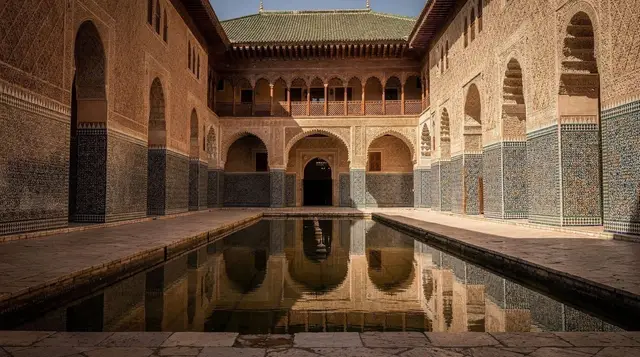
A medina base puts you within walking distance of nearly everything most visitors come to Marrakech for: the souks, Jemaa el-Fna, Bahia Palace, Ben Youssef Madrasa. The trade-off is the riad format itself — no lift, often several flights of stairs, and a taxi drop-off at the nearest gate rather than your door, since vehicles can’t enter most of the pedestrian derbs. The guide to staying in a riad covers this in detail; it’s worth reading before booking if you haven’t stayed in one before.
Noise is the other genuine consideration. Rooms built around an interior courtyard are generally well insulated from street sound by thick traditional walls, but a riad’s proximity to Jemaa el-Fna or a busy souk lane still matters — closer means more convenient during the day and louder at night, particularly on weekends. Ask specifically about room location within the riad, not just the riad’s general neighbourhood, when booking.
What staying in Gueliz actually means
Gueliz trades that walkable immersion for the conveniences of a modern district: wide streets, straightforward taxi and car access, international dining and shopping, and hotels built (or renovated) with lifts, air conditioning systems sized for the building rather than retrofitted, and predictable room layouts. It’s a genuinely easier base for anyone prioritising step-free access, late-night quiet, or simply not wanting to navigate unmarked medina lanes after a long day.
The cost is distance. Gueliz sits roughly twenty to thirty minutes on foot from Jemaa el-Fna, or a five-to-ten-minute taxi ride depending on traffic, which means every trip into the old town — and you will make several — involves a bit of planning rather than simply walking out the door. A guided orientation on day one, such as this half-day Marrakech city tour with a local guide, is a useful way to link both areas early in a trip if you’re staying in Gueliz and want the medina to feel less like a separate expedition.
Questions worth asking before you choose
Most of the decision comes down to a handful of honest questions about how you travel, rather than which area looks better in photos.
How do you feel about arriving on foot? In the medina your taxi stops at a gate and someone from the riad usually meets you to carry the bags through the lanes. Some travellers find this charming, others find it stressful after a long flight. If it sounds stressful, say so in your booking message, or read the airport transfer guide to plan the last stretch calmly.
How much do you want to be out and about early or late? A medina base rewards early starts, because the lanes are calmest in the morning and you can be at a palace or a madrasa before the crowds build. A Gueliz base rewards people who like to come back to a quiet street after dinner.
How patient are you with a bit of hassle? The medina is denser and more tourist-facing, so you’ll meet more touts and unsolicited offers of help. The scams guide and the piece on hassle in Marrakech explain what is normal and what to ignore. Gueliz feels more like an ordinary city district, with less of that friction.
Who are you travelling with? Families with small children, older relatives or anyone with limited mobility will often prefer the lifts and car access of Gueliz. Couples and solo travellers who want atmosphere tend to lean toward the medina. The family activities guide is useful if children are part of the picture.
Eating, evenings and daily rhythm
Your base shapes the rhythm of your days more than any single sight. From a medina riad, breakfast on the roof, a morning in the souks, a long lunch and a rest at the riad while the heat peaks make a natural pattern. You are never far from your room, so a midday break costs you almost nothing.
From Gueliz the day tends to be organised in blocks. You head into the old town with a plan, spend a good stretch there, then return by taxi when you’ve had enough. That suits people who like structure, and it can be tiring for those who prefer to drift. If you are in Gueliz, a midday return to the hotel is still possible but it takes more effort than simply walking back through a gate.
For food, the medina leans toward traditional Moroccan cooking and rooftop terraces, and the street food stalls of Jemaa el-Fna are a short walk from most riads. Gueliz offers a wider spread of international cooking, wine bars and modern cafés. If you want both, the Marrakech food guide helps you plan which meals to take where, whichever side of the city you sleep on.
Getting around from each base
Inside the medina you will mostly walk. Lanes are narrow, many are unmarked, and a map app can lose its way among the turns, so it helps to learn two or three landmarks near your riad and to ask staff for the easiest route back at night. The medina walking route gives a sensible loop that works from nearly any medina base.
Beyond the walls, petit taxis are the everyday answer from either area. Agree the way you’ll pay before you set off, and keep small change handy. The Marrakech taxi guide covers how this works in practice, and the broader getting around guide compares the other options. A Gueliz base makes taxis a daily habit, while a medina base makes them an occasional one.
If you plan to hire a car for the Atlas or the coast, Gueliz is simpler for pick-up and parking, whereas medina riads usually mean leaving the car outside the walls. Read the driving in Morocco guide before deciding whether a car is worth having at all.
How your base affects day trips
Day trips usually start with a pick-up, and where that happens matters. From a medina riad, the meeting point is often a gate or a square a short walk away, so you may need to be ready a little earlier and find your way through the lanes in the half-light. From a Gueliz hotel, a driver can often collect you at the door, which many people find easier for early departures.
Either way, the classic excursions are open to you. A full day on the coast works from both bases, as in this day trip to Essaouira or, if you want a small-group format, a small-group day out to the Essaouira medina. The best day trips from Marrakech page lists the rest, so you can judge how much time you really want to spend away from your base before you commit to one.
What you actually give up either way
Picking the medina doesn’t mean sacrificing every modern comfort — a growing number of riads have added small plunge pools, air conditioning and reliable wi-fi over the past decade, and the gap with a standard hotel room has narrowed considerably. What it doesn’t solve is the structural stuff: no lift is still no lift, and a walk-in arrival is still a walk-in arrival, regardless of how well-appointed the room turns out to be. If those two points genuinely don’t bother you, most of the old objections to a medina stay have faded.
Picking Gueliz doesn’t mean losing all of Marrakech’s character either. The district has its own worthwhile sights — the Majorelle Garden district chief among them — plus a restaurant and café scene that, in places, is more varied than what the medina offers, simply because Gueliz isn’t built primarily around tourism the way the old town increasingly is. What it does mean giving up is the specific experience of walking out of your accommodation directly into a souk, which for a lot of visitors is a meaningful part of why they came to Marrakech at all.
A third option: Hivernage
Between the two sits Hivernage, a smaller, quieter district just south of Gueliz that’s popular with visitors wanting proximity to both the medina and the newer parts of the city without fully committing to either. It tends to have more resort-style hotels than Gueliz’s mix of boutique and business hotels, and it’s a five-to-ten-minute taxi ride from Jemaa el-Fna, slightly closer than most of Gueliz proper. It’s worth considering if the medina-versus-Gueliz choice still feels like an awkward compromise either way.
Splitting your stay
For trips of five days or longer, splitting the accommodation between both areas is a genuinely good option that neither guidebook advice nor most hotel booking habits account for well. A few nights in a medina riad for the souks, the palaces and the atmosphere, followed by a few nights in Gueliz for a quieter finish with easier logistics for an early airport transfer, gives you both experiences without fully compromising on either.
A private walking tour like this private walking tour of Marrakech works well scheduled for the transition day, linking what you’ve already seen in the medina with Gueliz’s own sights — the Majorelle Garden district in particular — on the way to your new base.
Fitting the choice into your itinerary
Your base is easier to pick once you know how long you have. On a short stay, the medina saves time because nothing separates you from the sights. The two-day itinerary and the three-day plan both assume you can reach the old town quickly, which a medina base makes effortless. With more time, the five-day itinerary leaves room to rest in a quieter district, so a split stay starts to make sense.
If you are still deciding how long to stay, the 3 versus 5 days comparison will help you choose, and the first-time guide pulls the rest of the planning together. For a closer look at the old town itself, the medina destination page sets out its different quarters, which is worth knowing because the feel of the area varies from lane to lane.
The short version
If in doubt, and this is your first trip, the medina is the better default — it’s the base most guides, tours and restaurants are built around, and the inconvenience of stairs and a walk-in arrival is genuinely minor compared to the convenience of stepping out the door into the souks. Save Gueliz for a return trip, a longer stay, or a specific need for modern hotel infrastructure that a riad can’t provide.
Whichever you choose, it’s worth booking with the trade-offs in mind rather than picking on photos alone — a beautiful riad on a noisy square isn’t the same booking as an equally beautiful riad on a quiet side street, even though listing photos rarely make that distinction clear. A quick message to the property asking about room location, noise, and access before booking resolves most of the uncertainty either area involves, and it’s a habit worth carrying into every accommodation booking for the rest of the trip, medina or Gueliz alike.
None of this needs deciding months in advance either. Plenty of visitors change their minds partway through planning once they’ve read enough about what each area actually involves day to day, and switching a booking before the high season crunch sets in is usually painless and often free of charge with a flexible cancellation policy.
Medina and souk tours on GetYourGuide
Verified deep-linked GetYourGuide tours. Book through these links and we earn a small commission at no cost to you.
Photo: our own image of the location, not the operator’s product photo.