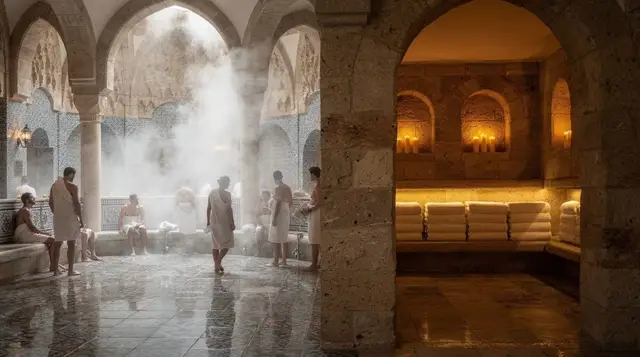
Marrakech hammam guide
What is a Marrakech hammam and how much does it cost?
A hammam is a steam bath used for washing and exfoliating. A public neighbourhood hammam (beldi) costs 15-50 MAD (about €1.50-4.50) and you bring your own soap and gant kessa; a riad or hotel hammam costs 400-1,000+ MAD (€37-93+), is booked in advance, and supplies everything.
A hammam is a steam bath, and in Marrakech it comes in two versions that share a name and almost nothing else. One is the neighbourhood hammam beldi, a working bathhouse where locals go to wash, priced in single-digit euros and run to a strict men’s-and-women’s timetable. The other is the version built for visitors — a riad or hotel hammam, private, pre-booked, with towels and products supplied and a price tag to match. Neither is more “authentic” than the other in any useful sense; they’re different services solving different problems, and knowing which one you actually want saves both money and confusion.
Both versions share the same underlying ritual, which is worth understanding before you book either one. You steam in a hot, humid room until your skin softens, then get scrubbed down with a rough exfoliating mitt, which strips off a startling amount of dead skin in a single session. It sounds unpleasant described like that and is, in practice, one of the more satisfying things you can do with an hour in this city.
| Where | Public hammams in every medina neighbourhood; riad and hotel hammams by reservation |
| Cost | 15-50 MAD (€1.50-4.50) public; 400-1,000+ MAD (€37-93+) riad or hotel |
| Time needed | 45 minutes to an hour for a basic wash; 1.5-2 hours with a full treatment |
| Getting there | Public hammams are walk-in and unmarked from outside; riad hammams are on-site or a short taxi away |
| Best time | Public hammams run separate men’s and women’s hours, check locally; hotel hammams take bookings any time |
What actually happens in a hammam
The core ritual is the same wherever you go. You sit in a heated, steam-filled room until you’re sweating properly, which softens the skin enough for the next step to work. Then comes the scrub: savon noir, a dark, soft soap made from macerated olives, is worked into the skin and left a few minutes, followed by a vigorous going-over with a gant kessa, a coarse exfoliating glove that removes dead skin in visible grey rolls — startling the first time, satisfying by the second. Many sessions finish with rhassoul, a mineral clay from the Moyen Atlas mountains, applied as a mask to hair and skin before a final rinse.
In a public hammam you do most of this yourself, or a fellow bather helps you with your back, which is the one spot nobody can reach alone. In a riad or hotel hammam, an attendant does the scrubbing for you as part of the package, and the whole thing runs closer to a spa treatment than a wash.
Why locals still go weekly
For Marrakchis, the hammam isn’t a wellness indulgence, it’s a household routine that predates modern plumbing and has simply outlasted it. Plenty of medina homes still lack a proper shower, and even those that don’t often keep the weekly hammam visit as a social fixture rather than a purely practical one — a chance to catch up with neighbours while the steam does its work. That context matters for visitors mainly because it explains the atmosphere of a public hammam: unhurried, unglamorous, entirely unconcerned with looking good for anyone watching, because nobody there is watching. It’s the opposite of a spa’s curated calm, and part of what makes it worth experiencing rather than just reading about.
Public versus private, the short version
The public hammam beldi is a genuine neighbourhood institution: locals of all ages go regularly, it costs next to nothing, and it’s non-mixed by design, with fixed hours for men and separate hours for women. You bring your own savon noir, kessa glove and a bucket if you have one; most also rent or sell these at the door for a few extra dirhams if you turn up without. A tayeba — a woman who does professional scrubs — is often available inside for a negotiated 50-100 MAD (€4.50-9.30) on top of the entry fee. It is not a spa and doesn’t try to be: expect tiled rooms, plastic stools, and a functional rather than luxurious atmosphere.
A riad or hotel hammam flips every one of those details. You book ahead, pay considerably more, and everything — towels, savon noir, kessa, rhassoul, robe — is provided. Sessions are usually private, often in a couple’s cabin, and the room itself is built to be beautiful rather than merely functional. For a full breakdown of which suits which kind of traveller, see our dedicated comparison of public hammams versus spa hammams.
This traditional hammam and spa experience is a reliable way to get the full ritual — steam, savon noir, kessa scrub and rhassoul — without needing to negotiate anything or bring your own supplies.
What to bring and how to behave
For a public hammam: a change of underwear (you keep it on throughout, nobody bathes nude), flip-flops for the wet tiled floor, a towel to dry off outside, and ideally your own savon noir and kessa glove, sold cheaply at any medina grocer if you don’t already have them. Bring a bit of extra cash for the tayeba’s scrub and a small tip. For a riad or hotel hammam, bring nothing but yourself; a swimsuit is worth packing if you’d rather not be in just underwear, though most private hammams don’t require it.
Gender separation matters in the public version specifically — check the posted hours or ask your riad host, since arriving during the wrong slot means turning around and coming back. Photography inside any hammam, public or private, is not something to attempt; leave the phone in a locker or with your things.
Booking a hammam experience
If the idea of finding an unmarked neighbourhood hammam and working out the etiquette solo doesn’t appeal, a booked experience solves it entirely. This combined hammam and Berber carpet-weaving workshop pairs the ritual with a craft demonstration, which works well if you’d rather not spend a whole half-day on wellness alone. For something more straightforwardly relaxing, the royal eucalyptus hammam adds aromatic oils to the standard scrub-and-steam sequence.
Women travelling without a male companion sometimes prefer a hammam staffed and attended entirely by women — this women’s hammam and massage experience with hotel transfer is built around exactly that, with pickup included so there’s no need to find the address alone.
Public hammams beyond the medina
Public hammams aren’t confined to the old city — Gueliz and Hivernage have their own neighbourhood versions, generally quieter and less used by visitors than anything near Jemaa el-Fna, since they serve the residents of those newer districts rather than a passing tourist crowd. If you’re based outside the medina, ask your hotel front desk for the nearest one rather than assuming you’ll need to travel back into the walls to find one — most staff know their local hammam and can point you to it directly, along with the current men’s and women’s hours, which shift slightly from one neighbourhood to the next.
Price at these outer-district hammams tends to sit at the same 15-50 MAD range as the medina versions, occasionally a touch higher in the more residential parts of Gueliz. The etiquette and ritual don’t change at all — savon noir, kessa, rinse, optional rhassoul — only the neighbourhood around the door does.
Before your first session
A first hammam goes better if you arrive unhurried. Eat lightly beforehand, drink water, and don’t schedule anything demanding straight afterwards. Steam and a hard scrub leave most people pleasantly slack, and the sensible plan is to return to your room, rest and let the skin settle. That is why a hammam fits so well into a slower afternoon, after a morning on foot through the medina walking route or a long session in the souks, when your legs are ready to stop anyway.
If you’re nervous about the scrub, say so. In a riad or hotel hammam the attendant will usually adjust pressure when you ask, and a firm “softer, please” is understood anywhere. In a public hammam, the tayeba works at her own pace, so agree the price and the scope before she starts rather than after. Treat it as a small negotiation of the kind covered in our haggling guide, only friendlier and with far less theatre.
Reading the room in a public hammam
A public hammam is usually a sequence of rooms, from cooler to hotter, and most people settle in the one that suits them. Find a spot, fill your bucket, and take your time. Nobody expects you to know the choreography, and a visitor who is polite, quiet and sensible about space is welcomed more often than not. Keep your voice low, rinse your own area when you leave it, and don’t splash neighbours.
The social side is half the point. Women often come in groups, and conversation drifts on at a comfortable pace. Watching how people work through the steps is the best lesson you’ll get, far better than any description in a guide. If a fellow bather offers to scrub your back, accept with a smile and return the favour. It’s an ordinary courtesy there, and it’s how the back, the one place you cannot reach, gets done.
Choosing between the experiences
The booked options each suit a slightly different mood, so pick by what you want from the afternoon rather than by name. For a straightforward ritual with nothing else attached, a traditional hammam and spa session is the simplest choice. If you like the idea of pairing wellness with something hands-on and cultural, the carpet-weaving combination makes the outing feel more like a half-day than a single appointment. For a scented, gentler session, the eucalyptus version is the one to look at. Solo women who want the reassurance of an all-female team and a pickup will find the women’s option the most comfortable of the lot.
Whichever you choose, check what the listing includes and whether a hotel transfer is part of it, because that changes how much planning the rest of your day needs. For a wider view of massage, facials and full spa days, see the Marrakech spa guide, and if budget is shaping your decisions, the budget guide shows where a hammam sits among the other things worth paying for.
Looking after your skin afterwards
Skin that has just been exfoliated is more sensitive than usual, and that deserves a little respect. Moisturise afterwards, keep out of harsh midday sun for the rest of the day, and go easy on anything fragranced or abrasive. A drop of argan oil is the traditional finishing touch, and our argan oil guide explains what to look for. Hair that has had rhassoul tends to feel different for a while, so don’t be alarmed if it behaves unusually until your next wash.
Think about the season too. In the hotter months a cool rinse and plenty of water make a hammam far more comfortable, and our Marrakech in summer guide covers the heat. In the cooler months a hammam is one of the nicest ways to warm up, which is why it features so often in winter in Marrakech plans.
Dress, modesty and who it suits
Modesty is built into the hammam, and it rarely troubles visitors once they see how it works. Underwear stays on, towels are wrapped, and everyone is focused on their own washing. If you are wondering how to dress for the walk there and back, the what to wear in Marrakech guide has the practical details. Solo travellers who feel uncertain about going alone will find useful context in our solo female travel guide.
Hammams suit most people but not everyone. Anyone who finds heat and steam hard to tolerate, or has sensitive or broken skin, should think twice or ask the attendant for a gentler session. When in doubt, a lighter visit with less scrubbing is a perfectly good way to try it.
Where this fits into your trip
A hammam pairs naturally with a wider look at wellness options in the city — our Marrakech spa guide covers massage, facials and full spa days beyond the core hammam ritual, while our argan oil guide explains the product that turns up in most post-hammam massages and how to tell a genuine bottle from a tourist-shop fake.
If you’re staying in the medina, ask your riad host to point you to the nearest neighbourhood hammam rather than searching blind — most have a regular one they’ll happily direct you to, and it’s usually two minutes’ walk from wherever you’re sleeping in the medina or the quieter Mouassine quarter.
A hammam also earns its place in a short stay. On a tight schedule such as the three-day itinerary, it works best as a quiet late-afternoon pause between a busy morning and an evening on Jemaa el-Fna. On a longer trip, like the honeymoon itinerary, a private couple’s session makes a natural centrepiece. If you’re planning your first visit overall, start with the first-time guide and add the hammam where it feels right.
Hammam and wellness experiences on GetYourGuide
Verified deep-linked GetYourGuide tours. Book through these links and we earn a small commission at no cost to you.
Photo: our own image of the location, not the operator’s product photo.