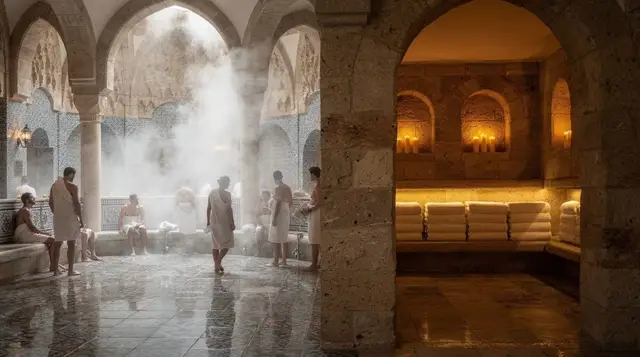
Public hammam or spa hammam
Should I go to a public hammam or a spa hammam in Marrakech?
Go public if you want the real neighbourhood experience, don't mind a bare-bones room, and are comfortable bringing your own soap and glove for a few dirhams. Go private (riad or hotel) if you want to relax without navigating an unfamiliar etiquette, don't mind paying 400 MAD or more, and would rather book ahead than turn up and hope.
Every visitor to Marrakech eventually has to make this decision, usually without quite realising there’s a decision to make: the word “hammam” covers two entirely different experiences, and picking the wrong one for your temperament leads to either disappointment or overspending. This guide lays the two side by side so the choice is informed rather than accidental.
The short version is that a public hammam beldi is a real neighbourhood bathhouse, priced for locals, functional rather than pretty, and entirely self-service beyond the optional paid scrub. A riad or hotel hammam is a tourism product built around the same core ritual, private, pre-booked, and priced to include everything you’d otherwise have to bring or figure out yourself.
| Where | Public: any medina neighbourhood. Private: riads, hotels, dedicated spas |
| Cost | Public 15-50 MAD (€1.50-4.50); private 400-1,000+ MAD (€37-93+) |
| Time needed | Public 45 minutes-1 hour; private 1.5-2 hours with treatments |
| Getting there | Public hammams are unmarked, ask locally; private ones are on-site or a booked taxi away |
| Best time | Public runs fixed men’s/women’s hours; private takes bookings any time |
The public hammam beldi
Walk into a neighbourhood hammam and there’s no reception desk, no menu of treatments, no attendant waiting to greet you — just a changing area, a heated room, and other people from the neighbourhood going through the same routine you are. Entry runs 15-50 MAD (€1.50-4.50), and you’re expected to bring your own savon noir (the dark olive-oil soap), a gant kessa (the exfoliating glove) and, ideally, your own bucket, though most hammams sell or rent basics cheaply at the door for anyone who arrives without.
You keep your underwear on throughout — nobody bathes nude here — and the routine is steam until you’re properly sweating, lather with savon noir, scrub with the kessa, rinse. If you want a proper professional scrub rather than doing your own back badly, a tayeba works the room and will negotiate a price on the spot, typically 50-100 MAD (€4.50-9.30). Hours are strictly separated by gender, either different rooms or different times of day, so checking the schedule before you go matters more than almost anything else on this list.
Etiquette inside a public hammam
The unwritten rules are mostly common sense, and nobody expects a first-timer to get everything right. Keep your voice low, keep your underwear on, and don’t stare; the room is a place where neighbours wash and unwind, not a spectacle. If you are unsure what to do, copy the people around you: the sequence of warming up, lathering, scrubbing and rinsing is the same for everyone, and watching a regular for a minute teaches you more than any guidebook.
Practical habits help too. Carry your kit in a bag you can leave in the changing area, wear flip-flops on the wet floor, and have small change ready for the entry fee and any scrub you agree to. Agree the price of a tayeba before the scrubbing starts, not after, in the same spirit as the advice in our Marrakech haggling guide. A small tip for good service is customary, and tipping in Morocco explains what feels right without overthinking it.
The riad or hotel hammam
Book ahead, and everything changes. You’ll be given a private cabin or a couple’s suite, an attendant handles the scrub for you rather than leaving you to manage your own back, and towels, savon noir, kessa and usually rhassoul clay are all supplied as part of the price. Sessions run longer, often folding in a massage afterwards, and the room itself is designed to be relaxing rather than merely functional — dim lighting, warm tiles, sometimes music.
This traditional hammam and massage package with hotel transfer is a solid representative of the category: fixed price, everything included, a driver so you don’t need to find the address yourself. Expect to pay 400-1,000 MAD (€37-93) or more depending on how many add-on treatments come with it, against the 15-50 MAD of the public version — the gap is the entire point, not a pricing error.
A booked session also tends to follow a gentler rhythm than the public version. You are shown to your cabin, left to warm up in the steam, then scrubbed by an attendant, rinsed, and often moved on to a massage or a rest with mint tea afterwards. The point of paying more is that you never have to decide what comes next. If you enjoy that kind of unhurried afternoon, our Marrakech spa guide shows how a hammam slots into a longer spa visit, and the Moroccan mint tea guide explains the glass you will probably be handed at the end.
What you’re actually paying for
The price difference isn’t really about the ritual itself, which is nearly identical either way — steam, savon noir, kessa, rinse, optionally rhassoul. What the higher price buys is privacy instead of a shared room, an attendant instead of self-service, supplied products instead of your own kit, and a guaranteed time slot instead of walking in and hoping the right hours line up.
For a solo traveller on a tight budget, that’s an easy trade to skip; for a couple wanting an easy, relaxing afternoon with zero planning, it’s an easy trade to make. A full riad spa day extends the private version further still, folding the hammam into a longer sequence of treatments if half a day of relaxation is what you’re after.
Hygiene and first-timer worries, addressed
The most common hesitation about the public version isn’t the etiquette, it’s hygiene — and it’s largely unfounded. Neighbourhood hammams are used daily by local families, including small children and elderly residents, and are cleaned and re-heated on a regular cycle as a matter of course, since they’re a genuine utility rather than a novelty.
The floors are wet and can be slippery underfoot, which is a real practical concern worth packing flip-flops for, but it’s a footing issue rather than a cleanliness one. Language is the other worry that rarely materialises as a real problem: the routine of steam, lather, scrub and rinse doesn’t require conversation once you’ve watched how it’s done once, and most public hammams have at least one regular who’s happy to show a visibly new visitor the ropes.
Who each option actually suits
A solo traveller comfortable with a bit of improvisation and keen to see how the city actually lives gets more out of the public version, both for the price and for the experience itself — a shorter 50-minute hammam and massage session is a useful middle ground if a full public visit still feels like too much unknown for a first attempt. Couples and honeymooners tend to prefer the private route specifically for the shared cabin option, which the public version can’t offer at all.
Families travelling with children generally default to a booked riad or hotel hammam too, mainly because it removes the need to navigate an unfamiliar gender-separated schedule with kids in tow. None of these are rules — plenty of solo travellers book private for convenience, and plenty of couples go public separately for the cultural experience — but they’re a reasonable starting point if you’re genuinely unsure which to pick.
Where a hammam fits in your Marrakech days
A hammam is best placed after a physically tiring stretch rather than before one. After a long morning in the medina, working through the lanes on our medina walking route, warm steam and a scrub are a welcome reset. Neighbourhoods such as Mouassine and Riad Zitoun are dense with riads, so a booked hammam is often only a short walk from where you are staying, while public hammams sit in residential corners of the old city and are easiest to find with a local pointing the way.
It also works as recovery after the more demanding excursions. If you have just come back from a night in the dunes or a day of trekking, a quiet hammam the following day does more good than another sightseeing push; our guides to the Sahara desert camp and the Atlas Mountains day trip are good starting points for planning that kind of trip.
Couples building a relaxed itinerary may like the five-day honeymoon plan, and anyone leaning towards a more indulgent stay can see how a spa session sits in the four-day luxury itinerary.
What to pack and wear
For a public hammam, the short list is savon noir, a kessa glove, flip-flops, a towel and a change of clothes, plus something to carry it all in. For a private session, almost everything is supplied, so you mainly need to arrive relaxed. Either way, wear something easy to slip on afterwards, because you will leave warm and a little drowsy. Our guide to what to wear in Marrakech covers the day-to-day dress question for the rest of your visit.
If you like what the soap and clay do for your skin, the argan oil guide is a natural next read, since oils and cosmetics are a common souvenir after a hammam.
Choosing based on how you travel
Travelling alone as a woman, you may feel more comfortable with a booked session at first; the solo female travel guide has wider advice on settling in. With children, Marrakech with kids is worth a look before you decide, since the gender-separated hours of a public hammam can be awkward for a mixed family group.
If you’re staying in a riad, ask your host where the neighbourhood hammam is — most riad owners use one themselves and can point you to it directly, which sidesteps any awkwardness about finding an unmarked entrance.
If your Arabic or French is minimal and you’d rather not navigate an unfamiliar routine on your own, a booked private hammam removes that entirely: this hammam and massage package with hotel pickup handles transport, language and etiquette in one booking. Families and solo women travellers in particular tend to default to the private option for exactly this reason, though plenty go public without any trouble at all once they know roughly what to expect.
There’s also nothing stopping you from doing both on a longer trip — a public hammam early on to get a feel for the ritual and the city, and a booked spa hammam later as a planned splurge once you already know what to expect from the routine itself. Several returning visitors say they end up preferring the public version once the initial unfamiliarity wears off, purely because it’s cheaper, quicker to fit into a day, and closer to how the ritual is actually meant to be used.
If you are still choosing where to sleep, staying in a riad and riad versus hotel explain how on-site hammams and host recommendations differ, and the first-time guide places this decision in the wider trip. For another view of daily life at a riad, read riad life explained.
For the fuller picture of what actually happens step by step inside either kind of hammam, see our Marrakech hammam guide. If you’re weighing a hammam against a wider spa day with massage and facials, our Marrakech spa guide covers that ground, and travellers watching costs closely should also read Marrakech on a budget, where the public hammam is one of the better-value entries on the whole list.
Hammam and wellness experiences on GetYourGuide
Verified deep-linked GetYourGuide tours. Book through these links and we earn a small commission at no cost to you.
Photo: our own image of the location, not the operator’s product photo.