Leather and the tanneries
Are the Marrakech tanneries worth visiting?
Bab Debbagh's tanneries are real working tanneries, but much smaller and less visually dramatic than the famous ones in Fes — worth a short stop if you're already nearby, not worth a special trip on their own. Watch for the mint-sprig guide scam, where an unofficial 'guide' hands you mint to mask the smell then demands a large fee to leave.
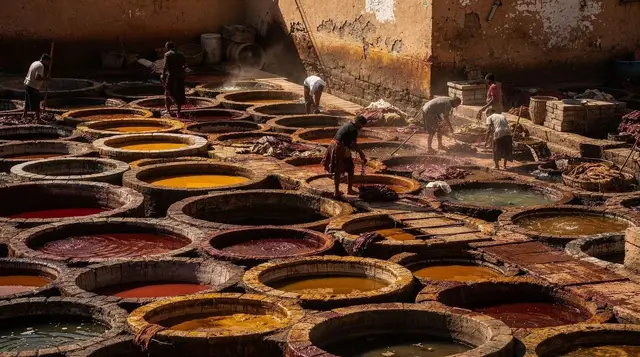
Leather has been worked in Marrakech for centuries, and the tanneries at Bab Debbagh, on the medina’s eastern edge, are where the raw hides still get treated the traditional way — soaked, limed, dyed in round stone pits that from above look almost like a honeycomb. It’s a genuinely interesting working site, but it’s also the setting for one of the most reliably reported scams in the city, which is worth naming clearly before you go rather than discovering on the spot.
| Where | Bab Debbagh, the medina’s eastern gate |
| Cost | Free to view from the surrounding area; a proper tour with a licensed guide runs 50-150 MAD (€4.50-14) |
| Time needed | 20-30 minutes at the tanneries themselves |
| Getting there | 15-20 minutes’ walk from Jemaa el-Fna, or a short taxi to Bab Debbagh |
| Best time | Mornings, when the pits are most active and the smell, while present, is more manageable |
What Bab Debbagh actually is, and isn’t
Bab Debbagh’s tanneries are real, working tanneries where hides are still processed using methods that haven’t changed drastically in generations — the pits, the natural dyes, the physical labour of soaking and treating each hide by hand. What they aren’t is the sprawling, dramatically photogenic complex that Fes is famous for.
Fes has some of the largest and oldest tanning operations in the country, with dozens of pits stepped across a much bigger site and a long-established viewing infrastructure built around it. Bab Debbagh is smaller, less organised for visitors, and considerably less visually dramatic — worth a stop if you’re in the area, not worth planning a special trip around on its own. If tanneries are genuinely a priority, a Fes visit delivers the fuller version of the same craft.
The site itself sits right at Bab Debbagh, the gate it takes its name from, on the medina’s northeastern edge — a part of the city most visitors don’t otherwise pass through, since it’s beyond the main souk routes and closer to residential quarters than to Jemaa el-Fna. That relative distance is part of why it doesn’t get the same casual foot traffic as the central souks, and also why the unofficial guides operating there rely so heavily on visitors who’ve made a deliberate trip and don’t yet know the layout.
Planning the stop within your medina day
Because Bab Debbagh sits on the far side of the old city, it works best as one stop in a longer walk rather than a destination you cross town for. Many visitors fold it into a wander that starts around Jemaa el-Fna and drifts east through the lanes of the medina, ending at the tanneries before heading back through quieter residential streets. Our medina walking route shows how the different quarters connect, and it helps you judge how much of the day the tanneries should realistically take.
If walking in the heat sounds unappealing, a taxi to the gate and a walk back through the lanes is a sensible split. The getting around guide and the taxi guide explain how to agree a fare before you set off, which matters just as much here as anywhere else in the city. Go in with a rough idea of where you are on the map, because the lanes around the eastern gate are less signposted than the central souks, and looking confident is the best defence against anyone offering unwanted directions.
Wear shoes you don’t mind getting a little dirty, and keep your bag closed and close to you while you look at the pits. The ground near the working areas can be wet, and the surrounding paths are narrow, so you’ll want your hands free. For more on dressing comfortably and respectfully in the medina, see what to wear in Marrakech.
The mint-sprig scam, named clearly
This is the single most consistently reported hassle at Bab Debbagh, and it follows a near-identical script every time: an unofficial “guide,” not affiliated with any tannery or tour company, approaches with a sprig of mint, explains it helps with the smell, and hands it over before you’ve agreed to anything. He then walks you through the tanneries, offering commentary you didn’t ask for, and at the end demands a fee — commonly cited around 200 MAD — for a tour that was never agreed or priced upfront. The fix is simple: decline the mint and the unsolicited guiding from the first approach, politely but clearly, and keep walking if it continues. Nothing bad happens from refusing; the pressure is entirely social, not physical.
This same pattern — an unofficial guide attaching themselves uninvited, then demanding payment at the end — shows up elsewhere in the medina too, not just at the tanneries, and is worth recognising on sight rather than treating Bab Debbagh as an isolated case. A firm, early “no, thank you” stops it every time; the people running this particular hustle rely on visitors being too polite to refuse rather than on any real leverage.
The tanning process, briefly explained
Understanding what’s actually happening in the pits makes the smell and the visit itself more interesting rather than just something to get through quickly. Raw hides arrive salted and are first soaked in a mix of water, lime and pigeon droppings — the traditional softening agent, and the main source of the smell most visitors brace for — which loosens the hair and fat from the skin over several days. Workers then scrape the hides by hand before moving them into the dye pits, where natural pigments (poppy for red, indigo for blue, henna for orange) colour the leather in stone vats sunk into the ground, the same honeycomb pattern visible from the viewing platforms above.
A guided walking tour through the medina’s hidden souks that includes the tanneries area with a proper, agreed-price guide avoids this entirely — you know the cost before you start, and there’s no ambiguity to exploit.
Once you know the sequence, the pits stop looking like a random patchwork of colour and start reading as stages of a long process. Each vat has a purpose: some are for softening and cleaning, others for colour, and the hides move between them by hand. Watching a worker lift a heavy, dripping skin from one pit to the next gives a far better sense of the physical effort than any photograph, and it explains why finished leather goods carry the price they do. It also changes how you look at the stalls afterwards, since a well-made bag or pair of slippers represents a lot of unglamorous labour.
For anyone who would rather have this explained than guess at it, a guided outing that combines crafts with a leather stop, such as a tour that pairs a leather workshop with rugs and a Berber pharmacy, gives you context from someone who is accountable for what they say, and the price is settled before you start. Our comparison of a guided tour versus going independently helps you decide which suits you.
Buying leather goods in the souk
Away from the tanneries themselves, leather goods fill entire stretches of the souk near Semmarine: babouches (the pointed leather slippers, sold in every colour), bags, belts, wallets and poufs (the round leather ottomans that pack flat and ship well). Quality varies enormously between stalls selling near-identical looking items, so a few quick checks help: smell the leather — a strong chemical or plastic smell suggests poor or synthetic tanning rather than the real thing — and flex a corner gently to see whether it creases naturally, the way real leather does, rather than cracking or feeling stiff and artificial.
A babouche leather workshop in the medina is a good way to see genuine leatherwork made in front of you and understand what separates a well-made pair from a mass-produced one, before buying anywhere else in the souk.
Prices, like almost everything else in the souks, are negotiated rather than fixed — our haggling guide covers the general method, and leather responds well to the same approach: start well below the first quote, expect a few rounds of back-and-forth, and be willing to walk toward a neighbouring stall selling near-identical goods if the price doesn’t move. A well-made pair of babouches typically runs 150-350 MAD (€14-32) after negotiation, with poufs and larger bags running considerably higher depending on size and leather quality.
Choosing between leather and other crafts
Leather is only one of the crafts competing for your luggage space, and it helps to decide early what you actually want to bring home. If you are drawn to textiles, the rug buying guide explains what to look for before you commit, and ceramics have their own logic, covered in the pottery guide. For a wider sense of how the market is organised, the souks guide maps the different trades onto the different parts of the medina, and the artisan workshops guide points to places where you can watch makers at work rather than only browse finished stock.
A practical way to shop is to look first and buy later. Spend your first pass through the leather stalls simply comparing: handle a few pieces, note which stalls smell of real leather and which don’t, and notice how much the opening prices vary for similar items. Then come back to the stall you trusted most. Buying on the first day, from the first persuasive seller, is the most common way people overpay. The blog post on shopping without getting ripped off goes deeper on that mindset.
Pay attention to the practical side too. Poufs are sold unstuffed, which is why they travel so easily, and a bag or belt is worth trying on or checking against your own measurements rather than trusting a seller’s reassurance. If a seller claims a piece is a particular type of leather, ask where it was made and listen to how specific the answer is. Vague answers, combined with a strong chemical smell, are a reason to walk on.
Visiting respectfully
The tanneries are a working livelihood for the people there, not a backdrop set up for visitors, and that’s worth remembering with a camera in hand. Ask before photographing anyone working, and expect that a polite request is usually met with a yes — it’s refusing to ask, not the photo itself, that causes friction. The same courtesy applies throughout the leather souk: a stallholder demonstrating a technique or working on a piece is generally happy to be watched and asked about, less happy to be photographed without a word first.
Some tanneries and viewing points offer a small rooftop or terrace for a better overhead view of the dye pits, sometimes for a modest entrance fee separate from anything an unofficial guide might demand. This is a legitimate charge, generally posted or stated clearly by whoever runs the terrace, and worth distinguishing from the mint-sprig scam covered above — a stated, upfront fee for a specific vantage point is a normal transaction, not a hustle. If in doubt about whether a fee is legitimate, ask what exactly it covers before paying; a straight answer is a good sign, vagueness is not.
Where the tanneries fit in a longer trip
On a short stay, the tanneries are a good candidate for the “if there’s time” slot rather than a fixed appointment. A first-timer with only a couple of days will usually get more from the headline sights, so check the two-day itinerary or the three-day plan to see where an extra stop would fit comfortably. If you’re still deciding how long to stay at all, the 3 versus 5 days comparison helps set expectations.
If tanneries are central to your interest, it is worth weighing the two cities directly: our Marrakech versus Fes comparison explains what each offers, and leather is one of the clearest differences between them. Either way, go in curious, keep your sense of humour about the smell, and treat the hustle as a minor nuisance you already know how to handle.
For the wider souk landscape beyond leather specifically, our Marrakech shopping guide covers the other craft categories worth your time, and Marrakech scams and hassle lists the other common set pieces to recognise around the city, tanneries included.
Shopping and craft tours on GetYourGuide
Verified deep-linked GetYourGuide tours. Book through these links and we earn a small commission at no cost to you.
Photo: our own image of the location, not the operator’s product photo.