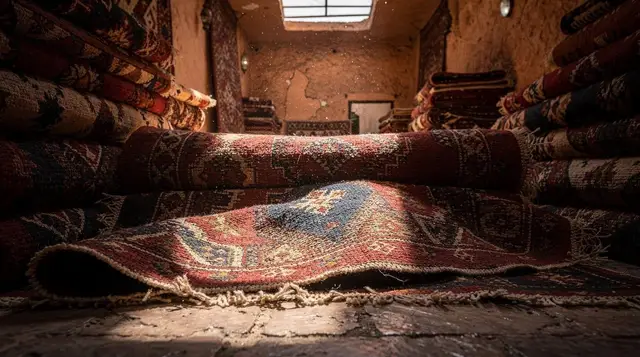
Buying a Moroccan rug
What's the difference between a Beni Ouarain and an Azilal rug?
Beni Ouarain rugs are cream wool with black or brown geometric diamond patterns, woven in the Middle Atlas. Azilal rugs use brightly coloured wool in freer, more abstract patterns, woven in the High Atlas. They come from different regions and different weaving traditions, not just different colour choices.
A Moroccan rug is one of the few souvenirs from this trip that will still be in daily use a decade later, which is exactly why it’s worth ten minutes of preparation before you walk into a rug shop. The market is genuinely full of beautiful, well-made pieces — and just as full of thin, poorly-knotted rugs sold with the same confident pitch. Knowing the four types you’ll actually encounter and having a negotiating method ready turns a stressful purchase into a straightforward one.
| Where | Souk des Teinturiers, Rahba Kedima, and dedicated rug shops throughout the souks |
| Cost | Roughly 1,500-8,000+ MAD (€140-740+) depending on size, wool and knot density |
| Time needed | 30-60 minutes for a proper look and negotiation per shop |
| Getting there | On foot within the medina |
| Best time | Mornings, when sellers are fresher and less rushed |
The four types you’ll actually see
Beni Ouarain rugs are the ones most visitors picture when they think “Moroccan rug”: cream, undyed wool with sparse black or brown geometric diamond patterns, woven in the Middle Atlas by the Beni Ouarain tribal confederation. They’re prized for the wool’s softness and the pattern’s restraint, and genuine older pieces command real prices.
Azilal rugs come from the High Atlas and look almost nothing like Beni Ouarain: brightly coloured wool — reds, oranges, purples — worked into looser, more abstract, often asymmetric patterns that read as folk art more than formal geometry. Each one is genuinely distinct rather than following a repeated template, which is part of the appeal.
Boucherouite rugs are woven from strips of recycled fabric and old clothing rather than wool at all, a tradition born from practicality in households that couldn’t afford wool for every piece. They’re typically the cheapest of the four, unmistakably colourful and improvised-looking, and increasingly collected specifically for that raw, one-off quality.
Kilim rugs are flat-woven rather than knotted — no pile, thinner and lighter than the other three, which makes them easier to pack and often cheaper, while still carrying traditional geometric patterning. A rug art experience with tea and an artisan visit is a good way to see several of these types side by side and handle the wool before you commit to buying anywhere.
Choosing a type that fits your home
Before you ever step into a shop, it helps to decide what the rug is for. A rug that will lie under a dining table or in a hallway has to cope with feet, chairs and cleaning, while a piece meant for a bedroom or to hang on a wall can afford to be softer and more delicate. Beni Ouarain wool suits quiet, neutral rooms where the pattern should whisper. An Azilal piece works the opposite way: it can carry a whole room’s colour scheme on its own, so think about whether you want a focal point or a backdrop. A boucherouite is a good answer for a reading corner or a kitchen where you want personality rather than formality, and a kilim is the sensible choice for a space where weight and thickness are a concern.
Take a few measurements and a couple of photos of the room before you travel, along with a note of the main colours in it. Sellers will happily unroll twenty rugs for you, and having a clear brief keeps you from being steered toward whatever the shop most wants to move. It also gives you a polite way to end a visit: “it isn’t the right size for my space” is a reason nobody can argue with.
Where to look in the medina
Rugs are sold across the old city rather than in one single street, and the experience changes a lot depending on where you shop. The broader layout of the markets is covered in our guide to the Marrakech souks, and a loop through the lanes is mapped in the medina walking route. If you want to understand the district itself before you go hunting, the medina destination page gives the lay of the land, and the quieter streets of Mouassine are a pleasant place to browse away from the busiest crowds.
A sensible approach is to treat your first pass as pure looking. Walk, handle a few pieces, drink the tea if it is offered, and learn what different shops show you first. The square at the centre of it all, described in the Jemaa el-Fna guide, makes a convenient landmark to return to when you need to get your bearings and rest your feet between shops. Only on the second pass, once your eye has adjusted, should you start to negotiate seriously.
Judging quality: wool, knots and dye
Beyond simply recognising the four types, a few physical checks separate a well-made rug from a poorly made one within the same category. Run a hand across the surface: real wool feels slightly oily and springs back when pressed, where synthetic fibre feels drier and flatter. Turn the rug over and look at the back — tighter, more even knots mean a denser, more durable weave, and a good rug shows a clean, consistent pattern on the reverse rather than loose or irregular threads. Smell it too, gently; a strong chemical odour suggests synthetic dye rather than the plant and mineral dyes traditional weaving uses, though a faint wool smell is entirely normal and not a fault.
Colour consistency is a genuine judgement call rather than a simple pass-fail: hand-dyed wool naturally varies slightly batch to batch, which shows up as subtle tonal shifts across an older or handmade piece — collectors often prize this rather than seeing it as a flaw, since it’s proof of hand-dyeing rather than a uniform synthetic batch.
Vintage versus new rugs
Vintage rugs, generally meaning pieces woven decades ago and sourced second-hand from Berber households, carry a different pricing logic entirely — condition, rarity of pattern and provenance matter more than size alone, and prices can run well above a comparable new piece for a rug with real age and a documented origin. New rugs, woven to order or already made by current cooperatives and workshops, are more predictable in price and easier to verify, since you’re often buying directly from or close to the weaver. Neither is inherently the better choice: a vintage piece brings history and individual character that a new rug can’t replicate, while a new rug gives more certainty about what you’re actually getting for the price.
The “cooperative auction” and other set pieces
A specific scam pattern worth naming directly: being led to a “cooperative auction,” where rugs are unrolled dramatically one after another and prices seem to build toward a group-pressure sale. It isn’t a real auction and there’s no cooperative discount at the end of it — it’s a sales technique built around urgency and social pressure, and walking away costs nothing. The other common line is being told it’s “the last day of the souk sale” or that a specific rug is the “last one” of its kind — treat both as sales patter, not information.
A carpet-weaving workshop with women artisans sidesteps all of this: you watch and try the actual weaving process with the people who make rugs for a living, away from any sales-floor pressure, which is also one of the more reliable ways to learn what quality knotting genuinely looks like up close.
Negotiating: a starting method
Treat the seller’s first quoted price as an opening position, not a real estimate of value — a reasonable starting counter is roughly a third of that first number. From there, expect several rounds of back-and-forth, usually settling somewhere between your opening counter and the seller’s first price, closer to the middle for a shop you’re building rapport with and closer to your own number for a purely transactional stall. Mint tea offered mid-negotiation is a normal part of the ritual, not an obligation to buy — it’s fine to drink it and still walk away.
A private souks tour focused on artisans and their crafts is useful preparation if you want a guide to model a fair negotiation in front of you once before doing it solo.
Keeping your composure in the shop
Most of the discomfort people feel in a rug shop comes from the format rather than from any bad intent: you are seated, offered a drink, and shown piece after piece by someone who is very good at this. None of that obliges you to anything. Decide in advance that you will not buy on the first visit, and the pressure drops away. Ask to see the rugs you actually came for, say plainly which ones you like, and put the rest aside. If a seller keeps pulling out pieces you have said no to, that tells you something about how the rest of the conversation will go.
If you want to be better prepared for the wider range of sales tactics in the old city, the Marrakech scams guide lists the patterns worth recognising, and the blog piece on shopping without getting ripped off is a more personal account of the same lessons. Both pair well with the haggling guide before you start putting numbers on the table.
Pairing a rug with other crafts
A rug rarely makes the trip home alone. The same souk visit is a good moment to look at ceramics, and our Moroccan pottery guide explains what to look for there. Leather is another staple of the markets, and the leather and tanneries guide covers how that trade works. If you would rather bring home something edible, the argan oil guide helps you tell the real thing from the imitations, and the mint tea guide explains the ritual you will meet in every rug shop you enter.
Buying several things in the same shop is also a reasonable lever in negotiation, though it only works if you genuinely want everything you are asking about. Do not add items to a purchase just to tip a price; a rug you love at a fair price is a better outcome than a bundle of things you will never use.
Planning the purchase into your trip
Because a good rug takes time to choose, it fits best on a day with no fixed schedule. On a short stay, the three-day itinerary leaves room for an unhurried souk morning, and the Marrakech budget guide is worth a look so that a large purchase does not throw the rest of your spending off course. If you are staying in a traditional house, the guide to staying in a riad is useful too, since your hosts can often point you to trustworthy sellers and advise on what a fair deal looks like locally.
Getting a rug home
Small kilims fit in checked luggage if you’re travelling with room to spare; larger Beni Ouarain or Azilal pieces generally don’t, and most established rug sellers offer courier shipping instead, typically two to six weeks and added to the agreed price. Ask about shipping cost and timeline before finalising a purchase, not after — it should factor into whether the total price still feels fair.
For anyone determined to carry a rug home, vacuum-compression bags bought before the trip compress a rolled rug down to a fraction of its unpacked size, though checked luggage weight limits still apply and are worth checking against airline policy beforehand. A rug carried this way arrives with the buyer rather than waiting weeks for a courier, which some travellers prefer purely for the peace of mind, even if it means an awkward-shaped piece of luggage for the flight home. Whichever route you choose, ask the seller for a receipt showing the price paid and a description of the piece — useful both for any customs declaration at home and as a record of what you agreed to if a shipped rug arrives looking different from what left the shop.
For the wider negotiating context beyond rugs specifically, see haggling in the souks, and for other craft categories worth your time in the same souk visit, our Marrakech shopping guide and artisan workshops guide cover the rest of the ground.
Shopping and craft tours on GetYourGuide
Verified deep-linked GetYourGuide tours. Book through these links and we earn a small commission at no cost to you.
Photo: our own image of the location, not the operator’s product photo.