Bahia Palace guide
Is Bahia Palace worth visiting, and how much does it cost?
Yes — it's the single most consistently rewarding palace visit in Marrakech, thanks to its painted cedar ceilings, zellige-tiled courtyards and quiet garden rooms. Entry runs around 100 MAD (€9), and the best strategy is arriving right at opening to see it before tour groups fill the courtyards.
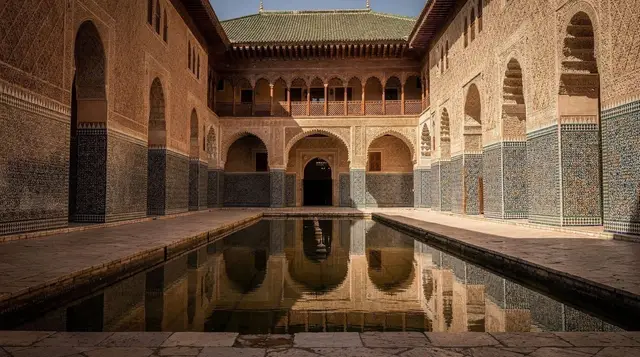
Bahia Palace is the palace most guidebooks point to first, and for once the reputation holds up. Built in the late 19th century for Si Moussa, grand vizier to the sultan, and later expanded by his son Ba Ahmed, it was designed as a private residence rather than a seat of state power — which shows in the scale: intimate courtyards and garden rooms rather than the imposing throne halls found elsewhere. That domestic scale is part of why it photographs and walks so well today.
The name Bahia means “brilliance,” and the palace earns it mainly through decorative detail rather than size: painted cedar ceilings, carved stucco, zellige tilework in geometric patterns that took skilled craftsmen years to complete. Nothing here is ruined or half-restored the way parts of El Badi Palace are — Bahia is essentially intact, which makes it the easiest of the Kasbah quarter’s palaces to appreciate without having to imagine what’s missing.
| Where | Kasbah quarter, a 15–20 minute walk south of Jemaa el-Fna |
| Cost | Around 100 MAD (€9), subject to change |
| Time needed | 45–60 minutes |
| Getting there | Walk from the medina, or taxi to Bab Agnaou and walk the last stretch |
| Best time | Right at opening, around 9am, before tour groups arrive |
What’s actually inside
The palace unfolds as a sequence of courtyards rather than one grand hall, which is part of why arriving early matters — narrow doorways between sections bottleneck quickly once a coach tour group is moving through. The large courtyard near the entrance, paved in white marble and bordered by orange trees, is the most photographed space and usually the most crowded. Push through to the smaller, quieter rooms beyond it: a series of private apartments built for Ba Ahmed’s wives and concubines, each with its own painted ceiling design, none of them identical.
The Grand Vizier’s private council chamber and the harem quarters are the two sections most visitors linger in longest, both for the ceiling work and for the relative quiet compared to the entrance courtyard. Take the time to actually look up — the painted cedar ceilings are the palace’s real showpiece, and they’re easy to walk past if you’re focused on the tilework at eye level instead.
A short, focused visit like this Bahia Palace entry ticket with digital audioguide is a reasonable middle ground if you want context on what you’re looking at without committing to a full multi-site guided tour.
The history behind the name
The palace’s full story is worth knowing because it explains the architecture better than any single room does on its own. Si Moussa, the grand vizier who commissioned the first phase of construction, built it as a demonstration of his own wealth and standing during a period when Marrakech’s court politics ran heavily on visible displays of status.
His son Ba Ahmed later expanded it substantially after inheriting his father’s position, adding most of the private apartments and much of the decorative work visitors see today. Neither man was royalty in the strict sense — both were powerful court officials rather than sultans — which is part of why the palace reads as intimate and residential rather than ceremonial in the way a true royal palace would.
After Ba Ahmed’s death in 1900, the palace was reportedly stripped of much of its portable wealth by rivals at court, and it later served briefly as a residence for the French Resident-General during the protectorate period before eventually passing into state ownership as a heritage site. That history of changing hands is one reason some rooms feel more complete than others — restoration has focused on the structural and decorative elements that survived intact rather than attempting to recreate furnishings that were long since dispersed.
Getting the timing right
Bahia Palace sits on most Marrakech coach tour itineraries, which means a predictable crowd pattern: relatively quiet at opening, busy from roughly 10:30am through early afternoon, and thinning out again in the last hour before closing. If your schedule allows any flexibility at all, build your visit around the two quiet windows rather than the middle of the day — the difference in how much breathing room you get in the smaller rooms is significant.
Combining Bahia with nearby sites
The Kasbah quarter concentrates several of Marrakech’s best heritage sites within a few minutes’ walk of each other. The Saadian Tombs and El Badi Palace are both close enough to combine with Bahia in a single morning, and doing so means only one trip out to this part of the medina rather than several. A guided option like this Saadian Tombs, Bahia Palace and medina experience bundles the logistics of visiting all three, including the queuing that can otherwise eat into your morning.
If you’re building a full day around the medina’s landmarks rather than just the palace quarter, the self-guided medina walking route routes through Bahia as part of a longer loop that also covers the souks and Ben Youssef Madrasa. For a wider view of what else counts as a museum or heritage site worth the entry fee nearby, see the Marrakech museums guide.
Reading the decoration
Two decorative traditions dominate the palace and are worth being able to tell apart, since almost every room combines them. Zellige is the geometric mosaic tilework covering lower walls and floors, individually cut and hand-set by craftsmen trained for years before being allowed to work on a commissioned piece — look closely at any panel and the slight irregularities between tiles are a sign of genuine handwork rather than a flaw.
Above the tile line, carved and painted stucco takes over, typically floral or calligraphic patterns cut into wet plaster and left to harden, then sometimes painted afterward as in several of Bahia’s ceiling panels. The painted cedar ceilings themselves are a third technique again, wood rather than plaster, painted directly and installed as finished panels — these are the most fragile of the palace’s surviving decoration and the reason flash photography is discouraged in some of the smaller rooms.
Practical notes for the visit
There’s minimal shade inside the palace grounds beyond the garden courtyards, so a hat matters even for a short visit, particularly in the warmer months. Photography is generally permitted throughout, though tripods and extended setups can draw attention from staff trying to keep the narrow passageways moving. Toilets and a small rest area exist near the exit but shouldn’t be relied on as a long break — plan those for a nearby café instead, of which several sit within a five-minute walk toward Jemaa el-Fna.
If Bahia Palace is your first stop of the day in the Kasbah quarter, it’s worth pairing with a look at the Marrakech souks guide beforehand for what’s on the walk down from Jemaa el-Fna — several smaller artisan workshops sit along the route and are easy to miss if you’re walking with a fixed destination in mind rather than looking around on the way. Comfortable, flat shoes matter more here than at most medina sights, since the marble courtyards can be slippery when polished and the transitions between rooms often involve small, easy-to-miss steps.
How Bahia fits into a Marrakech itinerary
Bahia works best as a morning anchor. Because the quiet window is at opening, it makes sense to put the palace first and let the rest of the day follow from the Kasbah quarter back toward the centre. If you are planning a short stay, the Marrakech in 2 days itinerary and the 3-day itinerary both give the palace a natural slot, and the Marrakech in 48 hours piece shows how a compressed schedule can still leave room for a slow walk through the courtyards.
First-time visitors who are still deciding what to prioritise will find the first-time guide to Marrakech useful for putting the palace in context alongside the souks, the gardens and the main square. Bahia is rarely the thing people regret skipping less than the others; it is more often the visit they say surprised them, precisely because it is calmer and more domestic than the reputation of the medina suggests.
Guided visit or on your own
The palace is easy to walk without help, and many visitors do exactly that. A guide earns their place when you want the names, the stories and the explanation of why a particular ceiling or doorway looks the way it does. Without one, much of the decoration reads as simply beautiful rather than meaningful, which is fine, but it is a different visit. If you are weighing the two approaches more generally, the guided tour versus independent comparison lays out the trade-offs for Marrakech as a whole.
For people who like context but dislike being led, an audioguide-style visit is the compromise: you set your own pace, stop where you like, and skip what does not interest you. For people who would rather hand over the logistics entirely, a guided route such as this guided Bahia Palace tour with skip-the-line entry removes the question of queuing and of which rooms to prioritise, leaving you free to look.
Pairing the palace with the rest of the medina
Bahia sits at the southern end of the medina, so the walk back north is part of the experience rather than an afterthought. Many visitors continue toward the Ben Youssef Madrasa, whose carved courtyard offers a different take on the same craft traditions you have just seen at Bahia. Others prefer to stay in the heritage mood and add the Koutoubia Mosque, whose minaret is a useful landmark for finding your way when the alleys start to blur together.
If the day has been heavy on monuments, Le Jardin Secret is a gentler follow-up, a walled garden where you can sit down and let the morning settle. And when you are ready for lunch, the Marrakech food guide will help you choose somewhere better than the first terrace that waves you in. For the neighbourhood itself, the medina destination page and the Kasbah and Mellah page give a wider view of what surrounds the palace.
What to bring and how to pace yourself
A visit to Bahia is short enough that you do not need much, but a few small habits make it smoother. Carry water, wear shoes you can walk in for the rest of the day, and keep your phone charged if you plan to take photographs, since the ceilings and tilework invite far more pictures than people expect. Move slowly through the smaller rooms and let groups pass rather than competing for the doorway: the palace is designed on a domestic scale, and it rewards patience.
It also helps to decide in advance what you want from the visit. If it is photography, the early light and the empty courtyards matter most. If it is understanding, read a little of the palace’s story beforehand and look for the differences between the apartments. If it is simply a pleasant hour out of the heat or the bustle, the garden courtyards are the place to linger. Any of the three is a good reason to go, and the palace does not demand that you choose only one.
Who will enjoy it most
Bahia suits almost every kind of traveller. Couples and solo visitors tend to enjoy the quiet corners, families find the open courtyards easy to move through, and anyone interested in craft will find more to look at than the hour suggests. Travelling with children is straightforward as long as they are reminded that the decoration is fragile; the Marrakech with kids guide has more on keeping younger visitors engaged in the medina’s heritage sites. If you are travelling alone, the solo female travel guide covers the practical side of moving around the Kasbah quarter comfortably.
Visitors with limited time who are choosing between several paid sites should remember that Bahia is the most complete of the palaces nearby, and that a short, well-timed visit here often gives more than a long, crowded one elsewhere. Pair it with whatever else fits your energy, and leave the rest for another day.
Palace and heritage tours on GetYourGuide
Verified deep-linked GetYourGuide tours. Book through these links and we earn a small commission at no cost to you.
Photo: our own image of the location, not the operator’s product photo.