Marrakech Museums Guide
Which Marrakech museums are actually worth visiting?
The Marrakech Museum and MACMA are the strongest for most visitors — good collections in genuinely beautiful buildings. Tiskiwin rewards anyone interested in Saharan trade routes specifically. The Photography Museum is a pleasant smaller stop rather than a destination in itself, and textile-focused museums vary a lot by what's on rotation.
Marrakech has more museums than most visitors realise, scattered between the medina and Gueliz, ranging from genuinely excellent to skippable depending on what’s currently on display. Unlike the city’s palaces and mosques, which are fixed historic buildings, several of these museums rotate their exhibits or have had uneven funding over the years, so a strong review from a few years back isn’t always a reliable guide to what you’ll find today. This is a hub guide to help you pick two or three that suit your actual interests rather than trying to see all of them.
The short version: if you only have time for one, make it the Marrakech Museum, for the building as much as the collection. If contemporary work interests you more than historic decorative arts, MACMA is the better call. Everything else here is a genuine “depends what you’re into” rather than an automatic addition to every itinerary.
| Where | Mostly clustered in the northern medina, with MACMA and a few smaller options in Gueliz |
| Cost | Individual tickets typically run 30-100 MAD (3-9 €) depending on the museum |
| Time needed | 30-45 minutes per museum; a half-day for two or three in the same area |
| Getting there | Medina museums are walkable from most riads; Gueliz options need a taxi |
| Best time | Late morning, after the initial rush but well before closing |
How to choose between museums and palaces
Marrakech rewards a mix of formats, and it helps to decide early how much of your trip you want to spend indoors. The palaces, such as the Bahia Palace and the El Badi Palace, are experienced mostly as architecture: you walk through courtyards and decorated rooms and take in the craftsmanship. The museums covered here are closer to curated collections, even when they sit inside beautiful houses. If you have only two or three days in the city, our first-time guide will help you see where a museum slots in beside the big sights, and the 3 vs 5 days comparison shows how much room you realistically have.
A useful rule of thumb: choose one museum for the building, one for a subject you genuinely care about, and leave the rest. Anything beyond that tends to blur together, especially in the heat.
The Marrakech Museum (Dar Menebhi Palace)
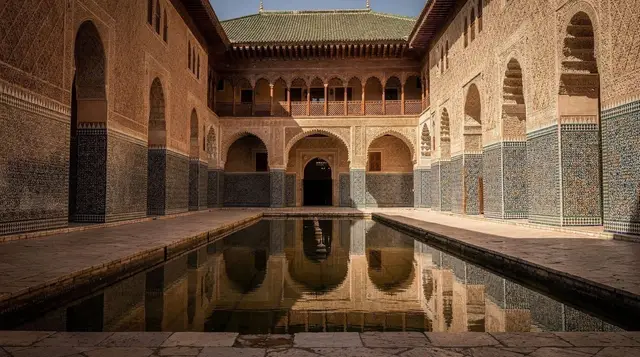
The Marrakech Museum occupies a restored late-19th-century residence, Dar Menebhi, and the building is arguably the main event: a grand central courtyard under a large brass and iron chandelier, with the original hammam and reception rooms still intact around it. The permanent collection covers Moroccan ceramics, coins, jewellery and manuscripts, displayed without much interpretive text, so the experience leans more on wandering the architecture than reading exhibit labels. It sits a couple of minutes from the Ben Youssef Madrasa, and the two are almost always visited together given how close they are.
For most first-time visitors, this is the museum to prioritise if you’re only doing one — the setting alone justifies the ticket, and it’s an easy add-on to a morning already built around the madrasa and the Almoravid Koubba next door.
The collection itself is modest in scale rather than exhaustive, and the museum doesn’t try to compete with a national institution on breadth. What it offers instead is a coherent look at the decorative and everyday objects of Moroccan life across several centuries — ceramics from various regional traditions, minted coins that trace the different dynasties that ruled from Marrakech, and jewellery pieces that turn up again in the design language of the palaces and riads across the medina. Seeing them here first, before or after visiting a working palace like the Bahia, makes the connections between the objects and the architecture easier to spot.
MACMA and the contemporary art scene
The Museum of Contemporary African Art (MACMA) is a different proposition entirely: housed in a converted riad, it shows rotating exhibitions of 20th and 21st-century African art rather than historic decorative pieces, which makes it a good counterweight if you’ve spent a few days seeing palaces and want something more current. An admission ticket to MACMA gets you into whatever’s currently showing — worth checking what’s on before you go, since the quality of a visit here depends heavily on the specific exhibition rather than a fixed permanent collection.
Because MACMA is a different mood from the rest of the medina, it also pairs well with a slower afternoon. After the galleries, the nearby streets of Gueliz offer cafés and shops, and our comparison of the medina versus Gueliz explains how differently the two districts feel, which helps you decide where to base the rest of your day. If you enjoyed a contemporary collection, the Majorelle Garden is a natural next stop, with its own strong visual identity.
Tiskiwin, textiles and the smaller specialist museums
Tiskiwin is a private house-museum built around one collector’s lifetime of objects gathered along the old trans-Saharan trade routes — Berber jewellery, textiles and everyday objects from Morocco down to Mali, arranged more like a personal collection than a formal exhibition. It’s small, easy to see in half an hour, and rewards anyone specifically interested in Saharan trade history; it’s a niche stop rather than a broad crowd-pleaser, and skippable if that subject doesn’t interest you.
Textile-focused options such as carpet and weaving museums vary in quality and are often more about the live demonstration than a formal collection — this carpet museum visit with live weaving and rooftop tea is a reasonable example of the format: useful if you’re weighing up a rug purchase and want to understand the techniques first, less essential if you have no interest in buying. Treat these as a pleasant hour rather than a core stop on a first visit.
For anyone genuinely interested in the difference between regional weaving styles rather than just the finished product, a stop like this is more useful than it sounds — the demonstration typically covers how High Atlas, desert and coastal traditions differ in pattern and material, context that’s easy to miss when browsing rugs in a souk stall with a seller more focused on closing a sale than explaining technique.
The Museum of Photography and other small stops
A smaller but well-regarded option in the northern medina houses a private collection of Moroccan photography from the early 20th century onward, including some genuinely striking early images of Marrakech before much of its current infrastructure existed, along with portraits and street scenes from across the country’s regions. It’s compact — comfortably done in 30 minutes — and works best as an add-on to a museum morning rather than a standalone trip, particularly if you’re already walking between the Marrakech Museum and the madrasa and have a spare half hour to fill before lunch.
Beyond these, a handful of smaller specialist collections open and close around the medina with some regularity; check current listings locally rather than relying on older write-ups, since a few well-reviewed small museums have closed or relocated in recent years.
Making the most of a visit
Museums here are quieter than the souks, but a little preparation still pays off. A few habits make the difference between a rushed tick-off and a visit you remember:
- Go in with one question. Decide what you want to understand, whether that is how a wealthy family once lived, how Saharan trade shaped local crafts, or what contemporary African artists are doing now. With little interpretive text in some rooms, a focus keeps you looking rather than drifting.
- Pace yourself. Mix indoor stops with time outside. The medina can be tiring, and a courtyard bench is a good place to pause before the next building.
- Carry small change and dress sensibly. Our guide on what to wear in Marrakech covers clothing that works for both the streets and quieter interiors.
- Ask before photographing. Some rooms and collections have their own rules, so check with staff at the entrance.
If you are weighing whether to hire someone to unlock the context, our comparison of a guided tour versus going independently lays out the trade-offs. Museums with minimal signage are exactly where a guide earns their fee, while a well-labelled gallery is easy to enjoy alone.
For visitors who already know they want to buy something, the shopping guide and the rug buying guide are worth reading before any textile demonstration, so you can compare what you see with what you might be offered later.
Which ones are genuinely overrated
Being honest about which museums underdeliver matters as much as recommending the good ones. A few of the smaller textile and craft-focused stops rely almost entirely on a shop attached at the exit, with the “museum” portion amounting to a handful of loom demonstrations and a short explanation before the sales pitch begins. That’s not necessarily a bad way to spend twenty minutes if you’re genuinely in the market for a rug or a piece of weaving, but it’s worth knowing going in that the educational content is thin and the commercial intent is the real point. Treat any museum billed as free or donation-based with a shop at the end as exactly that arrangement, not a straightforward cultural stop.
Building a museum morning
The most efficient combination for a first visit groups the Marrakech Museum, Ben Youssef Madrasa and Almoravid Koubba into a single walk, since all three sit within a couple of minutes of each other in the northern medina. A guided tour covering the palace, museum and madrasa highlights handles that combination with context from a local guide, which adds real value at sites with minimal signage.
If you’d rather combine the museum cluster with a stretch of the souks on the same outing, this museum, Almoravid Koubba and souk walking tour links the two naturally into one morning.
For visitors with a broader interest in art beyond the historic medina, the Bahia Palace and the YSL Museum in the Majorelle district round out a fuller picture of Marrakech’s collections — the latter especially if fashion or the Majorelle Garden is already on your itinerary, since the two sit next to each other.
Fitting museums into a wider itinerary
Museums work best as a counterweight to busier days. After a lively evening on Jemaa el-Fna, a calm museum morning is a welcome change of pace, and the medina walking route shows how to thread several stops together without backtracking. If you like to see how others have planned their days, the 2-day and 3-day itineraries show where a museum or two can sit alongside the palaces, gardens and souks.
Travelling with children changes the calculation, since a long run of quiet galleries can test patience. In that case, choose one building with an impressive courtyard and keep the visit short, and see the family activities guide for ideas that balance culture with something more active. If the weather is very hot, museums also make a sensible indoor break, a point worth keeping in mind when you read about visiting in summer.
Whichever you choose, treat the museums as part of understanding the city rather than a checklist. The objects, rooms and courtyards you see here tend to resurface later in the palaces, riads and workshops, and recognising them is one of the quiet pleasures of a longer stay.
Palace and heritage tours on GetYourGuide
Verified deep-linked GetYourGuide tours. Book through these links and we earn a small commission at no cost to you.
Photo: our own image of the location, not the operator’s product photo.