Ben Youssef Madrasa Guide
Is the Ben Youssef Madrasa worth visiting?
Yes — of the medina's paid historic sites, its carved stucco, zellige and cedar woodwork are the most concentrated and best-preserved example in Marrakech, and a full restoration means the courtyard looks close to its original state rather than worn and patched.
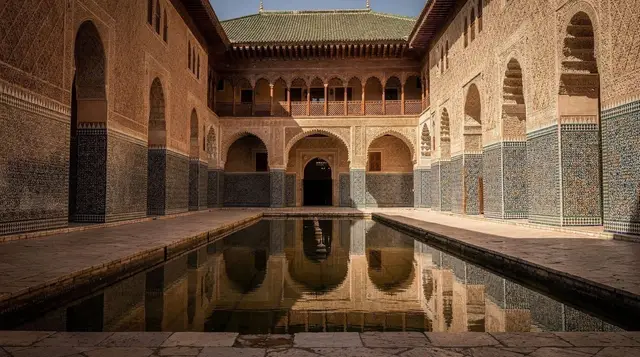
The Ben Youssef Madrasa was a Quranic school, founded in the 14th century and rebuilt in its current form under the Saadians in the 16th century, when it became the largest madrasa in North Africa. Students lived and studied here for centuries, and the building was restored and reopened to visitors after a lengthy renovation project. That restoration is the reason the carved stucco, zellige tilework and cedar woodwork on show today look sharp and legible rather than faded — this is one of the few medina monuments where the craftsmanship reads exactly as it was designed to.
What you’re actually paying to see is a single rectangular courtyard, ringed by a two-storey gallery of small student cells, with a prayer hall at one end that’s covered floor to ceiling in decoration. There’s no furniture, no exhibits, nothing to read at length — the building itself is the entire point. That makes it a quick visit by the standards of the medina’s paid sites, and a rewarding one if you slow down and actually look at the tilework rather than photograph it and move on.
| Where | Northern medina, a few minutes’ walk from the souks, next to the Marrakech Museum |
| Cost | Around 100 MAD (roughly 9 €) |
| Time needed | 45 minutes to an hour |
| Getting there | Walkable from most medina riads; taxis drop at the nearest gate, not at the door |
| Best time | Mid-morning, before tour groups arrive and while the light in the courtyard is best for photos |
What you’re actually looking at
The courtyard is organised around a shallow rectangular pool, and every surface above knee height carries a different technique: geometric zellige mosaic along the lower walls, carved stucco in bands above it, and cedar wood lintels and screens higher still, most of it left unpainted so the grain shows. The prayer hall at the southern end is the densest concentration of decoration in the building, with a wooden dome and a mihrab niche surrounded by Quranic inscriptions carved directly into stucco. None of it is roped off or behind glass — you walk through the same spaces students used, which is part of why the place photographs so well and feels different from a museum.
Upstairs, a warren of small student cells opens onto the courtyard through the gallery — over a hundred of them at the building’s peak, each barely large enough for a bed and a desk. Climbing up to see a few of these cells gives a sense of scale that’s easy to miss from the courtyard floor alone; the building housed several hundred students at once, and the contrast between the plain cells and the ornate public spaces below says something real about how the institution valued study over comfort.
The madrasa and the mosque it served
The madrasa takes its name from the Ben Youssef Mosque next door, still an active place of worship today and, like every working mosque in Morocco, closed to non-Muslim visitors. That’s worth spelling out because the two buildings sit close enough together that the distinction can get lost: the mosque itself isn’t part of any ticketed visit, and there’s no route through the madrasa that leads into it. What you’re touring is the school that trained students who would go on to study and teach at institutions like it, not the mosque itself — a separate but connected piece of the same religious and educational complex that shaped this corner of the medina for centuries.
Why the restoration matters here specifically
A lot of medina monuments show their age — worn tilework, faded paint, sections closed off for structural reasons. The Ben Youssef Madrasa had a full restoration that addressed exactly those problems, which is why it now stands out among the medina’s heritage sites as the clearest, most complete example of what this kind of Saadian-era craftsmanship actually looked like when it was new. If you only have time for one detailed close-up look at zellige and stucco work in Marrakech, this is the site that rewards it best, ahead of the more grandly scaled but less finely detailed palaces.
Combining it with the museum and the koubba
The madrasa’s real strength is its location: the Marrakech Museum is a two-minute walk away in the former Dar Menebhi palace, and the Almoravid Koubba — the oldest dated monument still standing in the city — sits just beyond that.
A guided visit like this Ben Youssef Medersa and museum tour covers all three in a couple of hours with someone who can explain what you’re looking at, which matters more here than at sites with information panels. If you’d rather move at your own pace, a skip-the-line entry ticket to the madrasa avoids the queue that builds up once the mid-morning tour groups arrive.
For visitors who want the madrasa folded into a longer walk through the northern medina rather than treated as an isolated stop, this Ben Youssef Medersa and souks walking tour links it to the surrounding artisan streets, and a version that adds the Bahia Palace on the same ticket, this Bahia Palace, Ben Youssef Medersa and souks tour, is worth considering if you’re trying to cover the medina’s main heritage sites in a single organised outing rather than several separate visits.
How to look at the decoration
Most people walk into the courtyard, take a wide photo and leave. A better approach is to treat the building as three layers and read them in turn. Start low, with the zellige: notice how the geometric patterns repeat but never feel mechanical, because each small tile was cut and fitted by hand. Move up to the carved stucco, where the bands of script and floral motifs change from one section to the next. Finish with the cedar, where the carving is shallower and the natural grain does much of the work.
Give the prayer hall its own few minutes. The wooden dome and the mihrab niche are where the three techniques meet, and standing still in the middle of the room, rather than at the doorway, lets you see how the decoration was meant to draw the eye upward. If you want context on how these crafts survive today, the artisan workshops guide explains where the same skills are still practised in the medina, and it makes a good follow-up to the visit.
A guide makes a real difference to this kind of site. With no exhibits and little signage, the explanations of who the students were, how they lived and why the building is laid out this way come almost entirely from the person beside you. If you prefer to decide on this before arriving, the guided tour versus independent comparison sets out when paying for a guide is worth it and when it is not.
Where it fits in a Marrakech trip
The madrasa is a short stop rather than a full day, so it works best as one piece of a wider medina morning. First-time visitors will find it already folded into the first-time guide and into the shorter itineraries, such as the two-day itinerary and the three-day itinerary, where a heritage site in the north of the medina is paired with a slower afternoon elsewhere.
For a different kind of heritage, the Bahia Palace guide covers a grander, more spacious building, and the El Badi Palace guide covers a ruin that makes a deliberate contrast with the madrasa’s intact interiors. Seeing the three in one trip gives a useful sense of how different the city’s historic spaces are, from a school built around study to palaces built to impress. The Saadian Tombs guide is another stop that shares the dynasty behind the madrasa’s current form.
If the weather is a concern, the best time to visit Marrakech guide helps you choose between cooler months for walking and the hotter stretches when you will want to spend the middle of the day indoors. A courtyard building with shade in the gallery is a comfortable choice for that.
Reading the visit alongside the wider medina
The madrasa sits in a part of the medina where the pace changes. Just outside, the streets are busy with shoppers, porters and shopkeepers calling out; inside, the noise falls away. That contrast is part of the experience, and it is worth keeping in mind as you walk back out into the lanes.
Once you leave, you may want to shop, and the shopping guide and the haggling guide are useful to have in mind before you step into the stalls near the exit. For a sense of what the neighbourhood is like beyond a single monument, the medina destination page places the madrasa among the surrounding quarters, and the Mouassine page describes a neighbouring area worth a slower look.
If the crowds in the lanes bother you, the hassle blog post is honest about what to expect and how to handle it, and the scams guide covers the common approaches around the main sites. Neither should put you off, but both help you walk in with realistic expectations.
A sensible order for the day
A simple plan is to arrive early, spend your first hour in the courtyard and the upper cells, and then continue to the museum next door while your attention is still fresh. After that, let the souks take over: browse without a target, stop for tea when you are tired, and keep the afternoon loose. Trying to add several more monuments to the same day tends to blur them together, and the madrasa deserves to be remembered as more than one more tile pattern.
If you are travelling with children, the visit is short enough to hold their interest, particularly if you turn it into a game of spotting the different materials. The family activities guide has other ideas for balancing heritage visits with things younger travellers enjoy more.
Practical details worth knowing
Photography is allowed throughout, without a flash, and the courtyard’s north-south orientation means the light shifts noticeably between morning and afternoon — arriving before midday generally gives the most even light for photos of the tilework. There’s minimal signage inside, in French and English, so a guide or an audio option adds real value if you want the history rather than just the visuals. The floor of the courtyard can flood shallowly around the central pool after rain, which is rarely an issue but worth knowing if you’re wearing sandals.
Queues build fastest between roughly 10am and 1pm, when the site sits on most day-tour itineraries alongside the Bahia Palace and the souks. Arriving at opening or after 3pm avoids the worst of it. There’s no dress code enforcement beyond what applies across the medina’s religious and historic sites — shoulders and knees covered is a sensible default, even though this building is no longer used for worship.
Comfortable, closed shoes make a real difference here — the courtyard’s stone and tile floor is uneven in places, and the staircases up to the student cells are narrow, steep and worn smooth by centuries of use, with no lift and limited handrail. Families with young children or anyone with mobility concerns should weigh that before planning a long visit, though the ground-floor courtyard and prayer hall are accessible without the stairs and cover the bulk of the site’s decoration on their own.
Getting there and what’s around it
The madrasa sits in the northern medina, reachable on foot from most riads within fifteen to twenty minutes, and it’s a natural stop on the self-guided medina walking route if you’re covering the old town on foot over a morning.
From the souks, it’s a short walk north through the dyers’ and metalworkers’ quarters, which makes it easy to combine with an afternoon of browsing rather than treating it as a separate trip. If mosques and their architecture interest you more broadly, the exterior of the Koutoubia — the medina’s most visible landmark, though not one you can enter — is a twenty-minute walk south and worth the detour on the same day.
Palace and heritage tours on GetYourGuide
Verified deep-linked GetYourGuide tours. Book through these links and we earn a small commission at no cost to you.
Photo: our own image of the location, not the operator’s product photo.