Saadian Tombs guide
Are the Saadian Tombs worth visiting, and how busy do they get?
Yes — the Chamber of the Twelve Columns is one of the finest surviving pieces of Saadian-era decoration anywhere in Marrakech. The site gets genuinely crowded because access is through a single narrow passage, so arriving at or near opening (around 100 MAD entry) makes a significant difference to how much time you get to actually look rather than shuffle past.
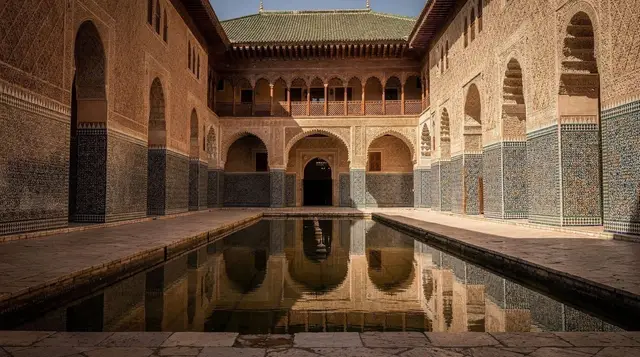
The Saadian Tombs are a small site by area but a dense one by history: a royal necropolis built in the late 16th century for Sultan Ahmad al-Mansur and his Saadian dynasty successors, tucked against the outer wall of the Kasbah mosque. What makes the site remarkable isn’t its size but the quality of what survives inside — carved cedar, gilded stucco, and Italian Carrara marble brought in at considerable expense, all concentrated into two or three small rooms rather than spread thin across a larger complex.
The tombs’ survival is partly accidental. When the Alaouite dynasty took power in the mid-17th century, they reportedly sealed off the mausoleum rather than destroying it outright, walling off access so thoroughly that the site was effectively forgotten for over two centuries. It was only rediscovered in 1917, via an aerial survey commissioned during the French protectorate, and opened to public visits after that.
| Where | Kasbah quarter, against the outer wall of the Kasbah mosque |
| Cost | ~100 MAD (€9), subject to change |
| Time needed | 30–45 minutes, including likely queuing |
| Getting there | 15–20 minute walk from Jemaa el-Fna, or taxi to Bab Agnaou |
| Best time | At or just after opening, before the single access passage backs up |
The Chamber of the Twelve Columns
The site’s centrepiece is the Chamber of the Twelve Columns, the mausoleum’s main hall, where twelve marble columns support a carved and gilded ceiling above the tomb of Ahmad al-Mansur himself. It’s one of the most photographed interiors in Marrakech, and deservedly so — the density of decorative work in a relatively small room is hard to match anywhere else in the city, including Bahia Palace’s larger but more sparsely decorated halls.
A second, smaller chamber holds additional royal tombs, less ornate but still worth the few minutes it takes to see. Outside, a modest garden courtyard contains further graves, including those of household staff and lesser royal family members, laid out more simply among rosebushes and cypress trees. Most visitors spend the bulk of their time in the main chamber and treat the garden as a quick, calmer coda to the visit.
Who’s actually buried here
Ahmad al-Mansur, the sultan who commissioned the mausoleum, was the most powerful ruler of the Saadian dynasty, remembered for a decisive 1578 military victory that secured Morocco’s independence from both Ottoman and Portuguese ambitions in the region, and for the wealth that funded both this tomb and El Badi Palace nearby. He’s buried in the Chamber of the Twelve Columns alongside several of his successors, while the smaller second chamber and the garden hold earlier Saadian rulers, wives, and children — around sixty burials in total across the site, though only a fraction are individually marked with the elaborate stonework reserved for the ruling family itself.
The choice to seal rather than destroy the mausoleum after the Alaouite dynasty took power is often read as a mark of respect uncommon in dynastic transitions of the period, even as the new rulers worked to erase the Saadians from public memory elsewhere in the city. Sultan Moulay Ismail, who systematically dismantled the nearby El Badi Palace for its materials, apparently left the tombs themselves untouched, walling off the only access route instead. That distinction — dismantling one monument while sealing rather than destroying another — is part of what makes the site historically interesting beyond its decoration.
Why the crowds matter more here than elsewhere
Unlike Bahia Palace or El Badi Palace, which spread visitors across multiple open courtyards, the Saadian Tombs funnel everyone through a single narrow alley and a single doorway into the main chamber. This isn’t a design flaw so much as the original structure — it was built to be discreet, not to handle modern tourist volume — but it means the site can feel genuinely overcrowded even on a day with moderate total visitor numbers. Mid-morning during peak season, expect a real queue and a shuffling, elbow-to-elbow pace inside the main chamber itself.
Arriving within the first thirty minutes of opening avoids nearly all of this. A ticket like this Saadian Tombs entry ticket with digital guide app lets you move straight to the site without arranging entry on the spot, which shaves a few minutes off an already tight morning if you’re trying to beat the crowd to more than one site.
Combining with the rest of the Kasbah quarter
The tombs sit within easy walking distance of both Bahia Palace and El Badi Palace, and the standard approach for most visitors is to see all three in one focused morning, starting here while the queue is shortest and finishing at whichever of the two palaces suits your pace. A combined tour such as this Saadian Tombs, Bahia Palace and Kasbah medina tour handles the order and the queuing for you, which is genuinely useful here given how much the tombs specifically reward good timing.
For a longer walk that folds the Kasbah quarter into a wider morning through the souks and Ben Youssef Madrasa, see the self-guided medina walking route, and for a wider look at what else in the medina charges an entry fee, the Marrakech souks guide covers the free half of the neighbourhood immediately to the north.
How the visit unfolds, step by step
Once you find the alley, the visit follows a simple order. You pass the ticket booth, walk the narrow approach, and reach the garden courtyard and the chambers. Most people head straight for the Chamber of the Twelve Columns, and that is the natural first move: if the queue at the doorway is short, take it. If it has already built up, a few minutes in the garden first costs you nothing, and the line often loosens while you wait among the rosebushes and cypress trees.
After the main chamber, step into the smaller second chamber, then finish in the garden at an unhurried pace. Done in this order, the visit builds towards its best room rather than ending on a crush. It also leaves you calm enough to decide what comes next, whether that is another palace or a break for mint tea in the medina (the Moroccan mint tea guide explains what to expect).
Is a ticket, a guide or a tour the better choice?
For a site this compact, a guide is a question of how much context you want, not how much help you need. Independent visitors can read the history in advance and enjoy the rooms on their own terms. If you prefer to have the dynastic story explained as you stand in the chamber, a digital option such as an entry ticket that comes with a souvenir postcard keeps things simple, while a human guide adds names, dates and anecdotes that a plaque cannot.
The wider question of when a guide earns its fee is covered in guided tour vs independent. For the Saadian Tombs the answer leans towards independent if you have read this page, and towards a guide if the Kasbah quarter is new to you and you want the three sites to hang together as one story.
Reading the decoration
It helps to know what you are looking at. The carved cedar, the gilded stucco and the marble are three different crafts, and the chamber is memorable because they appear together. Look up first: the ceiling carries much of the ornament. Then look at the columns and the way they frame the tomb of Ahmad al-Mansur. Finally look at the wall surfaces, where repeated geometric and floral motifs shift slightly from one panel to the next.
If the craftsmanship interests you, the same traditions survive in the city today. The artisan workshops guide shows where carving, plasterwork and metalwork are still practised, and the museums guide lists other places where historic decorative arts are on display. Seeing the tombs first gives you a reference point for everything else.
Building the tombs into a longer day
The tombs fit comfortably into a half-day, and they pair naturally with their neighbours. El Badi Palace shows the other face of Saadian wealth, a ruin where the tombs are an intact interior, and the contrast is the whole point of seeing both. Bahia Palace is a later, more spacious palace that makes a good second stop once the tombs have set the scene.
If you prefer to have the route arranged for you, a guided experience linking the tombs, Bahia Palace and the medina is one way to do it. From there the Jemaa el-Fna guide and the Koutoubia Mosque guide cover the obvious next steps towards the main square, and the Medina district page places all of this on the map. Visitors planning a short stay can see how the tombs slot into a wider plan in the two-day Marrakech itinerary or the first-time visitor guide.
A quick practical note
There’s very little shade around the entrance queue, so a hat is worth carrying even for what should be a short wait. Photography is allowed inside the main chamber, though the crowded conditions during peak hours make tripods or careful staged shots impractical — a quick, considerate photo is more realistic than a long session with a camera.
The entrance itself is easy to walk past if you’re not looking for it — a narrow, unmarked alley off a busier street near the Kasbah mosque, with only a small ticket booth to signal you’ve found the right spot. If you’re arriving independently rather than as part of a tour, it’s worth building a couple of extra minutes into your plan for the search, particularly on a first visit before you’ve learned to spot the entrance from the surrounding shopfronts.
Why this site rewards patience over speed
Unlike the larger palaces nearby, where a rushed half-hour still covers most of what’s on offer, the Saadian Tombs are compact enough that patience matters more than pace. Standing still in the Chamber of the Twelve Columns for even an extra minute, once the initial crush of arriving visitors has moved through, reveals detail in the carved cedar and gilded stucco that’s easy to miss on a first quick pass — individual motifs repeated with small variations, and the way the marble columns catch light differently depending on where you stand. Visitors who treat this as a five-minute photo stop tend to come away underwhelmed; those who budget the full thirty to forty-five minutes generally rate it among the best sites in the city.
That same patience pays off in the smaller second chamber, which most visitors walk through in under a minute simply because it lacks the immediate visual impact of the main hall. Slowing down there reveals a different, quieter style of decoration — less gilding, more restrained carving — worth a proper look precisely because so few visitors give it one.
Respect, dress and behaviour on site
The tombs are a burial place, and the atmosphere should be treated accordingly. Keep your voice low in the chambers, avoid blocking the doorway while you take photos, and step aside once you have your shot so that others waiting behind you can move in. In a space this small, a little courtesy changes the experience for everyone. For guidance on appropriate clothing around historic and religious sites, see what to wear in Marrakech.
Mixing the tombs with other days in the city
Because the visit is short, the tombs work well as one item in a busy morning rather than a full outing. If your trip is tight, the Marrakech in 48 hours article shows how to pace a first stay, and the three versus five days comparison helps you decide how much heritage sightseeing to fit in. Those with more time can slow down and let the Kasbah quarter fill a whole morning, wandering the streets around the tombs after the visit rather than rushing back to the main square.
Whichever pace you choose, the lesson from this site is the same: go early, look slowly, and let the Chamber of the Twelve Columns do the work.
Palace and heritage tours on GetYourGuide
Verified deep-linked GetYourGuide tours. Book through these links and we earn a small commission at no cost to you.
Photo: our own image of the location, not the operator’s product photo.