The Best Time to Visit Marrakech
What is the single best time to visit Marrakech?
March to May and late September to November give the most reliable balance of warm days, cool nights and manageable heat. April and October are the two months locals themselves rate highest.
There’s no single “best” month for Marrakech so much as a best window, and it moves depending on how much heat you can tolerate and whether you’re planning to spend your days walking the medina or driving out to the Atlas and the desert. The short version: spring and autumn are the safe bets, summer rewards early risers who don’t mind serious heat by midday, and winter is genuinely pleasant in daylight but colder after dark than most first-timers expect.
| Best overall | March-May and late September-November |
| Hottest | July-August, regularly above 38-40°C |
| Coolest nights | December-February, 6-8°C after dark |
| Driest | Almost all year; rain concentrated November-March |
| Least crowded | January-February and peak summer |
Spring: the strongest all-round choice
March through May is when Marrakech works with the least compromise. March opens around 23°C by day and 10°C at night, still cool enough for long walks without a midday retreat indoors. By April, daytime highs reach a comfortable 26°C, gardens are at their fullest, and the Atlas peaks visible from rooftop terraces still carry snow. May pushes into the low 30s, which is warm but not yet punishing, though afternoons start to demand shade by the back half of the month.
This stretch also lines up well with a wider trip. An Atlas Mountains and Ourika Valley day tour is at its best in spring, when the valley is green and the waterfalls are running with snowmelt rather than reduced to a trickle. If you’re weighing how many days spring weather can realistically fill, three days or five in Marrakech breaks down what fits into each length of trip.
Summer: manageable if you plan around it
June through August is Marrakech’s hardest test. June climbs to around 35°C, and by July and August highs regularly sit at 38-40°C with spikes well past 45°C during heatwaves. Nights offer real relief at 18-21°C, but the middle of the day in the medina — stone walls, narrow alleys, no breeze — can be genuinely uncomfortable for sightseeing.
None of this makes summer a write-off. It does mean restructuring the day: souks and monuments before 11am or after 5pm, a long indoor or shaded break at midday, and evenings that stay warm enough for rooftop dinners well past sunset. Coastal escapes help too — a day trip to Essaouira trades the city’s heat for an Atlantic breeze that can run 10°C cooler than Marrakech on the same afternoon. Marrakech in summer goes into the specifics of surviving the season well.
Autumn: spring’s quieter twin
September starts hot, often still around 33°C, but cools fast through the month. By October, daytime highs settle around 28°C and nights around 15°C — arguably the single most comfortable combination of the year, and locals frequently name October as their favourite month. November eases further to about 22°C by day, with the first cool evenings signalling winter is close.
Autumn shares spring’s advantage of comfortable temperatures for both city walking and day trips into the Atlas or out to the coast, but with slightly thinner crowds since it falls outside the main European school-holiday windows. An Ouzoud Falls day trip with a boat ride works particularly well in autumn, when water levels are still decent after the summer and the heat has dropped enough to make the drive comfortable.
Winter: pleasant days, cold riad nights
December through February brings Marrakech’s mildest daytime temperatures — 18-19°C in January, dropping only slightly through the coldest stretch — under reliably blue skies. This is genuinely good weather for walking the medina, sitting at outdoor cafés, and touring palaces and gardens without ever feeling rushed by heat.
The catch is after dark. Nights fall to 6-8°C, and a lot of riads, built around open courtyards with thick stone walls, don’t heat well. A room that felt fine at 3pm can be properly cold by 10pm, so pack layers and confirm heating arrangements before booking a riad in January. It’s also the best season to add the desert: a 3-day desert tour from Marrakech to Merzouga avoids the summer’s brutal daytime heat on the drive south, though desert nights themselves drop below 5°C and demand serious warm gear.
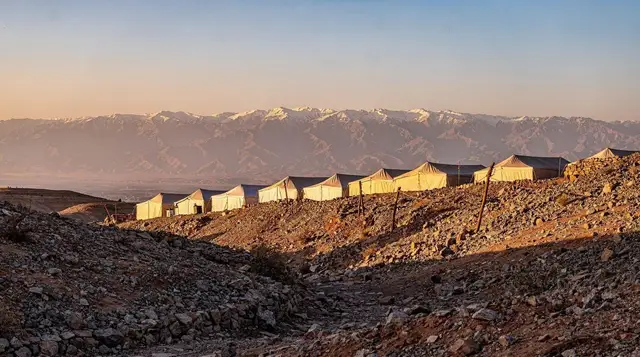
For the shoulder side of a colder trip, an Agafay Desert evening with a camel ride and dinner is closer and shorter than the full Sahara run, useful if you want one desert night without committing several days to it. Marrakech in winter covers what to pack and where the cold actually bites hardest.
How prices and crowds move with the seasons
Riad and hotel prices in Marrakech track the weather fairly closely. Spring and autumn, being the most requested seasons, also carry the highest average rates, particularly around Easter and the European autumn half-term. Summer sees prices soften noticeably from mid-June, since the heat puts off a meaningful share of leisure travellers even as flight capacity stays high. Winter is genuinely the best value stretch outside of the Christmas and New Year fortnight, which spikes independently of the weather and should be budgeted for separately if your dates fall in that window.
Crowd levels follow a similar but not identical pattern. The souks and main squares feel busiest in April and October, when comfortable weather draws the largest volume of visitors at once. January, February and the core of summer are noticeably quieter — an underrated reason to consider either end of the calendar if you’d rather not share Jemaa el-Fna’s evening crowd with quite so many other visitors.
Matching the season to what you want to do
A first visit built around the medina, the palaces and the souks is comfortable in any season except the peak of summer, since most of that time is spent walking rather than driving long distances. A trip weighted toward the Atlas Mountains or the Sahara benefits most from spring or autumn, when both the city and the road south sit in a comfortable temperature band. And a trip planned specifically around Ramadan needs its own separate check, since the dates shift by about eleven days every year — see visiting Marrakech during Ramadan for how that affects opening hours and daily rhythm regardless of which season it falls in.
Photographers chasing soft, golden light on the medina’s terracotta walls tend to prefer the low winter sun, which sits at a flatter angle for longer through the day than summer’s harsh overhead glare. Families with young children generally do best in spring or autumn, when neither the midday heat nor the cold evenings force too much compromise around nap times and outdoor play.
Hikers heading into the High Atlas should lean toward April-June or September-November, avoiding both summer’s heat on exposed trails and winter’s icy upper sections. And honeymooners chasing a genuinely romantic desert night under clear skies will find spring and autumn strike the best balance between comfortable daytime temperatures and cold-but-bearable desert evenings, without winter’s near-freezing overnight lows.
Trip length matters alongside season, too. A short 3-4 day visit can absorb almost any season reasonably well, since it’s built mostly around the city itself. A longer trip that leans on multiple day trips or a Sahara excursion benefits far more from landing in a comfortable weather window, since more of the itinerary depends on being outdoors or on the road for extended stretches. Three days or five in Marrakech is worth reading alongside this guide if you’re still deciding how long to stay before locking in your season.
Building a first itinerary around your season
Once the month is chosen, the shape of the trip follows. In the cooler months, a compact city stay works well: the two-day Marrakech itinerary packs the essentials into a short window, while the three-day plan leaves room for a slower pace and a garden or museum afternoon. In the hotter months, the same itineraries still work, but you will want to swap the order of stops so that the open-air ones fall in the early morning and the indoor ones take the middle of the day.
If this is your first time in the city, the first-time guide to Marrakech pairs naturally with this page, because the season you pick changes what is realistic on day one. Arriving in summer, for instance, usually means saving the big walking route for the next morning rather than attempting it straight after landing.
Which sights suit which season
Not every sight reacts to the weather in the same way. Open-air places with little shade, such as the great ruined palace, are far more pleasant in the cooler parts of the year, and the El Badi Palace guide explains why an early start helps whatever the month. Gardens behave differently: the Majorelle Garden guide is a good reference for a place that rewards a slow visit in spring and autumn, when the planting is at its most comfortable to stroll through, and that you can still enjoy in summer if you arrive at opening time.
Indoor and covered attractions are the opposite case. Museums, madrasas and hammams come into their own when the weather is at either extreme. A hammam in winter is a welcome way to warm up after a chilly evening, and in summer it offers a calm, cool pause in the middle of the day. The Marrakech hammam guide covers how to choose one, and the museums guide lists the places that make a sensible indoor fallback when the sun is at its strongest.
The souks sit somewhere in between. Their covered lanes give partial shade, which makes them more bearable than open squares in hot weather, but the crowds and the lack of airflow can still be tiring. The souks guide is worth reading before you commit your most energetic hours to shopping.
Eating and drinking through the year
The food side of a trip changes with the seasons as well. In cooler weather, slow-cooked tagines and warming soups feel exactly right, and a pot of sweet mint tea on a sunny terrace is one of the simplest pleasures of a winter visit. In hot weather, appetites shift towards lighter dishes, fresh juices and long evening meals once the temperature has dropped. The Marrakech food guide gives a broader sense of what to look for, whichever month you choose.
Evening life depends heavily on the season too. When nights are mild, the main square fills with stalls and people, and eating outdoors is part of the experience. When nights are cold, you will probably prefer a table indoors or a rooftop with heaters and blankets. Either way, it helps to decide in advance whether your evenings are meant to be outdoors, because that single choice can influence which season feels right to you.
Practical packing and booking advice
Whatever the month, the same few habits make a trip easier. Carry water, wear a hat and sunscreen in the warmer seasons, and keep a light jacket within reach in the cooler ones, since the gap between a sunny afternoon and a shaded alley or a night on a rooftop can be larger than expected. Comfortable, closed shoes make a difference on uneven medina paving in every season. For clothing that respects local norms while staying cool, the what to wear in Marrakech guide is a practical companion.
On the booking side, the busiest windows reward early planning. Riads with only a handful of rooms fill quickly when the weather is at its best, so reserving ahead gives you more choice. If you would rather stay somewhere with reliable climate control, the riad versus hotel comparison helps weigh up charm against comfort, which matters most in the hottest and coldest months.
Finally, remember that a forecast is never a promise. Even in the most reliable seasons, a cooler or warmer spell can arrive, so keep a little flexibility in your plan. Leaving one slot in each day open lets you move a trip to the Atlas or the coast to the best-looking day rather than the one you first pencilled in, and it keeps the whole visit relaxed instead of rushed. If you are curious about how a visit feels in practice rather than on paper, the Marrakech 48 hours blog post offers a short, personal impression of a quick stay.
Whichever season you land in, Marrakech weather month by month has the full breakdown of temperatures and rainfall if you want more detail than the seasonal overview here, and the Marrakech destination guide is a good next stop for what the city itself offers once the dates are settled.
Seasonal experiences on GetYourGuide
Verified deep-linked GetYourGuide tours. Book through these links and we earn a small commission at no cost to you.
Photo: our own image of the location, not the operator’s product photo.