Le Jardin Secret Guide
Where is Le Jardin Secret and how much does it cost?
It's inside the medina on rue Mouassine, a few minutes' walk from Jemaa el-Fna. Entry to the gardens is around 100 MAD (about €9); climbing the panoramic tower costs extra on top of the garden ticket.
Le Jardin Secret sits a few minutes’ walk from Jemaa el-Fna on rue Mouassine, and it solves a problem Majorelle Garden doesn’t: it’s actually inside the medina, so it fits into a souk-walking morning without a taxi ride out to Gueliz. The riad the garden occupies dates back to the Saadian era, was rebuilt several times over the centuries by successive owners, and sat closed and deteriorating for decades before a British-led restoration opened it to the public in 2016. Entry runs around 100 MAD (roughly €9), noticeably cheaper than Majorelle, and a separate ticket lets you climb the panoramic tower for one of the medina’s better rooftop views.
The garden is split into two distinct spaces with genuinely different design languages, which is part of what makes it worth the ticket beyond simple prettiness: an Islamic garden following the traditional four-quadrant chahar bagh layout, and an “exotic” garden with a looser, more naturalistic planting style drawing on species from around the world. Both are compact enough to see properly in under an hour, and the contrast between the two sections, walked back to back, does more to explain the difference between formal Islamic garden design and the looser exotic planting popularised by figures like Jacques Majorelle than either garden could show on its own.
| Where | Rue Mouassine, medina, a 5-minute walk from Jemaa el-Fna |
| Cost | ~100 MAD (€9) for the gardens; the panoramic tower is an additional ticket |
| Time needed | 45–60 minutes, more with the tower |
| Getting there | Walkable from most medina riads |
| Best time | Mid-morning, before the heat builds in the exposed Islamic garden section |
The two gardens and what to expect
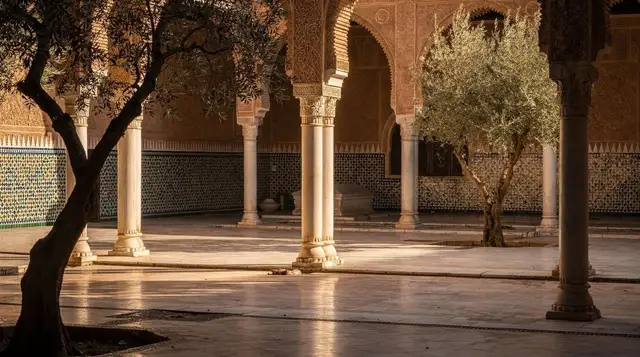
The Islamic garden follows the classic riad layout — four quarters divided by water channels, symbolising the four rivers of paradise in Islamic garden tradition, planted with citrus trees and roses around a central fountain. It’s formal, symmetrical, and shaded less than you’d expect, so it’s worth timing your visit for morning rather than midday in summer. The exotic garden, by contrast, is a looser collection of palms, succulents and plants gathered from five continents, closer in spirit to Majorelle’s cactus terraces but on a smaller scale and without the crowds.
Interpretation panels throughout explain the traditional irrigation system that fed the original riad — a khettara network drawing water from underground channels, restored as part of the 2016 renovation and still functioning. It’s a level of horticultural and engineering detail that most medina attractions don’t bother with, and it’s worth reading rather than walking past. A small exhibition space near the entrance covers the restoration project itself with before-and-after photographs, which is a useful reminder of how derelict the site was before the work began.
The panoramic tower
The tower climb, ticketed separately from garden entry, takes you up a narrow, steep staircase to a rooftop platform with an open view across the medina’s flat roofline toward the Koutoubia minaret and, on clear days, the Atlas Mountains beyond. It’s one of the few rooftop viewpoints in the medina that doesn’t require booking a restaurant table or buying a drink to access, which makes it good value for photographers specifically. The stairs are tight and unshaded at the top, so it’s not ideal for anyone with mobility concerns or a strong aversion to heat exposure at midday.
A guided visit combining the garden with nearby sites, such as this Ben Youssef Medersa, Le Jardin Secret and souk tour, packages the garden together with the neighbouring madrasa and a walk through the surrounding souks, which suits visitors who’d rather not navigate the ticket queues and route-planning independently. For a private version of the same idea, this private Jardin Secret and Marrakech highlights tour covers similar ground at your own pace with a dedicated guide, which is worth the extra cost for anyone travelling with young children or a limited walking tolerance.
A café stop worth knowing about
A small café sits at the edge of the exotic garden, serving tea, coffee and light snacks with a view over the planting — a reasonable stop if you’d rather sit for twenty minutes than move straight on to the next souk. It’s not a full restaurant and the menu is limited, but the setting is quieter than almost anywhere comparable in the immediate area around Jemaa el-Fna, and it’s a sensible place to plan the rest of a medina afternoon over a mint tea rather than standing in a crowded souk lane working it out.
The restoration story, briefly
The riad’s history stretches back to the Saadian dynasty in the 16th century, when the plot was likely part of a larger palace complex, though the building seen today largely reflects 19th-century reconstruction after earlier structures fell into disrepair. Ownership passed through a series of prominent Marrakech families over the following century, and by the late 20th century the property had been abandoned entirely, its irrigation channels dry and its planting overgrown or gone.
The restoration that opened the site to the public in 2016 took several years and involved specialists in both historic building conservation and traditional garden hydrology, rebuilding the khettara water system essentially from scratch using archival plans and comparable surviving examples elsewhere in the medina.
That level of restoration effort is part of why the entry ticket, modest as it is, feels reasonably justified compared to simply wandering a public park — the site functions as a working example of how a traditional riad garden was engineered centuries before modern irrigation, not just a pleasant space to walk through. Guides on the combined tours are generally well versed in this history and willing to explain the irrigation system’s mechanics in more depth than the on-site panels cover, which is worth asking about if the engineering side interests you as much as the planting.
When to visit relative to other medina sights
Le Jardin Secret works well as either an opening or closing stop on a medina walking morning, given its central location near Jemaa el-Fna. Visiting early, close to opening, gives the Islamic garden’s exposed courtyard the best light and the fewest other visitors, then leaves the rest of the morning free for the souks or nearby monuments once the heat builds. Visiting later in the day, after the souks, offers a quieter, calmer close to a walking-heavy morning, with the garden’s greenery a deliberate contrast to the density of the surrounding lanes. Either approach works; the choice mostly comes down to whether you want a calm start or a calm finish to the rest of your day.
Weekday mornings are generally quieter than weekends, when the garden sees more visitors from both international tourism and, increasingly, Moroccan visitors from Marrakech and beyond treating it as a local outing rather than purely a tourist attraction. That mix of visitors is itself worth noting — unlike some ticketed sites that skew almost entirely toward foreign tourists, Le Jardin Secret draws a genuinely mixed crowd, which adds to the atmosphere rather than detracting from it.
Photographing the gardens
The garden is a gift for anyone with a camera, mostly because the two sections give you such different material in such a small footprint. The Islamic garden rewards symmetry: stand at the edge of the central fountain and the four quarters, the water channels and the surrounding walls line up into a composition that almost frames itself. The exotic garden is the opposite, all layered texture, with palms, succulents and spiky leaves overlapping at different heights. Early light flatters both, and it is also when you are least likely to have strangers walking through every frame. For broader advice on shooting the old town, the Marrakech photography guide covers the habits that work in the medina’s tight lanes.
The tower is the other photographic prize. Looking out over the rooftops toward the minaret of the Koutoubia Mosque gives you a view of the medina that is very hard to get from street level, and it helps you understand how the old city is laid out. Wait your turn on the platform rather than crowding the edge, and be patient: the space at the top is small, and people tend to rotate through steadily.
How it compares with the city’s other gardens
Marrakech has several gardens that visitors tend to lump together, and it helps to separate them by what each one does best. Majorelle Garden is the famous one, a botanical collection with a strong colour identity, and it sits outside the old town in Gueliz. The Menara Gardens are a wide, open space with an olive grove and a large pool, more about breathing room than about detail. The Anima Garden is an artist-designed space outside the city centre with a very different, playful character.
Le Jardin Secret is the one that tells you the most about how people actually lived in the medina. It is a riad garden, built to be a private world behind a plain wall, and that is the real reason to see it. If you only have time for one garden inside the old city walls, this is the obvious pick; if you have a second slot, Majorelle makes a good contrast because the two gardens answer different questions. For the gardens’ wider context, the medina destination page explains how the old city fits together.
Building it into a wider day
Because the garden is compact, it works best as one part of a larger plan rather than the whole plan. A sensible medina morning might start at the garden, move on to the carved cedar and stucco of the Ben Youssef Madrasa, and drift through the souks afterwards. If you would like a ready-made version of that sequence, a guided route linking the garden with a palace and the madrasa keeps several of the old city’s headline sights in a single outing, which is handy if you only have a short stay.
Those on a short trip can slot the garden into a first or second day using the two-day itinerary or the three-day itinerary, and first-timers will find the first-time visitor guide helpful for deciding what to prioritise. The Bahia Palace is another natural neighbour for a day built around courtyards, tilework and quiet corners, and the Jemaa el-Fna guide covers the square that most medina walks begin or end at.
Guided or independent?
The garden is easy to visit on your own: it is a single enclosed site with clear signage, and the panels explain most of what you see. The case for a guide is stronger when the visit is part of a longer walk through the surrounding lanes, where the route itself is the harder part. Navigation in the medina can be confusing for newcomers, and a guide removes the stress of working out which turn leads where, while also adding the stories behind the buildings. If you are weighing the two approaches, the guided tour versus independent comparison lays out the trade-offs.
A reasonable middle path is to visit the garden independently and book a guide for the surrounding souk lanes, or the other way round. The garden is where unhurried reading pays off, so it suits independent visiting; the lanes are where local knowledge pays off, so that is where a guide earns their fee. Either way, bring a little patience for the souks, and keep the haggling guide in mind if the walk turns into a shopping detour.
Choosing the right season
Marrakech heats up considerably in summer, and the exposed courtyard of the Islamic garden is the part of the visit that feels it most. In the cooler months the garden is at its most comfortable and the light is gentle, which makes it a very pleasant place to linger. The best time to visit Marrakech guide explains how the seasons shape a trip, and the summer guide has practical advice if your dates fall in the hot months. In hot weather, the sensible plan is to arrive early, do the garden and the tower first, and keep the rest of the day for shaded or indoor sights.
Planning your pause
The café at the edge of the exotic garden is a good place to slow down, and a glass of tea is the natural order. If you would like to understand more about what you are being served and how it is traditionally poured, the Moroccan mint tea guide is worth a read before you go. Treat the visit as a pause in a busy medina day rather than another box to tick, and you will come away with a much better sense of why the garden is worth the modest ticket.
Nearby in the medina
Le Jardin Secret sits within easy walking distance of several other medina sights, which is its real advantage over Majorelle’s Gueliz location. The souks spread out in every direction from Mouassine, and Ben Youssef Madrasa sits a short walk north. For the wider Mouassine district and what fills out a morning there, see the Mouassine and the northern souks destination guide.
If you’re following a structured route through the old town, the self-guided medina walking route passes close to rue Mouassine and can be adjusted to include the garden without much of a detour. For a comparison with the city’s other paid gardens, see the Majorelle Garden guide and Menara Gardens guide.
Garden and photography tours on GetYourGuide
Verified deep-linked GetYourGuide tours. Book through these links and we earn a small commission at no cost to you.
Photo: our own image of the location, not the operator’s product photo.