Ait Ben Haddou Guide
Is Ait Ben Haddou worth the drive from Marrakech?
Yes, if you have a full day to give it or you're already heading toward Ouarzazate or the desert. The ksar itself is genuinely striking and free to walk through, but the round trip alone takes most of a day, so it's a poor fit for a short stay unless it's combined with a longer route south.
Ait Ben Haddou is a fortified ksar — a cluster of earthen kasbahs enclosed by defensive walls — built up over centuries along what was once a caravan route between the Sahara and Marrakech. It’s UNESCO-listed for exactly that reason: it’s one of the best-preserved examples of southern Moroccan earthen architecture, with tightly packed towers, decorated facades and narrow passages climbing up from the river to a ruined agadir, or communal granary, at the top of the hill. It’s also become one of the most recognisable film locations in Morocco, used as a backdrop for numerous international film and television productions drawn to its dramatic silhouette and dry, cinematic light.
None of that makes it a quick stop. The drive alone is a serious undertaking, and understanding what you’re signing up for — time, cost, and what the site actually offers once you arrive — matters more here than at anywhere else covered in this guide series.
| Where | On the Ouarzazate road, about 30 minutes before Ouarzazate itself |
| Cost | Free to enter the ksar; small optional contributions at some houses and workshops inside |
| Time needed | 3.5 hours’ drive each way; 2-3 hours at the site itself |
| Getting there | Guided tour, shared minibus, grand taxi, or self-drive over the Tizi n’Tichka pass |
| Best time | Morning for the light on the facades; avoid midday heat in summer |
The drive: the Tizi n’Tichka pass
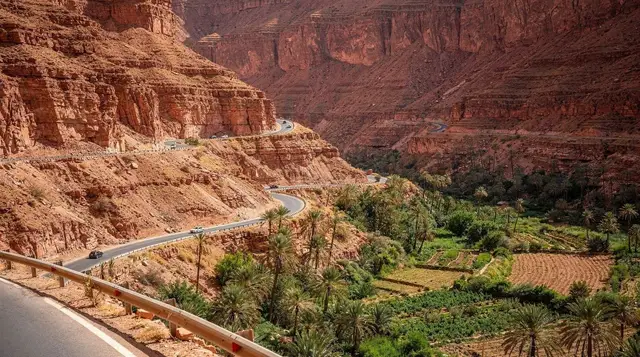
Getting to Ait Ben Haddou means crossing the High Atlas via the Tizi n’Tichka, Morocco’s highest major mountain pass, on a well-maintained but genuinely winding road that climbs past Berber villages, walnut groves and increasingly bare rock as the elevation rises. The pass itself is a destination in its own right for a lot of visitors — switchback after switchback with viewpoints pulling over for photos, and roadside stalls selling geodes and minerals at the top. Budget close to 3 hours 30 minutes for the drive from Marrakech, more if you stop often, and expect it to be slower in winter when snow occasionally closes sections near the summit.
Self-driving is possible but not the easiest introduction to Moroccan roads — the switchbacks demand full attention and there’s limited room to overtake slower trucks. Most visitors take a shared or private tour, which removes the driving stress and usually includes a stop at Telouet’s kasbah on the way, an atmospheric detour that’s easy to skip if you’re pressed for time but rewarding if you have it.
What you actually see inside the ksar
Crossing to the ksar itself involves a footbridge or, when the river’s high, a short walk across stepping stones — genuinely part of the experience, not just a logistics note. Once inside, narrow stone and mud-brick passages climb steeply between the kasbahs, past small shops selling paintings, sand art and jewellery, many run by the handful of families who still live within the walls. The climb to the top, where the ruined communal granary sits, is the payoff: a wide view over the valley, the river, and the newer village across it where most of the population relocated decades ago.
Some individual houses along the way, along with the odd viewpoint or terrace, ask for a small contribution to enter or to take photos from a rooftop — reasonable, given that it goes directly to the families maintaining these buildings, and worth having some small change ready for. The ksar’s main paths and the walk up to the granary itself cost nothing.
Independent local guides tend to gather near the footbridge and offer walking tours through the ksar for a negotiated fee, usually a few hundred MAD for a small group. Hiring one isn’t required, but it’s genuinely useful here: there’s almost no signage inside, and a guide can point out which sections are original earthen construction, which have been rebuilt or reinforced for stability, and which corners have hosted film crews over the years. Agree a price before setting off rather than after the tour, the same rule that applies everywhere in Morocco.
Facilities inside the walls are basic. A handful of small cafés and shops cluster near the entrance and partway up the climb, selling drinks, snacks and the usual sand paintings and jewellery, but there’s little in the way of formal toilets once you’re past the lower stretch, and mobile signal drops out in patches deeper inside. Carry water and sun protection regardless of the season — most of the upper paths have no shade, and the climb to the granary is steeper than it looks from the road.
Reading the ksar as you climb
It helps to treat the walk as a slow lesson in how people built in this region. The walls, towers and facades are made from the same earth as the hillside, which is why the whole place seems to grow out of the ground rather than sit on it. Look for the geometric patterns pressed into the upper parts of the towers: they are decoration, but they also tell you which buildings once belonged to families of standing. Notice, too, how the passages narrow and twist. They were laid out for defence and for shade, and in the heat of the day the difference between a lane in shadow and an open terrace is easy to feel.
Earthen architecture needs constant care, and you will see that for yourself. Patches of fresh render sit next to older, weathered surfaces, and some walls are propped or reinforced. None of this spoils the visit; it is the reason the ksar is still standing, and it gives you a sense of the effort that goes into keeping a place like this alive. If you are interested in the craft side of southern Morocco, the Marrakech artisan workshops guide is a good companion for what you will see in the shops on the way up.
Planning your time on site
Most people underestimate how much the visit depends on pacing. Arriving after a long drive, it is tempting to rush straight to the top, take a few photos and head back. A better rhythm is to cross the river, wander the lower lanes first, and save the climb for when you have found your legs. Pause at the terraces on the way up, since the view changes noticeably as you gain height, and the colour of the earth shifts with the light.
- Footwear: the paths are uneven, stony and in places loose underfoot, so sturdy shoes make a real difference.
- Light: the facades look their warmest in the morning, and the contrast softens as the sun climbs, which matters if photography is a priority. The Marrakech photography guide has more on working with this kind of light.
- Bags: carry only what you need, since the lanes are tight and the climb is easier with free hands.
- Respect: families live and work here, so ask before photographing people or the inside of a home.
If you are travelling with children, the climb is manageable for most but exposed, so build in breaks and water. The Marrakech with kids guide covers how to pace a long excursion for a family.
Film history, without overselling it
Ait Ben Haddou’s dramatic setting has made it a recurring choice for film and television productions needing a stand-in for the ancient Middle East or a fantastical desert kingdom, and the nearby Atlas Studios in Ouarzazate has hosted large-scale productions for decades. Guides on site are often happy to point out specific corners used in various shoots, though claims about exactly which production filmed exactly where should be taken as local colour rather than verified fact — the broad picture (used repeatedly as a backdrop for international film and television) is solid; the specifics vary by who’s telling the story.
Some of the buildings closest to the entrance have been reinforced or partially rebuilt over the decades specifically to keep them standing for film crews and visitors alike, which is worth knowing if you’re expecting an entirely untouched ruin. Local families and the national heritage authorities have both been involved in that upkeep, and it’s part of why the site still looks as complete as it does compared with some of the smaller, less-visited kasbahs scattered along the same valley.
Day trip versus a stop on a longer route
The core decision for most visitors is whether to treat Ait Ben Haddou as a there-and-back day trip from Marrakech or as a waypoint on a longer journey south. As a pure day trip, a private day trip to Ait Ben Haddou and Ouarzazate is the most comfortable format — your own vehicle and pace, without matching a group’s schedule, though it’s still a long day behind the windscreen. A tighter, more focused option, a two-hour guided tour of the kasbah itself, works well if you’re already staying in or near Ouarzazate and just need the on-site portion covered.
For travellers heading toward the Sahara anyway, Ait Ben Haddou sits naturally on the route, and a combined Ait Ben Haddou and Telouet kasbahs day trip adds the lesser-visited Telouet kasbah, once the seat of the Glaoui family, without significantly extending the day. Riding out to see some of the horses used in local film productions is a popular add-on for anyone wanting a slower, different angle on the surrounding valley than the standard walking visit, and a few operators near the entrance offer short rides on request.
Combining it with Ouarzazate and beyond
Ouarzazate itself, thirty minutes further on, adds the Atlas Studios and the Taourirt Kasbah to the same day, and a premium day trip covering Ait Ben Haddou and the Atlas Studios is a sensible way to see both without a second long drive on a separate day. For visitors mapping out where this fits among Marrakech’s other excursions, the best day trips from Marrakech guide compares it against closer, shorter alternatives if a full day isn’t realistic for this trip.
If you’re continuing beyond Ait Ben Haddou toward Ouarzazate and further south, treat this as the first stage of a multi-day route rather than a there-and-back excursion — the same road continues on toward Skoura, the Dades Valley and eventually the desert, and backtracking the full Tizi n’Tichka twice in one day is a genuinely tiring way to see a small slice of what the route offers. For the Ait Ben Haddou destination itself, including accommodation options for an overnight stop, see the dedicated destination page.
Choosing between a tour and going independently
The question most readers ask is whether a guided option is worth it. For a site with almost no signage, a long mountain road and several possible stops, a tour earns its place for many people, mostly because it removes decisions. You do not have to plan the stops on the pass, think about parking, or work out where the day’s timings can flex. The trade-off is that a group sets the pace, so you may have less time in the ksar than you would like. The guided tour versus independent travel guide weighs this up in more general terms, and the driving in Morocco guide is worth reading before you decide to take the wheel yourself.
If you would rather not drive but still want flexibility, a private vehicle with a driver gives you the most control over the day. It lets you linger on the pass, stop at a village that catches your eye, or cut the afternoon short if the heat gets to you. For wider options on public transport south, see the Morocco trains and buses guide.
Making it part of a bigger route
Ait Ben Haddou works best as one chapter in a longer trip. Two broad shapes are worth considering. The first is a loop through the south that continues past Ouarzazate and returns by a different leg, which suits travellers who want to see the valleys and oases and not only the ksar. The Marrakech southern circuit itinerary sets out that kind of route in full. The second is a shorter trip that ends in the dunes, for which the Marrakech Sahara itinerary is the natural reference.
If you are still deciding how much time you can spare for the Atlas side of a trip, the two-day Atlas itinerary offers a gentler alternative to a long push south, and the Tizi n’Tichka pass page covers the mountain crossing that links everything together. Travellers who want to see how the desert stop fits in afterwards can read about Sahara desert camps before booking.
What to take away
Whatever format you choose, go in with realistic expectations. This is a place to be absorbed slowly, not ticked off. The best memories tend to come from the unplanned moments: a conversation in a doorway, a view that opens at the turn of a lane, tea on a terrace once the climb is done. Give the visit room to breathe and it will repay the long road that brought you here.
Palace and heritage tours on GetYourGuide
Verified deep-linked GetYourGuide tours. Book through these links and we earn a small commission at no cost to you.
Photo: our own image of the location, not the operator’s product photo.