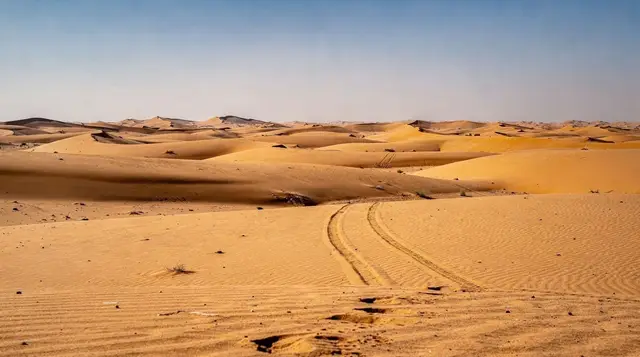
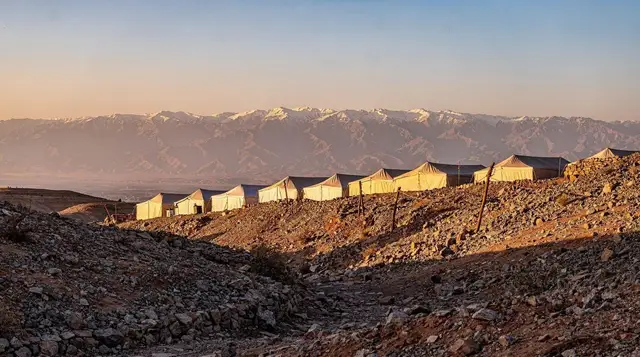
Almost everyone who sees the Draa Valley sees it from a moving vehicle, on the road between Ouarzazate and Zagora. That’s not a criticism — the drive itself is the point for most travellers, a roughly 200 km ribbon of date palms following the Draa river through a landscape that’s otherwise dry rock and gravel. The contrast is what makes it memorable: green fronds against bare mountains, earthen kasbah walls the same colour as the ground they’re built from.
The valley runs from Agdz in the north to Zagora in the south, and the road threads directly through it, so nobody doing the classic Marrakech-to-Zagora or Marrakech-to-Merzouga route misses it entirely. The question isn’t whether you’ll see the Draa Valley, but whether you’ll actually stop in it, and that’s worth doing at least once if you have any flexibility in your schedule.
Two stops reward getting out of the vehicle: Tamnougalt, a partially restored kasbah village near Agdz with some of the best-preserved earthen architecture in the region, and Tamegroute, a small town near Zagora known for green-glazed pottery made with local clay and cobalt-manganese glaze, sold from workshops you can walk straight into.
| Where | Between Agdz and Zagora, roughly 300-360 km south of Marrakech |
| Cost | Free to drive through; kasbah entry from around 20-30 MAD (2-3 €); pottery workshop visits are free, purchases optional |
| Time needed | Half a day for a proper stop at Tamnougalt and Tamegroute; the drive-through takes as long as the road itself |
| Getting there | En route on any Zagora, Erg Chigaga or Merzouga (via Zagora) tour, or as a dedicated day trip from Ouarzazate |
| Best time | October to April for comfortable walking; spring for the most vivid green in the palm groves |
Kasbahs of packed earth
The Draa Valley’s kasbahs are built the same way most pre-modern architecture in southern Morocco was: rammed earth, or pisé, mixed with straw and shaped into thick defensive walls that keep interiors cool through brutal summer heat. Unlike Ait Ben Haddou further north, which has been restored, filmed in, and turned into a well-organised heritage site, most Draa Valley kasbahs remain lived-in, half-crumbling, and largely unvisited by tour groups.
Tamnougalt is the exception that gets organised visits, with a guided walk through its old granary, decorated reception rooms, and defensive towers. It gives a genuine sense of how these fortified villages worked, without the crowds or gift-shop atmosphere that’s crept into some of the more famous kasbahs on the wider southern circuit.
Day trip from Ouarzazate to the Draa Valley and Tinfou dunes covers this stretch properly if you’re based in Ouarzazate rather than passing through on a longer desert tour, taking in the kasbahs and a small dune field near Tinfou that gives a taste of Sahara scenery without the long drive to Merzouga.
Tamegroute’s green pottery
Tamegroute sits near the southern end of the valley, close to Zagora, and is known throughout Morocco for a distinctive green pottery glaze made with local minerals — the colour ranges from olive to a deep bottle green depending on the firing. Workshops here still use wood-fired kilns and techniques passed down through generations of the same families, and most are happy to let visitors watch the process, not just buy the finished pieces.
Prices are genuinely lower here than in Marrakech’s souks, since you’re buying close to the source, though bargaining still applies. It’s worth budgeting some suitcase space if pottery interests you at all, since the pieces are heavy and better carried out than shipped from a Marrakech shop that may or may not be selling the genuine article.
3-day Draa Valley tour with Tamegroute pottery is aimed specifically at travellers who want proper time at the workshops rather than a fifteen-minute stop wedged between a kasbah and a dune camp — worth choosing over a generic Zagora tour if pottery and craft are a real interest, not an afterthought.
Combining with Zagora
Because the road to Zagora runs directly through the valley, most operators bundle a Draa Valley stop into their Zagora tours rather than selling it separately. Zagora and Draa Valley day tour from Ouarzazate is a useful option for travellers based in Ouarzazate who want to see both the palm groves and Zagora’s dunes without continuing on to Merzouga or Erg Chigaga.
If you’re coming from Marrakech on a standard desert circuit, ask your operator explicitly whether a kasbah or pottery stop is included, or whether the Draa Valley is simply scenery glimpsed through the window. The difference in itinerary quality is significant, and it usually costs little extra to choose a tour that stops properly.
The palm groves themselves
The Draa Valley’s palm groves aren’t wild — they’re a working agricultural system that’s sustained villages here for centuries, irrigated by a network of channels that draw from the Draa river and its underground water table. Date palms form the top layer, with pomegranate, fig and almond trees beneath them, and vegetable plots at ground level making use of every bit of shade and water the system provides. It’s one of the oldest continuously farmed landscapes in Morocco, and the contrast between this dense, layered greenery and the bare rock hills on either side is genuinely striking, especially from any of the small viewpoints along the road where the whole valley opens up below.
The river itself is seasonal and unreliable further south — droughts in recent decades have reduced flow significantly, and older residents in villages along the valley will tell you, if you ask through a guide, how much the palmery has changed within their own lifetimes. It’s a useful, sobering counterpoint to the postcard views, and worth a question if your guide seems knowledgeable about the area beyond the standard script.
Spring, roughly March to May, brings the most vivid green to the groves, before the summer heat takes its toll on the exposed sections of road between villages. Autumn is a close second, with harvest activity visible in some of the smaller settlements as dates are gathered and laid out to dry.
Where the valley fits in a longer route
The Draa Valley is rarely the reason for a trip, but it often decides whether a desert journey feels like a series of long transfers or a connected landscape. Travellers heading south from the city usually cross the High Atlas by way of Tizi n’Tichka, pass the earthen fortress of Ait Ben Haddou, stop in Ouarzazate, and only then drop into the palmery. Seen in that order, the valley is the moment the scenery changes from mountain to oasis, and it prepares the eye for the open dunes that follow.
If you are still choosing between desert bases, the Merzouga versus Zagora comparison explains how the valley road works as a built-in argument for Zagora: you pass through the palm groves on the way in, rather than skipping them. The long haul to the far dunes is covered in the Marrakech to Merzouga guide, and a ready-made schedule that threads the valley into a wider loop appears in the seven-day southern circuit. Shorter on time? The three-day Sahara itinerary keeps the pace tighter, which means the valley becomes a window view unless you ask for a stop in advance.
For those who prefer to leave the planning to someone else, a two-day Sahara tour to Zagora with desert and kasbah stops is one way to cover the valley without driving yourself, while a three-day Zagora desert and kasbahs tour gives the palm groves a more relaxed share of the schedule. Whichever you choose, check what the stops actually are before paying.
Pacing a stop in the valley
A good visit here is slow by design. Arrive with no fixed target beyond the kasbah and the pottery workshops, and let the rest happen: a walk along an irrigation channel, a few minutes watching someone tend a vegetable plot beneath the palms, a glass of tea if you are offered one. The valley is a lived-in place, not a museum, and the moments people remember are usually unplanned.
Light matters more than most visitors expect. Earthen walls change colour through the day, turning from flat beige at noon to deep ochre as the sun lowers, and the palm groves look their best when the angle is low. If photography is a priority, ask your driver to time the kasbah stop for the softer hours rather than the middle of the day, and read the Marrakech photography guide for general advice on shooting in strong southern light.
Respect is simple here. Ask before photographing people, keep to the paths between fields rather than cutting across planted ground, and treat a guide or a family offering hospitality as a host rather than a service. The honest piece on Moroccan hospitality sets out what to expect and how to respond graciously, and it applies as much in a palm grove as in a city riad.
Getting the best from a driver or guide
Many Draa Valley visits are decided in the first five minutes of a conversation with the driver. Say plainly that you want to get out of the vehicle at a kasbah and at a pottery workshop, and ask what the plan is for lunch and for the heat of the day. A driver who knows the road will usually welcome the interest, and a guide who can explain how the irrigation works or why the walls are built so thick adds far more than a quick photo stop could.
If you are weighing a guided option against going alone, the guided tour versus independent travel guide lays out the trade-offs, and anyone hiring a car should read the driving in Morocco guide first, since the southern roads reward patience and a daytime schedule. For packing for the longer desert leg that usually follows, the desert tour packing guide is a practical checklist.
What to bring
Sun protection matters here as much as anywhere further into the desert — the valley floor offers little shade outside the palm groves themselves, and midday stops at kasbahs involve walking across exposed stone and packed earth. A scarf or hat is worth having, along with cash in small denominations for pottery purchases and kasbah entry fees, since card payment is rarely available this far from Marrakech.
Comfortable, closed shoes matter more at Tamnougalt than the short visit might suggest — the kasbah’s interior stairs and passages are uneven, worn smooth by generations of use, and poorly lit in places. At Tamegroute, be prepared for a genuine sales pitch once you’re inside a workshop; it’s part of the culture of buying direct from the source, and a polite decline is entirely acceptable if nothing catches your eye after a proper look.
For more on the pottery tradition itself, see the Moroccan pottery guide. If kasbah architecture is the draw, Ait Ben Haddou and its dedicated guide cover the region’s most famous example. The Draa Valley sits directly between Zagora and the wilder dunes of Erg Chigaga, and anyone planning village visits more broadly should read visiting a Berber village honestly before booking. If the desert camp is the real goal, the Sahara desert camp guide and the Sahara tour booking guide help you choose well, and nearby valleys such as Skoura and Tinghir make natural companions on a longer southern loop.