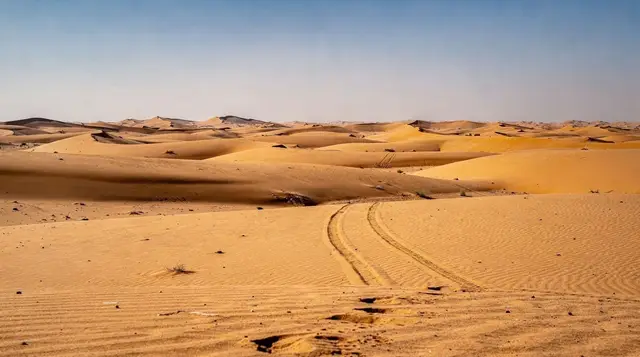
When someone in Marrakech says “the desert in 2 days,” they almost always mean Zagora. It’s roughly 7 hours from Marrakech by road, which sounds long until you compare it with Merzouga’s 8 to 10 hours — that 2 to 3 hour gap is exactly why Zagora works on a short trip and Merzouga doesn’t.
The town itself is unremarkable, a dusty administrative centre best known for one photograph: a road sign reading “Tombouctou 52 jours” — 52 days by camel to Timbuktu — a relic of the old trans-Saharan caravan routes that everyone stops to photograph on the way through. The actual draw is a short drive further on, where the dunes of Erg Zehar rise out of the flat gravel plain.
Be clear-eyed about scale before you book: Zagora’s dunes are real sand, unlike Agafay’s stone plateau, but they’re considerably smaller than Erg Chebbi’s 150-metre giants near Merzouga. If you have three days to spare, Merzouga’s dunes are more dramatic. If you only have two, Zagora is genuinely the better trade-off — real sand, an actual desert camp, and a route home that doesn’t cost you a third day.
| Where | ~360 km south of Marrakech, via the Tizi n’Tichka pass and Ouarzazate |
| Cost | 2-day shared tours from around 900-1,500 MAD (83-140 €) per person, including camel trek and one desert night |
| Time needed | 2 days minimum; 3 allows an extra kasbah stop |
| Getting there | Overland tour by minibus or 4x4, usually via Ait Ben Haddou and Ouarzazate |
| Best time | October to April; nights are cold December-February |
The classic 2-day route
Every 2-day Zagora tour follows roughly the same shape. You leave Marrakech early, cross the Tizi n’Tichka pass through the High Atlas, stop in Ait Ben Haddou for the fortified kasbah, pass through Ouarzazate, then continue south along the Draa Valley’s palm groves to reach Zagora by late afternoon. From there it’s a short drive to the dune edge, a camel trek to camp, dinner, and a night under the stars before the return drive the next day.
2-day desert tour from Marrakech to Zagora is the standard shared version of this route and the cheapest way to get a genuine desert night without committing three or more days. It’s a long two days of driving relative to time spent in the dunes, but it’s honestly the only way to fit sand dunes into a short Marrakech trip.
Some operators route the return leg differently, swinging back via Ait Ben Haddou again or adding a stop in the Draa Valley’s Tamegroute pottery cooperatives. 2-day Zagora desert tour via Ait Ben Haddou is worth choosing over a generic version if you haven’t seen the kasbah yet, since it folds two worthwhile stops into one trip rather than requiring a separate day trip to Ouarzazate later.
Camp comfort varies a lot
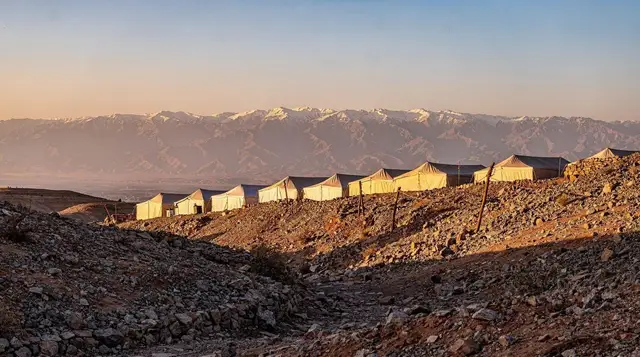
Not all Zagora desert camps are equal, and the gap between a basic shared tent and a proper camp with real beds is bigger here than the price difference suggests. Budget shared tours tend to use simple mattress-on-the-ground tents with shared washroom blocks a short walk away — fine for one night, not luxurious. 2-day Zagora tour with a luxury camp upgrades to proper beds, sometimes en-suite bathrooms, and noticeably better food, for a meaningful jump in price that’s worth it if comfort matters more to you than budget.
Private tours remove the group-pace frustration entirely. A private 2-day trip lets you set your own timing at Ait Ben Haddou and Ouarzazate instead of following a fixed group schedule, at a cost that’s higher per person but often reasonable when split between two or more travellers.
Extending to 3 days
Adding a single day changes the trip meaningfully. 3-day Zagora desert and kasbahs tour spreads the long driving days out, adds proper time in Ait Ben Haddou rather than a 30-minute photo stop, and often includes a detour into the Draa Valley’s palm groves and kasbah villages that the 2-day version skips entirely. It’s the version to choose if your schedule has even one extra day of slack.
For travellers who want more control over timing without a big group, a private 2-day Zagora trip keeps the same overall length but swaps the shared minibus for a private vehicle and a dedicated guide. It costs more per person than the shared version, though the gap narrows quickly once you’re splitting the fare between two or three travellers, and the freedom to linger an extra twenty minutes at a viewpoint or skip a stop that doesn’t interest you is worth more on this route than on most, given how much of the day is spent in transit either way.
What the Tombouctou sign actually means
The famous roadside sign reads “Tombouctou 52 jours” — Timbuktu, 52 days — and it’s a genuine relic of the trans-Saharan caravan trade that once ran through Zagora, when camel caravans carried salt, gold and goods across the desert to Mali and back over roughly seven weeks each way. It’s not a modern tourist prop, even though it now functions as one; every tour bus stops here, and the small stalls that have sprung up around the sign sell tea, trinkets and photo opportunities with a camel for those who want the full set.
Treat the stop for what it is: a five-minute photo break with real historical roots, not a site that needs more time than that. The genuine caravan history is worth a sentence or two from your guide, but there’s nothing more to see beyond the sign itself and the small cluster of stalls around it.
Combining Zagora with the Draa Valley
The road south to Zagora runs directly through the Draa Valley, Morocco’s longest palm-lined river valley, dotted with earthen kasbahs and the pottery village of Tamegroute. Most Zagora tours already pass through part of it, but a dedicated stop is worth building in if pottery or traditional architecture interest you — a 3-day Draa Valley tour built around Tamegroute pottery gives the valley proper time instead of treating it as scenery glimpsed from a moving vehicle, with a real stop at the workshops rather than a photo pause on the roadside.
How the two days feel in practice
The honest shape of a Zagora trip is a lot of road with a rewarding pause in the middle. The first day is mostly the drive: the climb through the High Atlas, the kasbah stop, the long run through the palm groves, then the camel ride into camp as the light softens. The second day is largely the way back. Knowing that in advance helps you settle into it. Bring something to read or listen to, charge your phone before you leave the riad, and treat the vehicle as part of the experience rather than dead time between highlights.
The mountain section is also where many people feel the journey most. If you tend to get car sick on winding roads, ask for a seat towards the front and take a remedy before the pass rather than after it. If you want a better feel for the mountains you are crossing, the High Atlas page explains what you are looking at through the window, and the guide to driving in Morocco is useful if you are weighing a self-drive against a tour.
Choosing between a shared tour and doing it your way
A shared tour is the simplest answer. Someone else handles the route, the camp and the dinner, and you simply turn up. The trade-off is the fixed schedule: breaks fall where the group stops, not where you would like to. If you value flexibility, read guided tour or independent before you commit, because on a route this long the question is less about money than about how much of the logistics you want to carry.
Whichever way you go, take a few minutes with the Sahara tour booking guide first. It covers what to ask an operator before you pay, such as what kind of camp you are getting, what is included at dinner and where you will be dropped off on the return. Those details matter more than the headline price, and they are the usual source of disappointment on budget departures.
What the camp evening is like
Once the camel ride ends, the evening is quiet and unhurried. You arrive as the heat fades, climb a dune if you have the energy, watch the sky change colour, and then eat together at the camp. After dinner there is typically music around a fire and a very dark sky if the weather is clear. It is a simple evening, and that simplicity is the appeal. If you want to know what to expect from a night under canvas in more detail, the Sahara desert camp guide goes through it step by step, and the camel ride guide is worth a look if you have never ridden one and want to know how it feels.
For something more reflective about waking up in the dunes, the blog piece on desert dawns captures the morning side of the experience, and what nobody tells you about the Sahara is a candid read before you book.
Fitting Zagora into a wider trip
Zagora works best as a single, well-judged excursion within a longer stay rather than the centrepiece of the whole holiday. If you are still sketching your overall plan, Marrakech in 3 vs 5 days helps you decide how much time the city itself deserves. Travellers who want a longer loop that continues beyond the desert can look at the southern circuit itinerary, which strings together several of the places this route only touches in passing.
Zagora also pairs naturally with the stops you pass on the way. Ouarzazate is the usual lunch or transit town, and a calmer base if you would rather split the drive. If the long road puts you off altogether, a night in the Agafay Desert is far closer to the city, though it is a stone desert, not sand.
What to pack for a short trip
Because a Zagora trip runs so short compared with Merzouga or Erg Chigaga, it’s tempting to under-pack, but the same basic desert rules apply. Nights drop sharply once the sun sets, even in a 2-day window, so a warm layer earns its space even on a single overnight. A headscarf or buff helps against blown dust on the drive south, and sturdy closed shoes are more useful than sandals once you’re off the paved road and onto the dune approach near camp.
Cash matters more here than almost anywhere else on a standard Marrakech itinerary — card machines are rare beyond Ouarzazate, and the small stalls around the Tombouctou sign, tea stops along the route, and any extras at camp all run on dirhams. Bring more small notes than you think you’ll need; nobody on this route can reliably break a large bill.
If you’re still deciding between the two main desert routes, Merzouga or Zagora lays out the trade-offs directly. For the wilder, less-visited option beyond Zagora, see Erg Chigaga, reachable only by 4x4 past M’Hamid. The Draa Valley itself is worth its own stop if you have any spare time on the drive south, and Ait Ben Haddou sits directly on the route. Anyone unsure whether they need a full Sahara trip at all should read Agafay or the real Sahara first, and the 3-day Marrakech to the Sahara itinerary shows how a longer route compares.