Desert Dawns and Long Roads South
The road south out of Marrakech climbs almost as soon as it leaves the city, and by the time it reaches Tizi n’Tichka’s first proper switchback, the palm groves and red walls of the medina already feel like a different country. This is the route to the Sahara, and it turns out the road itself is half the reason the trip stays with you.
Tizi n’Tichka, one bend at a time
The pass tops out above 2,200 metres, and the drive up is a genuine mountain road — hairpin after hairpin, roadside stalls selling amethyst and quartz at nearly every viewpoint, and a view back over the Atlas foothills that keeps expanding the higher the road climbs. It’s slow going by design; nobody covers this stretch quickly, and nobody should try to. Trucks grind up the same switchbacks in low gear, and the smart move is simply matching that unhurried pace rather than fighting it.
Somewhere near the top, the vegetation changes entirely — the argan and olive trees of the lower slopes give way to bare rock and scattered Berber villages built almost the same colour as the mountainside around them, as if the stone architecture had simply grown there rather than been built. It’s the first hint that the landscape ahead has very little in common with the city behind.
If the pass worries you, the driving in Morocco guide explains what self-driving involves on roads like this, while the guided tour versus independent travel comparison helps you decide whether to hand the switchbacks to a professional driver. The pass itself has its own page in the Tizi n’Tichka destination entry, and the wider range it crosses is covered under the High Atlas.
Ouarzazate and the kasbahs that taught cinema its desert
The descent on the far side of the pass leads to Ouarzazate, Morocco’s film capital, where several major studios have used the surrounding red-rock landscape as a stand-in for everything from ancient Egypt to imagined future worlds. It’s a strange, low-key town built almost entirely around this second industry, and it’s worth a stop specifically for that contrast — a working film backlot sitting a short drive from Ait Ben Haddou, one of the country’s most complete fortified kasbahs still standing.
Ait Ben Haddou at the hour before the coaches arrive
Ait Ben Haddou’s earthen towers rise directly out of the valley floor, crossed by a shallow river that coach groups ford on stepping stones by mid-morning. Arrive early and the kasbah is close to empty, its ochre walls catching the low sun before the day’s heat and crowds both build.
An Ait Ben Haddou guided tour in this early window is worth timing deliberately — a guide who knows which stairwells lead to the best overlook makes the difference between a quick photo stop and genuinely understanding how a fortified earthen village like this one functioned. A combined Ait Ben Haddou and Ouarzazate day trip pairs both stops efficiently if you’re not continuing all the way to the dunes on the same journey.
Both stops also have their own entries if you want to read before you go: Ouarzazate and Ait Ben Haddou. A little further along, Skoura is another oasis worth knowing about when you plan the stops between the mountains and the dunes.
The valleys keep unfolding after Ouarzazate
Past Ouarzazate, the road threads through a string of oasis valleys — palm groves and rose gardens hugging a river that has no business surviving in landscape this dry, kasbahs in varying states of ruin marking the old caravan route toward the Sahara. Each valley has its own particular colour of earth, and the drive through them is unhurried in a completely different way than the mountain pass — flat, wide, with the horizon doing most of the work instead of the road’s geometry.
The last stretch, and why it matters
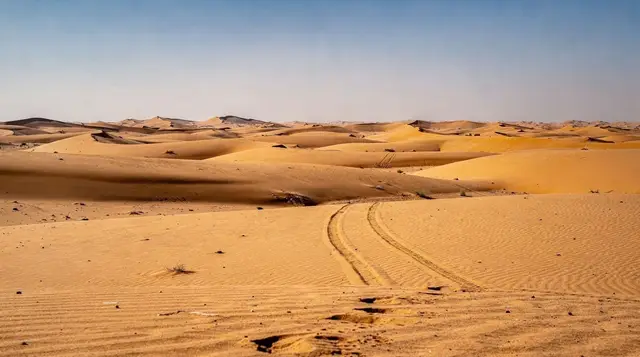
By the time Merzouga’s dunes appear on the horizon, usually late on the second day of a proper 3-day Marrakech to Merzouga desert tour, the scale of what you’ve crossed to get there has become part of the experience rather than an inconvenience to it. This isn’t a drive you do to reach the desert despite itself — by the final approach, the road has already done most of the work of making the dunes feel earned rather than merely arrived at.
Anyone who prefers a single booking to cover the whole journey can look at a three-day desert tour running from Marrakech to Merzouga, and the Sahara tour booking guide explains what to compare before choosing one. The Merzouga destination page describes the place where the road finally ends.
The drivers who make the whole route work
None of this route is realistic without a driver who knows it properly — the switchbacks, the reliable stopping points, which roadside stall sells genuine amethyst rather than dyed glass. Most multi-day desert tours include the same driver for the full journey, and by the second day the relationship shifts from transactional to something closer to a shared project: they know exactly when to suggest a break, when the light is about to turn, when it’s worth pulling over unscheduled for a viewpoint that doesn’t appear on any itinerary. It’s worth acknowledging how much of this trip’s texture depends on someone else’s accumulated knowledge of a road you’re crossing for the first and only time.
Rose valley and the smell that arrives before the view does
Between Ouarzazate and the deeper south, the road passes through the Dades region’s rose-growing valleys, and in the right season the scent reaches the van before the fields themselves come into view — thousands of Damascus roses grown for the region’s perfume and cosmetics industry, harvested by hand each spring. It’s an unexpected sensory detail on a route otherwise defined by rock and dust, and it’s a reminder that the “southern route” isn’t one landscape repeated for nine hours, but several distinct ones stitched together by the same road.
What surprises most people about the distance itself
Looking at a map beforehand, the distance from Marrakech to Merzouga looks deceptively manageable — a single thick line across a country that isn’t especially large by global standards. What the map doesn’t show is the mountain pass eating three hours on its own, or the fact that Moroccan road speeds through valley towns and market days slow the average pace considerably below what the distance alone would suggest. Nearly everyone who does this drive for the first time underestimates it slightly before departure and comes away, afterward, with a much more accurate sense of just how much geography actually separates the city from the dunes.
And then, the dawn
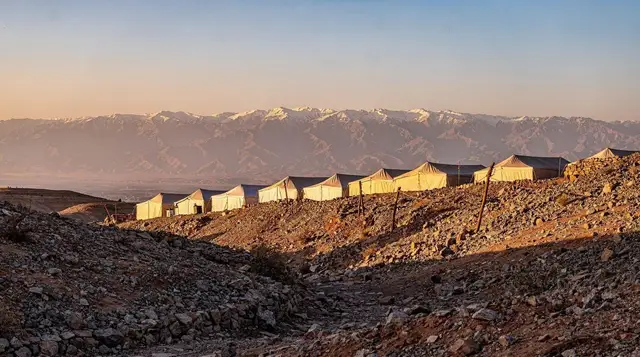
The reason this whole route exists is a specific ten minutes the following morning — climbing a dune before sunrise, the erg silent except for footsteps in sand, and the sky moving through colours that no photograph from the van window the day before quite prepared you for. The Marrakech to Merzouga overland guide covers the full route stop by stop, the Ait Ben Haddou guide goes deeper on the kasbah itself, and the Sahara desert camp guide explains what’s waiting at the end of the road.
Before you leave, the desert tour packing guide covers what to bring for the cold start and the sand, and the Marrakech Sahara 3-day itinerary lays the same route out day by day. For the other side of the story, what nobody tells you about the Sahara is a good companion read.
For a shorter version that still takes in the mountains and kasbahs without continuing to the dunes, the Ouarzazate day trip guide covers exactly that middle ground. Either way, the road south is not a delay before the good part starts. It’s most of the good part, several days before the dawn that gets all the photographs.
tours.Stories
Verified deep-linked GetYourGuide tours. Book through these links and we earn a small commission at no cost to you.
Photo: our own image of the location, not the operator’s product photo.