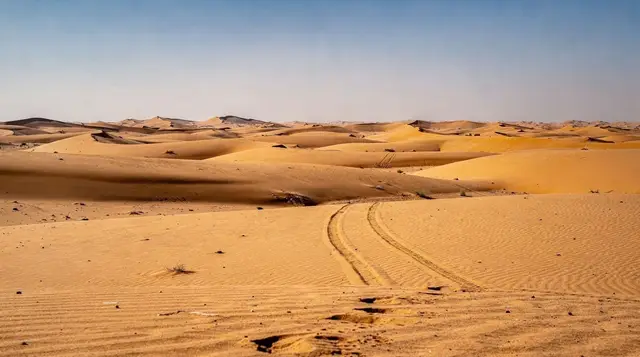
Merzouga is where the Sahara stops being a word and starts being sand under your boots. The dunes of Erg Chebbi rise up to 150 metres, the biggest reachable from Marrakech, and they look like nothing else in Morocco — golden, wind-rippled, and genuinely enormous once you’re standing at the base of one.
Getting there is the honest catch. Merzouga sits roughly 560 km from Marrakech by road, which means 8 to 10 hours behind the wheel over the Tizi n’Tichka pass and through Ouarzazate, usually broken into two driving days with an overnight stop. Flying to Errachidia cuts the worst of the driving but still leaves an hour or two on the road at the far end. Either way, this isn’t a day trip, and anyone advertising it as one is either lying or driving through the night.
Because of the distance, almost nobody sees Merzouga on its own — it’s the destination of a 3-day-minimum loop that also takes in Ait Ben Haddou, Ouarzazate, and often the Dades or Todra gorges on the way back. Treat it as the anchor of a proper southern circuit, not a side trip.
| Where | ~560 km southeast of Marrakech, on the edge of Erg Chebbi dune field |
| Cost | 3-day shared tours from around 1,800-2,800 MAD (165-260 €) per person, including camel trek, one desert night and transport; private and luxury tours run considerably higher |
| Time needed | 3 days minimum; 4 is more comfortable |
| Getting there | Multi-day tour by 4x4 or minibus, or fly to Errachidia and join a shorter overland leg |
| Best time | March-May and September-November; avoid the peak heat of July-August |
What the dunes actually involve
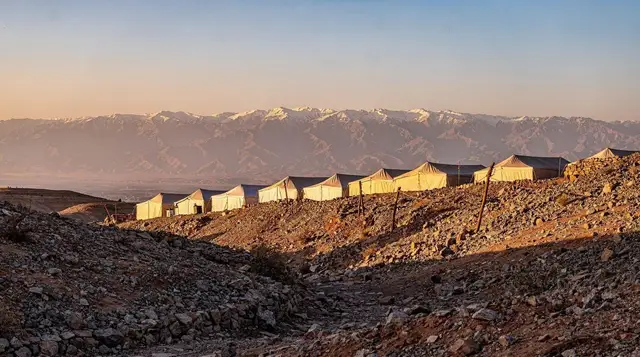
A standard Merzouga night runs the same way for almost every operator: you’re driven to the edge of Erg Chebbi in the late afternoon, transferred onto camels for a roughly 45-minute trek to a desert camp set among the dunes, and settled in before sunset. Dinner is a tagine cooked over the fire, followed by Berber drumming around the embers. Camps range from simple shared tents to genuinely luxurious ones with proper beds and en-suite bathrooms, at a matching range of prices.
The reason to stay the night rather than just visit for sunset is the sky. Away from any town lighting, the Milky Way is visible on a clear night in a way most travellers have never seen. The trade-off is comfort — desert nights drop below 5°C from December through February, and even in the shoulder seasons it gets properly cold once the sun is down, so pack for a temperature swing of 20°C or more between afternoon and midnight.
Sunrise is the other reason people set an early alarm. Guides typically wake guests before dawn to climb a nearby dune and watch the light hit the erg — it’s a genuine highlight, worth the early start, and one of the few moments on a group tour that isn’t scripted for a photo.
3-day desert tour from Marrakech to Merzouga is the standard entry point: two nights on the road, one night in the dunes, camel trek both directions, meals included. It’s the shortest version that still gives you a full night under the erg rather than a rushed evening visit.
Why 3 days is the real minimum
A 2-day version exists and gets sold aggressively in Marrakech’s medina, but it usually means one very long driving day out, a rushed sunset camel ride, and an equally long drive back the next morning — barely any time actually at Erg Chebbi. If your schedule genuinely only allows two days for a desert dune trip, Zagora is the better target: shorter drive, same format, smaller dunes. Save Merzouga for when you can give it three days properly.
A 4-day Merzouga tour adds breathing room — an extra stop in the Dades or Todra gorge, more time in Ait Ben Haddou, and a less exhausting pace on the long driving legs. If you have the days, it’s a noticeably better trip than the 3-day version, not just a longer one.
Private versus shared tours
Shared minibus tours are the budget option and the most common way people reach Merzouga — you’ll be grouped with 6-16 other travellers, following a fixed itinerary with set stops. A private luxury Merzouga tour costs considerably more but removes the two biggest frustrations of the shared version: waiting on other passengers at every stop, and a fixed pace that doesn’t allow for lingering at Ait Ben Haddou or the gorges.
For travellers short on time who still want a taste of the real dunes rather than Agafay’s stone desert, a 2-day Merzouga tour exists, though it should be understood for what it is: a long haul out, one desert night, and a long haul back, with almost no slack for anything else.
The overland route itself
The drive to Merzouga is as much a part of the trip as the dunes at the end of it, and most 3-day tours build in genuine stops rather than treating the road as dead time. The Tizi n’Tichka pass, the highest road pass in North Africa, climbs through switchbacks with views back over the Atlas foothills before dropping into Ouarzazate — Morocco’s film-industry town, where several major studios have shot desert scenes for decades. From there the route usually threads through the Dades or Todra gorge before the final stretch of flat plain that runs straight into Erg Chebbi.
Flying to Errachidia is the alternative for travellers who want the dunes without two full days of driving each way. The flight itself takes under an hour from Marrakech via Casablanca in most cases, though connections aren’t always direct, and you’ll still need roughly an hour and a half by road from Errachidia airport to reach Merzouga. It’s a reasonable trade for anyone whose schedule genuinely can’t absorb four days of driving, though it does mean missing Ait Ben Haddou and the gorges that make the overland route worthwhile in its own right.
Road quality on the main route is generally good and well maintained, though the final approach to Merzouga crosses flat, featureless plain where sandstorms can occasionally reduce visibility with little warning — another reason experienced local drivers are worth paying for over a self-drive option on this particular route.
Packing and practicalities
Days in the desert can still reach the mid-30s°C even outside summer, while nights fall sharply once the sun sets — layers matter more here than almost anywhere else on a Morocco trip. A headscarf or buff is genuinely useful in windy conditions, when blown sand gets into everything. Most camps supply blankets, but a warm layer of your own is worth the space in your bag between November and February.
Choosing between the desert options near Marrakech
Merzouga is not the only way to meet the desert from Marrakech, and being honest about the alternatives makes for a better decision. The stony, rocky landscape of the Agafay desert sits close to the city and suits an evening or a single night, but it is not a sand sea, and the guide to Agafay versus the Sahara explains clearly what you do and do not get. If what you want is towering dunes and a night that feels remote, Merzouga is the answer; if what you want is a change of scene without a long drive, it is not.
The wider Draa Valley is worth knowing about too, since it is the corridor that leads to Zagora and the quieter dune fields beyond. Many travellers weigh these against each other for days, when the real question is simply how much time the trip can spare for the road.
Making the long drive easier
The distance is the main thing people underestimate, so it helps to plan for it rather than hope it passes quickly. Take motion-sickness remedies if the switchbacks of the pass affect you, keep water and a few snacks within reach, and charge your phone before each driving leg. Treat the stops as part of the journey: a walk through the ksar at Ait Ben Haddou or an hour in Ouarzazate breaks up the day far better than pushing on without pause.
If you are weighing a shared minibus against doing it your own way, the discussion of a guided tour versus going independent is useful here, because the long distances and the camp logistics tilt the balance toward an organised trip more than they do for most places in Morocco. A good driver also handles the parking, the fuel and the route finding, which leaves you free to look out of the window instead of at a map, and that matters on a journey where the scenery is half the reason to go. For anyone considering the wheel themselves, driving in Morocco sets out what to expect from the roads, the checkpoints and the pace.
What to expect at the camp
Camps vary a great deal, and it is worth asking what you are actually getting before you pay for it. Some are modest shared tents, others have private rooms and proper bathrooms, and the difference is reflected in the price. The Sahara desert camp guide goes through how to read an offer, what the different tent styles mean and which questions are worth asking an operator before you commit.
Expect the evening to be unhurried. After the camel trek in, there is usually time to walk up a dune on your own, watch the colour change on the sand, and sit quietly before dinner is served. The silence is a large part of the appeal, and it is easy to lose by spending the whole evening on a phone. Bring a head torch for the walk to the toilet tents at night, and leave valuables in your main bag rather than carrying them across the dunes.
Who Merzouga suits best
Merzouga rewards travellers who are happy to trade comfort for scale. Photographers love the way low light shapes the ridges, couples tend to remember the quiet of the camp, and families with older children often find the camel trek a highlight. It is less suited to anyone who dislikes long journeys, cold nights or basic facilities, and that is fine: knowing this before you book is the whole point. If you are travelling with younger children, think carefully about the length of the driving days, and consider a slower, private option so you can stop whenever the group needs a rest. Whatever you choose, build a little slack into your Marrakech schedule on the day you return, since long road days can run late.
Booking sensibly
Because the same itinerary is sold by many different sellers, prices and quality can differ more than the brochure suggests. The Sahara tour booking guide covers what to check: who actually runs the vehicle and the camp, what is included in the price, and how groups are sized. Reading the inclusions line by line matters more than comparing headline prices, since extras such as drinks, tips and a second night can change the total considerably. For a sense of how to handle tips along the way, see tipping in Morocco.
If you would rather read about the experience before deciding, the blog piece on what nobody tells you about the Sahara is a candid account, and desert dawns describes the sunrise that many travellers call the highlight of the whole trip.
Fitting Merzouga into a longer stay
Merzouga works best as the far point of a broader journey rather than the only reason for a trip. The southern circuit itinerary shows how to combine the dunes with the gorges, the kasbahs and the oases without feeling rushed, and it gives the desert the time it deserves. Travellers with a few days to spare in Marrakech itself will find it easy to balance the long road with slower days in the medina on either side.
If your time is tighter than three days, read Merzouga or Zagora for a straight comparison before you book anything. For the practicalities of the drive itself, Marrakech to Merzouga overland covers the route stop by stop, and what to pack for a Sahara tour is worth reading the night before you leave. Travellers who want dunes without the crowds sometimes push further to Erg Chigaga, while Zagora remains the better choice on a 2-day budget. The 3-day Marrakech to the Sahara itinerary builds a full route around Merzouga end to end.