Agafay is the desert Marrakech sells you when it doesn’t have time to sell you the real one. It’s 30 to 40 minutes from the city by road, which means you can leave after breakfast, ride a camel over stony hills, eat dinner under a clear sky, and be back in your riad before midnight. No other stretch of desert near Marrakech is that convenient.
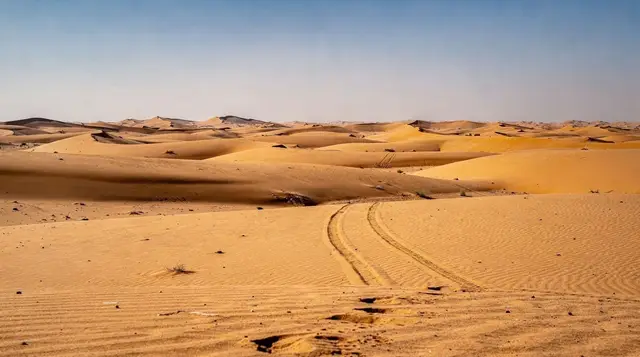
The trade-off is honesty, and it’s worth stating plainly: Agafay has no sand dunes. It’s a plateau of flattened rock and dry, cracked clay that stretches toward the Atlas foothills. From a distance, especially at sunset when the light turns everything gold, it photographs like a desert. Up close it’s stone underfoot, not sand between your toes. If dunes are the point of your trip, this isn’t the place — see Zagora or Merzouga instead.
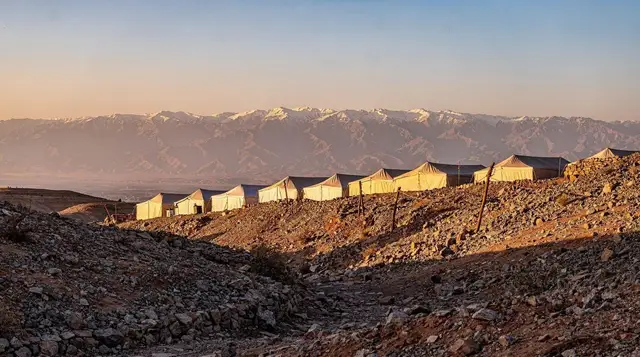
What Agafay does well is atmosphere on a tight schedule: silence, open sky, a horizon with nothing on it, and increasingly a string of well-run luxury camps that do dinner-and-stars evenings better than anywhere else within an hour of the city.
| Where | 30-40 minutes southwest of Marrakech, on the way to the Atlas foothills |
| Cost | Half-day camel ride from around 250-400 MAD (23-37 €); dinner-and-show evenings from 450-900 MAD (42-83 €); overnight luxury camps from 1,200 MAD (110 €) per person |
| Time needed | 3-4 hours for a sunset trip, or one night for a camp stay |
| Getting there | By organised tour with transfer included, or grand taxi if arranged in advance |
| Best time | Any evening year-round; daytime visits are more comfortable October-April |
Stone, not sand — and why that matters
The confusion is common enough that it deserves its own paragraph. Marketing photos for Agafay tours are shot at golden hour with long shadows, and they genuinely look like Saharan dunes to anyone who hasn’t been. They aren’t. Agafay sits in the pre-Saharan hammada zone: eroded rock, dry riverbeds, scrubby plants, the occasional Berber village. It’s a real and striking landscape, just not a sandy one.
Tour operators rarely lie outright, but they lean on ambiguous wording — “Marrakech desert experience”, “Sahara sunset” — that lets you assume dunes until you’re standing on gravel. Ask directly before booking: “does this trip go to Agafay or to Zagora/Merzouga?” If the answer is Agafay, you’re getting stone desert on a half-day budget, not the Sahara on a Sahara budget, and that’s a fair trade as long as you know it going in.
What there is to do
Camel rides are the default activity, usually an hour or so across the plateau timed for sunset, followed by mint tea at a Berber-style camp. Quad biking is popular for a faster, dustier version of the same terrain — routes wind between dry riverbeds and small hills with genuinely good views back toward the Atlas. Some operators combine both in a single afternoon.
Camel ride, dinner and show in the Agafay Desert is the standard sunset package: transfer from Marrakech, an hour on a camel, a Moroccan dinner in a decorated tent, and usually live music or a fire show afterwards. It’s touristy in the sense that everyone on the trip is a tourist, but the setting is genuinely good and the food is usually better than what you’d get at a comparable show inside the city.
For a longer stay, several camps now offer day-pass pool access alongside lunch — a useful option in the shoulder seasons when the afternoon sun is still strong enough to want a swim before the evening cools down. Agafay Desert day pool access with lunch works well as a half-day trip that doesn’t require an overnight commitment.
An overnight stay changes the experience meaningfully: once the day-trip crowds leave after dinner, the camps empty out and the sky does the rest. A one-night Agafay camp stay with a camel ride typically includes dinner, a fire pit, breakfast, and a transfer back to Marrakech the next morning — it’s the closest thing to a Sahara-style overnight that doesn’t require two days of driving.
Quad biking and other active options
Agafay’s terrain suits engines as well as camels. Quad bike routes typically run 1-2 hours and cover more ground than a camel ever could, weaving through dry wadis with stops for photos. Agafay Desert quad biking is sold both as a standalone activity and bundled into longer sunset packages.
Paragliding has also started appearing on the Agafay circuit, taking advantage of the open plateau and steady thermals in the late afternoon. Combined tours pair a short flight with quad time on the ground, giving a genuinely different perspective on the same stony landscape. It’s worth checking conditions and operator safety credentials before booking, since paragliding depends far more on weather than camel rides or quads do.
For travellers who want the desert evening without the physical activity, transfer-and-dinner packages exist that skip the camel or quad entirely and go straight to the camp for sunset drinks and a meal — a reasonable option for anyone with mobility limits or small children who won’t enjoy an hour on a camel.
Booking a tour versus arranging it yourself
Almost everyone visiting Agafay does so through a booked tour, and there’s a practical reason: the camps and activity operators are spread across a private, unsignposted stretch of land with no public transport and few clear roads. A grand taxi driver can get you there if you already have a confirmed booking and address, but turning up independently to negotiate on-site is a poor use of an afternoon.
Group tours are the cheapest way in and work well if you don’t mind sharing the camel line and the dinner tent with other visitors. Private tours cost more but let you set your own pace, particularly useful if you’re combining Agafay with a stop in the Atlas foothills on the same afternoon.
If you are still deciding between a short evening and a full night out there, Agafay day trip or overnight lays out the trade-offs, and the wider Agafay Desert guide covers the practical details camp by camp. Anyone weighing a guided outing against a more independent plan will find the logic in guided tour or independent travel useful, even though Agafay leans heavily towards the guided side.
What the evening actually feels like
A typical Agafay evening follows a rhythm that is easy to enjoy once you know it. You are collected from your riad or hotel in the late afternoon, and the city thins out quickly as the road climbs away from the palm groves and the last suburbs. The landscape opens up, the colours soften, and by the time you reach the camp the plateau is already starting to glow. Arrival usually means mint tea, a few minutes to find your bearings, and a chance to wander to the edge of the camp for photographs before the main activity begins. If tea is a ritual you want to understand, the Moroccan mint tea guide explains why it is poured the way it is.
Then comes the activity itself, whether that is the camel line, a quad convoy or simply a seat on a cushion facing the horizon. Sunset is the centrepiece. The light changes quickly on open ground with nothing to block it, and the hills in the distance move from gold to rose to a deep blue within a short window. Photographers tend to get their best frames in that stretch, and people who simply want to sit and watch are rewarded just as well. The Marrakech photography guide has advice on handling that kind of low, warm light.
Dinner follows in a tent or open-sided dining area, usually lit by lanterns and heaters when the air cools. The menu leans on Moroccan staples such as tagine, couscous, salads and grilled dishes, and if you want to know what you are eating, Marrakech food guide is a good primer. Entertainment varies between camps: some offer drummers and a fire show, others keep things quiet and let the stars carry the evening. Ask in advance which style your chosen camp favours, because the difference matters if you are hoping for peace or, conversely, for a lively night. The Agafay dinner shows guide compares what to expect from the different formats.
Choosing the right format for you
Not every traveller wants the same thing from a desert evening, and the options reflect that. Couples chasing atmosphere tend to prefer the overnight camps, where the quiet after the day-trippers leave is the main attraction. Groups of friends often lean towards quad biking followed by dinner, since the engine noise and dust are part of the fun. Families with children may prefer the pool-and-lunch format or a short sunset ride with an early return, which is easier on small travellers; the Marrakech with kids guide and the family activities guide give wider context for planning around children.
If your budget is tight, group sunset packages are the sensible entry point, while a private transfer and a quieter camp suit those who value space over savings. Whatever you pick, think about how the evening fits into the rest of the trip rather than treating it as an isolated outing. A heavy day in the medina followed by a late desert night can leave you tired the next morning, so it helps to keep the following day light. The first-time visitor guide can help you place Agafay within a sensible overall plan.
What to bring and how to dress
The plateau offers almost no shade and the ground is loose and stony, so closed shoes are a better choice than sandals, especially for quad biking or walking around camp after dark. Sunglasses and a scarf or light head covering help with both sun and dust, and a warm layer is wise whatever the season, since the temperature falls quickly once the sun drops behind the hills. Sun protection matters in daytime visits, and a refillable bottle of water is a good habit. For a fuller checklist, the desert tour packing guide covers it in detail, and the guide to what to wear in Marrakech helps with dressing respectfully on the way there and back.
Keep your phone charged and your valuables simple. Camps are generally relaxed, but there is little reason to carry more than you need into a tent at night. A small torch or phone light is handy for finding your way between tents once the lanterns are low.
Combining Agafay with the rest of your trip
Because Agafay is so close, it slots easily into almost any itinerary. Visitors on a short stay often add it to a city break as the single big excursion, and the Marrakech in 3 days plan shows one way to balance it against the main sights. Those with more time can pair it with a mountain stop, and Lalla Takerkoust and the High Atlas both sit in the same general direction, which makes for a varied day when the schedule allows. If the south is calling, Ouarzazate and Ait Ben Haddou are the natural next steps on a longer route, and Erg Chigaga is another option for genuine dunes. Travellers who want the full Saharan experience can read the Sahara desert camp guide before deciding whether to make the longer journey instead.
When to go
Evenings work all year, since the appeal is sunset light and a clear night sky rather than daytime comfort. Daytime visits are more pleasant from October to April; from June to August the exposed, shade-free plateau gets uncomfortably hot well before midday, and camel rides are usually scheduled for late afternoon regardless of season to avoid the worst heat.
Winter nights on the plateau are colder than most visitors expect from a desert this close to Marrakech — temperatures can drop close to freezing between December and February once the sun is down, so a warm layer matters even on a short evening trip, and it matters far more if you’re staying overnight in a camp. Bring dirhams in cash for any extras at the camp — tips, drinks beyond what’s included, or a small souvenir from the on-site stalls that some camps run — since card machines are unreliable this far outside the city.
Agafay works best as what it is: a low-effort, high-reward desert evening, not a substitute for the real Sahara. If you have the extra days, pair it with a proper dune trip — read Agafay or the real Sahara for a straight comparison, or check camel rides around Marrakech if Agafay is just one stop on a broader desert-activities day.
Hot air balloon flights also launch from this same stretch of plateau most mornings; see the hot air ballooning guide for how that pairs with an Agafay evening. For travellers building a longer route south, Marrakech and the Atlas in 2 days shows how Agafay fits alongside a mountain stop.