Agafay: Day Trip or Overnight
Is an Agafay overnight camp worth the extra cost over a day trip?
If stargazing after the day-trip crowds leave is the main draw, yes — that's the one thing an overnight gives you that no evening trip can. If you just want the sunset, camel and dinner, a day trip delivers the same core experience for roughly half the price.
Every Agafay operator sells both a day-trip version and an overnight version of essentially the same evening, and the marketing rarely spells out what the extra night actually buys you. The short answer: a day trip gives you the sunset, the camel ride, and the dinner; an overnight gives you all of that plus a genuinely dark, quiet sky once the group tours have gone home. Whether that’s worth the extra cost depends on what you’re actually after.
| Where | Agafay Desert, 30-40 minutes southwest of Marrakech |
| Cost | Day trip: 450-900 MAD (42-83 €); overnight: from 1,200 MAD (110 €) per person |
| Time needed | Day trip: one evening, back by 10pm; overnight: leave afternoon, return next morning |
| Getting there | Included transfer with both formats |
| Best time | Year-round for either; daytime comfort is better October-April |
What a day trip actually includes
A standard Agafay day trip is built around sunset. You’re collected from your hotel in the mid-afternoon, driven 30-40 minutes to the plateau, and timed to be on a camel or quad as the light starts to turn gold. A camel ride, dinner and show in the Agafay Desert covers the standard version: an hour or so riding, mint tea, a Moroccan dinner in a decorated tent, and usually live music or a fire show before the drive back.
The whole evening runs three to four hours on-site and gets you back in Marrakech by 9 or 10pm, which means it costs you nothing from the rest of your trip — you can spend the same day exploring the medina and still make the sunset transfer with time to spare. It’s also the cheaper option by a wide margin, since you’re not paying for a room, breakfast, or the camp’s overnight staffing.
What the overnight adds
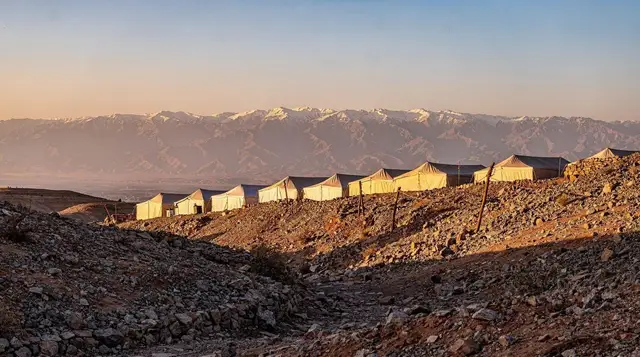
Once the day-trip groups climb back into their minibuses after dinner, the camps that offer overnight stays quiet down fast, and that shift is the entire case for paying more. An Agafay Desert overnight stay with dinner and a show keeps the same evening programme as a day trip but adds a fire pit, proper stargazing without headlights and chatter from other groups, a night in a berber-style tent, and breakfast before the return transfer.
The gap between camp tiers is real and worth understanding before you book. A mid-range overnight tent typically means a proper mattress, shared toilets, and a few hours of solar-powered lighting. At the top end, a luxury Agafay tent stay with pool access and dinner adds a private bathroom, more reliable power, and often pool access the following morning — useful if you’re staying through the heat of a shoulder-season day rather than heading straight back.
Who each format suits
Families with young children, first-time visitors on a tight schedule, and anyone travelling on a backpacker budget are usually better served by the day trip — it delivers the headline experience without the added cost or the logistics of an overnight bag. Couples, photographers chasing a genuinely dark sky, and travellers who’ve already done a day trip elsewhere and want something calmer tend to get more out of the overnight.
One format that splits the difference: a pool-day pass, which trades the evening dinner-and-camel programme for daytime lounging and lunch. Agafay Desert day pool access with lunch works well in the shoulder seasons when an afternoon swim outranks another sunset camel ride, particularly for travellers who’ve already ridden a camel elsewhere on their trip.
Cost breakdown in practice
For a couple choosing between the two, a shared day trip runs roughly 900-1,800 MAD (83-165 €) total including transfer, dinner and the camel ride. The equivalent overnight in a mid-range camp runs from about 2,400 MAD (220 €) total for a shared tent, rising well past 5,000 MAD (460 €) for a private luxury tent with its own bathroom. Group size affects per-person pricing more than most people expect — solo travellers pay a noticeable premium on private options, while larger groups often get better per-head rates on shared camps.
What the extra hours actually contain
It helps to picture the two evenings side by side rather than just comparing a headline price. A day trip ends the moment the fire show winds down: guests are back in the minibus by 9 or 9:30pm and in their hotel beds within the hour. Nothing about the day trip is rushed exactly, but the clock is always running in the background, and the transfer schedule shapes the whole evening.
An overnight strips that time pressure away. Once the day-trip vehicles pull out, the camp’s own guests are usually the only people left on the plateau, and the couple of hours after dinner — sitting by a fire pit, looking at a sky with no light pollution for miles — are the part that day-trippers never get to experience. Breakfast the next morning, often served as the light comes up over the plateau, is a genuinely different mood from the same meal eaten back at a Marrakech riad.
Weather and season considerations
Both formats work year-round, but the calculation shifts slightly by season. In peak summer, the overnight’s main advantage — a quiet evening under the stars — is somewhat offset by daytime heat that makes any activity before sunset uncomfortable; a day trip timed purely for the evening avoids the worst of it. In winter, the extra hours of an overnight mean more exposure to the cold night air, so pack accordingly if you’re staying — the day trip’s shorter window is easier to dress for.
Fitting either into a wider Marrakech itinerary
A day trip is the easier of the two to slot into a packed schedule, since it only claims a single evening and leaves the rest of your day free for the medina, a hammam, or the souks. Most travellers treat it as one evening among several during a longer Marrakech stay rather than building a day specifically around it.
An overnight needs slightly more planning, since it effectively removes a morning from your Marrakech time too — you won’t be back at your riad until mid-to-late morning the following day, having left the plateau after breakfast. For a short 3-4 day trip to Marrakech, that’s a meaningful chunk of your available time, and worth weighing against what else is on your list. For a longer stay of a week or more, losing half a day to a slower, more atmospheric desert morning is a smaller trade-off.
Which one first-timers usually regret not choosing
Anecdotally, the choice people second-guess after the fact tends to run in one direction: travellers who did the day trip usually don’t wish they’d stayed overnight, since the evening delivers what they came for. Travellers who chose an overnight, on the other hand, rarely regret the extra cost — the quiet hours after the day-trip crowd leaves are consistently the part people mention afterwards as worth the upgrade. That’s not a reason to always choose the overnight, since budget and schedule are real constraints, but it’s worth knowing which way the regret tends to run before you decide.
Before you pay a deposit
Whichever format you lean towards, a few questions are worth putting to the operator before you commit. Ask what the programme includes in practice: whether the camel ride is part of the price or an add-on, whether dinner is served at a shared table or in a private tent, and whether the show is live music, a fire display or both. The desert dinner shows guide explains how these evenings differ from one camp to the next, which helps you read a listing critically rather than trusting the photos alone.
For an overnight, ask who else will be staying. A small camp with a handful of tents feels very different from a larger one where several groups overlap, and the quiet that justifies the extra cost depends heavily on that. Ask too about the toilets and washing facilities, how power is supplied, and what time breakfast and the return transfer happen, because these details shape the morning after more than any headline description does.
Getting the most out of the camel ride
The camel ride is the part most visitors picture when they book, and it is short and gentle rather than a trek. If it is the main reason you are going, the camel ride guide covers what to expect, what to wear and how to treat the animals well. Closed shoes, long trousers and something to cover your head are sensible choices on stony ground, and the desert tour packing guide goes through the rest of the list, including the warm layer that overnight guests tend to forget.
Day-trippers and overnight guests get the same ride in most programmes, so the camel itself is never a reason to pay more. What changes is the light and the crowd: the ride at sunset is the busiest moment of the evening, and an overnight guest can sometimes enjoy the quieter hours that follow.
How Agafay compares with the Sahara
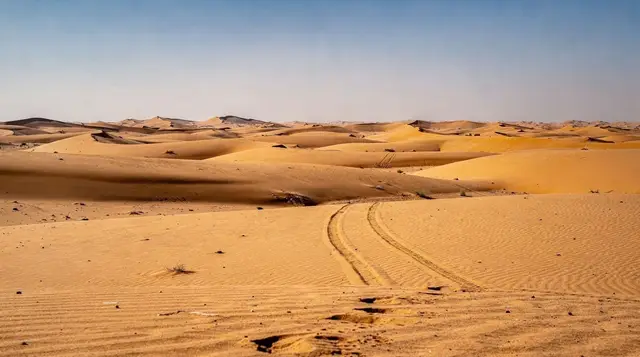
Agafay is a stone plateau with the Atlas Mountains on the horizon, and that is both its charm and its limit. It is close enough to reach on a single evening, which is exactly why the day-trip format exists. The real Sahara is a different undertaking: it needs several days, a long overland journey and a different budget. The Agafay versus Sahara comparison lays out the trade-offs, and the Sahara desert camp guide shows what a proper dune camp involves if you decide the overnight at Agafay is not enough of a desert for you.
If you are weighing a longer escape, the three-day Sahara itinerary from Marrakech shows how that trip is usually structured, and it makes the case for treating an Agafay evening as a short taster rather than a substitute.
Where the evening fits among other plans
Because a day trip takes only an evening, it pairs easily with a day spent in the city. A morning in the medina or an afternoon in the Jemaa el-Fna area leaves you rested enough to enjoy the transfer out. An overnight sits better with a slower day around it, so it is worth reading the Marrakech two-day itinerary if your schedule is tight and you are unsure where a night away would fit.
Travellers with a bit more time often prefer to pair the desert with a mountain day. The best day trips from Marrakech lists the alternatives, and the Agafay Desert destination page gives a broader sense of the area itself. If you are still choosing how long to stay in the city overall, the 3 versus 5 days comparison helps you decide how much room you really have.
A simple way to decide
If you find yourself going back and forth, picture the moment you are most looking forward to. If it is the golden light, the ride and a lively dinner, the day trip covers it and leaves your budget and your mornings intact. If it is sitting outside in the dark with nothing to do and nowhere to be, the overnight is the better match, and the extra cost buys precisely that. Neither choice is wrong, and both are easier to enjoy once you know which of those two moments you are really booking.
If you’re still deciding whether Agafay fits your trip at all, the Agafay Desert guide covers the full range of tour formats and how to choose an operator. For the dinner-and-show side specifically, read desert dinner shows: what you actually get before committing to either version. And if what you really want is proper Sahara dunes rather than a stone-desert evening, Merzouga or Zagora is the comparison to read next.
Best day trips from Marrakech on GetYourGuide
Verified deep-linked GetYourGuide tours. Book through these links and we earn a small commission at no cost to you.
Photo: our own image of the location, not the operator’s product photo.