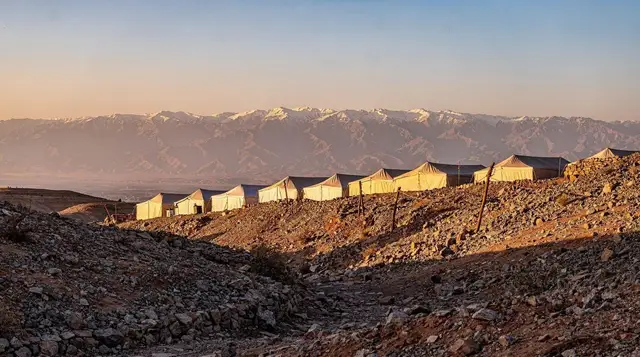
The High Atlas is the wall of mountains you see from any Marrakech rooftop on a clear day — snow-capped well into spring, dust-brown by August. It runs roughly north-east to south-west for over 700 km, and the stretch closest to Marrakech, from Asni through to Oukaimeden and Setti Fatma, is where almost every day trip and trek out of the city actually goes. Beyond the first ridge lines it keeps going for a very long way, but this is the accessible slice.
What you find up there depends entirely on how far you go. The first 45 minutes of driving gets you rolling foothills, argan and olive groves, and roadside stalls selling walnuts and dried figs. Another 45 minutes and you’re in proper mountain terrain — pisé villages stacked on hillsides, terraced fields following the contour lines, rivers running fast with snowmelt in spring. At Toubkal, North Africa’s highest peak, the range tops out at 4,167 m.
| Where | South of Marrakech, starting around 40 km out and rising toward the Toubkal massif |
| Cost | Day tours from roughly 250–450 MAD (€23–42) per person; private cars and guided treks cost more |
| Time needed | Half a day for the nearest foothills, a full day for a proper valley, 2+ days for trekking |
| Getting there | Shared or private day tour, grand taxi to a specific village, or self-drive |
| Best time | March–June and September–November; snow closes the high passes December–February |
The geography, in short
The High Atlas separates Marrakech’s plain from the pre-Sahara. Rivers draining north off the range — the Ourika, the N’Fis, the Rheraya — have cut valleys that each feel distinct: the Ourika is broad and touristy near the bottom, the N’Fis valley around Ouirgane is quieter and greener, and the Rheraya valley funnels straight up to Imlil and Toubkal. Villages sit where the valley widens enough for terraced fields, usually near a river.
Altitude changes fast. Marrakech sits at about 460 m; Imlil, the main trekking gateway, is at 1,740 m; the Toubkal refuge is above 3,200 m. That’s why the mountains can be shirtsleeves-warm in the valley and genuinely cold two hours’ walk higher, even in summer — pack a layer whatever the season.
Amazigh villages
Nearly everyone living in these valleys is Amazigh (Berber), and village life still runs on agriculture, small livestock, and — increasingly — tourism income from guiding, mules, and gîtes. Houses are built from pisé (rammed earth) and stone, flat-roofed, stacked so tightly on hillsides that one family’s roof is another’s terrace. Walnut and apple orchards line the valley floors; the higher slopes are grazing land for goats and mules.
Village visits sold as day-trip stops — tea with a family, a walk through the alleys, sometimes a cooking demonstration — are genuine income for people who live there, not a show staged for buses. That said, they vary a lot in quality: some feel like an honest cup of tea and a chat, others like a transaction with a gift shop attached. If village culture is the actual reason for your trip rather than a lunch stop, our guide to visiting a Berber village honestly is worth reading first.
Crafts and local produce
Weaving, carpet-making and pottery are still practised in many villages, often as household work rather than a dedicated tourist trade, though some families do sell directly to visitors on day-trip stops. Rugs made in these valleys tend to be simpler and more geometric than the finer city workshops of Marrakech, woven from local wool with natural dyes still in use in some households. Prices asked of tourists are usually higher than a local would pay, so a bit of polite negotiation is normal and expected, not rude.
Honey is another local speciality worth looking out for — thyme and other wild mountain flowers make for a distinctive, often quite strong flavour compared with the milder honey sold in Marrakech’s shops. Walnuts, almonds and dried apricots grown in the valley orchards are sold at roadside stalls throughout the foothills, usually at fair prices since there’s less of a tourist premium built in on food than on crafts.
What a gentle walk in the mountains feels like
You do not need to be a trekker to enjoy the High Atlas on foot. Most day-trip walks follow well-worn mule tracks between villages, with a local guide pointing out which orchard belongs to whom, which channel carries the irrigation water, and which path the school children take each morning. The pace is slow, the gradients are mostly modest on valley-floor routes, and the reward is the sort of quiet that Marrakech’s medina cannot offer. If you have just spent a few days in the medina and around Jemaa el-Fna, the contrast is part of the appeal.
Footwear matters more than most visitors expect. Trainers with a decent grip are fine for valley walks, but loose stones and river crossings make sandals a poor choice. A hat, sun protection and a refillable bottle are worth carrying even on a short outing. Guides and gîte hosts will usually tell you honestly whether a particular path suits your fitness and the weather that day; listen to them rather than your itinerary.
Seasons up here
Spring (March–June) is the strongest season: wildflowers, running water, snow still visible on the summits without blocking valley roads. Autumn (September–November) is nearly as good, with clearer air and fewer crowds. Summer brings relief from Marrakech’s 40°C-plus heat once you’re above 1,500 m, but midday sun on exposed trails is still hard work. Winter (December–February) closes some high passes to snow and ice; Oukaimeden turns into Africa’s small but real ski resort, while lower valleys stay accessible and quiet.
Each season also changes what you should wear and expect. In spring the valleys can be muddy and the rivers loud, so waterproof shoes help; in autumn mornings are crisp and afternoons warm, so layers are the answer. Our weather guide explains how the city’s climate differs from the mountains, and if you are travelling in the colder months, Marrakech in winter and the blog essay on the Atlas in winter show what the range looks like under snow. For the hottest months, Marrakech in summer makes the case for heading uphill, and the question of when to come overall is covered in the best time to visit Marrakech.
Day trip or overnight — what actually fits
A single day gets you a valley floor, one or two villages, a walk of an hour or two, and lunch — that’s Ourika, Ouirgane, or the lower slopes near Asni. It does not get you Toubkal, a mountain summit, or the feeling of being properly remote; you’ll be back in a Marrakech riad by dinner.
An overnight in a gîte — usually in or near Imlil — opens up half-day and full-day hikes with real elevation gain, dinner cooked by your hosts, and a night quiet enough to hear the river. Two nights or more is what you need for Toubkal itself: since 2023, the ascent legally requires a licensed mountain guide, arranged either through a trekking agency or directly in Imlil.
a day tour combining several valleys and a village stop is the easiest way to sample the range without committing to gear or a guide of your own, while a three-day trek with a local homestay is closer to what serious hikers come for.
If you prefer a route that links several river valleys in one go rather than focusing on a single one, a day trip that strings three valleys together gives you variety, at the cost of less time in each place. That trade-off is exactly why the verdict below leans towards choosing one valley when your time is short.
Staying overnight in a gîte
A gîte is a simple guesthouse, often a family home that has opened its doors to walkers. Expect shared or basic rooms, hot food prepared by your hosts, mint tea on arrival, and a terrace or rooftop looking over the valley. Comfort is modest, but the welcome is usually generous, and the evening conversation with hosts and fellow walkers is much of the point. Bring a warm layer for the night and a torch, and keep cash for the bill, since cards are rarely accepted.
Staying a night changes the rhythm of the whole trip. You are not racing the clock back to the city, you see the villages in early morning light before the day-trip buses arrive, and you can start a walk when the air is still cool. For ideas on how this fits into a wider plan, the two-day Atlas itinerary and the hiking week both build the mountains into a Marrakech stay without pretending a single afternoon can do them justice.
Getting around
Most visitors book a day tour that includes transport, a driver, and usually a guide — sensible given the mountain roads, which are narrow, switchbacked, and occasionally landslide-damaged after heavy rain. Self-driving is possible with a capable car and a calm head for hairpin bends, but grand taxis or a private driver are more relaxing for a first visit. For anyone extending into a multi-day trek, tandem paragliding over the foothills is a striking way to see the terrain from above before setting off on foot.
Phone signal is patchy above the main villages and disappears entirely on higher trails, so download offline maps and tell someone your route if you’re heading out independently. Cash is essential — there are no ATMs once you leave Asni or Imlil, and village shops and gîtes rarely take cards.
Road quality varies a great deal by season. Spring can bring landslip debris or temporary closures after heavy rain, particularly on the higher passes toward Oukaimeden and the routes beyond Ouirgane; local drivers generally know which roads are currently passable, which is another reason a guided day tour beats a rental car for a first visit. Fuel stations thin out quickly past Asni, so fill up before heading further into the mountains regardless of how you’re travelling.
Going independently or with a guide
Some travellers like to work out their own route with a hired driver, others prefer the structure of a tour. Both can work. A tour removes the logistics and gives you someone who knows the villages, while independent travel gives you flexibility to linger where you like. Our comparison of a guided tour versus going independently lays out the trade-offs, and the Atlas Mountains day trip guide walks through what a typical outing includes. If you are thinking of driving yourself, read driving in Morocco first, and for the city end of the journey, getting around Marrakech covers taxis and transfers. For a broader view of excursions, see the roundup of the best day trips from Marrakech.
Which valley should you actually pick
If you want water and greenery with the shortest drive, go to Ourika. If you want the classic trekking-village atmosphere and possibly a mountain underfoot, go to Imlil. If you want a lake, watersports, and an easy half-day rather than a hike, Lalla Takerkoust is closer and flatter, though it sits just outside the range proper. All three, plus the ski slopes at Oukaimeden, draw on this same mountain wall — the High Atlas is less a single destination than the umbrella over all of them, and picking the right slice matters more than trying to see all of it at once.
Two other valleys are worth knowing about if the usual choices feel crowded. The Ourika valley guide explains how to enjoy that valley beyond the busiest stretch, and Setti Fatma sits at the top of it, where the walk towards the waterfalls begins. Imlil has its own dedicated guide for anyone planning to base themselves there, and Asni is the market town you pass on the way up. Whichever you choose, treat the mountains as a change of pace rather than a checklist, and leave room in the day for a slow lunch and an unhurried walk back to the car.