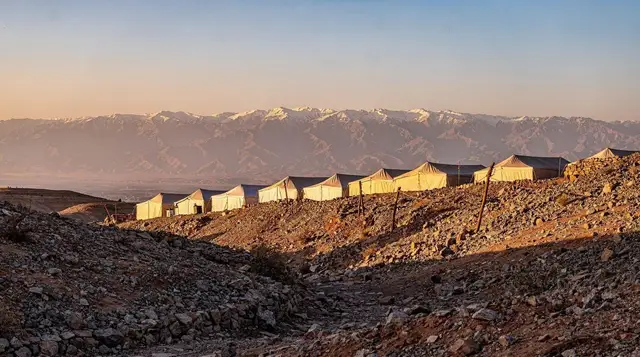
Imlil is the village Marrakech’s trekking industry runs on. Sitting at 1,740 m in the Rheraya valley, about 65 km and an hour and a half’s drive south of the city, it’s the last proper settlement before the trail up Mount Toubkal — and the point where mules, guides, and gîtes replace cars as the way of getting around. Even for visitors with no intention of climbing anything, it’s the most atmospheric mountain base within easy reach of the city.
The drive up passes through Asni and climbs steadily, the road narrowing as it follows the river into the Toubkal National Park. Imlil itself is compact — a cluster of shops, cafés, gear-rental stalls and gîtes along a single main street — but the setting does the work: walnut trees, terraced fields, and the Toubkal massif rising directly above.
| Where | Rheraya valley, Toubkal National Park, about 65 km south of Marrakech |
| Cost | Day tours from roughly 300–500 MAD (€28–46); gîte beds from around 100–200 MAD (€9–19) a night |
| Time needed | A day trip is workable; two days and a night are much better |
| Getting there | Grand taxi, day tour, or private transfer via Asni |
| Best time | April–June and September–October for trekking conditions; winter brings snow and needs proper gear |
What Imlil actually is
It’s a working trailhead, not a resort. Mules laden with supplies or luggage are a constant sight on the main street, heading up toward higher gîtes and refuges that have no road access at all. Local guides, muleteers and gîte owners make up much of the village economy, and the whole place has the low-key, purposeful feel of a mountain town that exists to support people going up, rather than one dressed up to look picturesque.
That doesn’t mean it’s unpolished — there’s decent coffee, functioning wifi in most gîtes, and enough English and French spoken to get by comfortably. It’s simply oriented around trekking logistics: hiring a guide, renting gear, arranging a mule, checking the weather.
The village has grown up almost entirely around this function over recent decades, with new gear shops and gîtes still appearing to meet demand from an increasing number of independent trekkers alongside the traditional agency-booked groups. That growth hasn’t erased the working-village feel, though — Imlil still functions first as a base for getting up the mountain, and only secondarily as a place to browse or linger.
The walk to Aroumd and Armed
For visitors not planning a serious trek, the walk from Imlil up to Aroumd is the single best way to spend a couple of hours here. Aroumd (also spelled Around) sits on a hillside about 45 minutes to an hour above Imlil, a genuinely striking pisé village with sweeping valley views back down toward Imlil and up toward the Toubkal massif. The path is a well-used mule track, moderately steep but not technical, and manageable in normal trainers by anyone reasonably fit.
Continuing to Armed, a smaller village a little further along, extends the walk into a half-day loop without demanding any real trekking equipment or a guide, though hiring one locally is inexpensive and adds context you’d otherwise miss. A guided Imlil walking tour is built around exactly this kind of route.
Both villages sit high enough to give genuinely sweeping views back down the Rheraya valley, and both are still lived-in, working communities rather than sites preserved purely for visitors — expect mules passing through, children on their way to school, and washing hung out to dry alongside the odd café aimed at trekkers. The walk between the two is gentle enough for most fitness levels but does involve sustained, gradual climbing, so factor in more time than the map distance alone suggests, especially in the heat of a summer afternoon.
The Kasbah du Toubkal and other viewpoints
Above Imlil village, on a rocky outcrop, sits the Kasbah du Toubkal, a restored fortress-turned-lodge that’s become something of a local landmark, visible from much of the valley below. Non-guests can usually visit for a coffee or lunch on the terrace, which gives one of the better panoramic views of the surrounding peaks without a serious hike required. It’s a useful reference point for orientation, too — most walking routes out of Imlil are described relative to it.
Further short walks branch off from the main village in several directions, following irrigation channels and mule paths through the orchards along the valley floor before the terrain steepens. None of these require planning beyond a decent pair of shoes and a couple of spare hours, making them a natural way to fill an afternoon either side of a longer trekking day.
Weather and what to pack
Temperatures at 1,740 m run noticeably cooler than Marrakech year-round, and the gap widens further with any elevation gained on a walk. Summer days are pleasantly warm rather than oppressive, but evenings cool quickly once the sun drops behind the ridgeline; a fleece or light jacket earns its place in the bag even in July. Winter brings genuine snow and ice on higher paths, and layers plus proper footwear matter far more than they do down in the city.
Sturdy, broken-in walking shoes make the biggest practical difference of anything you pack, given how much of an Imlil visit involves uneven mule tracks rather than paved paths. A refillable water bottle, sun protection, and a printed or downloaded offline map round out what’s genuinely useful; gear rental in the village covers most trekking equipment reasonably well if you didn’t bring your own.
Mules, gîtes, and staying over
Mules aren’t a novelty here — they’re the practical solution to a landscape with no vehicle access above the village, used for freight, luggage, and sometimes for less mobile trekkers on gentler routes like the Kik Plateau. A mule ride out to the Kik Plateau is a genuinely enjoyable, low-effort way to see the surrounding terrain if walking for hours doesn’t appeal.
Gîtes range from simple shared rooms to comfortable en-suite guesthouses, nearly all family-run, with home-cooked tagine dinners included as standard. Staying a night, even without any trekking plans beyond the Aroumd walk, changes the experience — the village empties of day-trippers by late afternoon, and evenings are quiet enough to actually hear the river.
Booking ahead matters more in peak trekking seasons — spring and early autumn weekends can see the better-known gîtes fill up, particularly around any local moussem or holiday period. Prices are modest by international standards regardless of season, and most include breakfast alongside the evening meal, which suits the early starts most walking routes out of the village require.
Choosing between a day trip and a longer stay
The honest way to decide is to ask what you want from the mountains. If the goal is a change of air after the medina, a day out works: you leave the heat behind, walk a short loop, eat lunch with a view and return to the city by evening. Our Atlas Mountains day trip guide compares the different valleys on offer, and Imlil usually comes out as the one with the strongest mountain character. An organised day trip suits travellers who want everything arranged, including the transport.
If you want to actually walk, the calculation changes. A night in a gîte gives you an unhurried morning on the trails, before the minibuses arrive, and an evening when the village belongs to the people who live there. It also fits neatly into a short escape from the city, such as the two-day Atlas itinerary, which is built around exactly this kind of overnight in the mountains.
Travellers who like to compare options before committing can weigh Imlil against the other mountain valleys within reach. Ourika Valley is the more popular choice for a quick day out, with its riverside restaurants and waterfalls, while Imlil is the one that rewards a slower pace and a pair of walking shoes. Neither is wrong; they simply answer different questions.
Water, walnut groves and the rhythm of the valley
Part of Imlil’s appeal is how visibly the valley is shaped by water. Irrigation channels run along the terraces, feeding orchards and small fields, and walking beside them is one of the easiest ways to understand how the villages survive at this altitude. The sound of the river is never far away, and in spring the meltwater gives the whole valley a freshness that is hard to find on the plain below.
A short valley excursion is a good fit for visitors who want scenery without a long climb. Keep in mind that paths near water can be slippery, so shoes with a decent grip matter more than they might appear to on a map.
The rhythm of daily life is part of the experience too. Mornings start early, with shopkeepers opening up and muleteers loading their animals; the middle of the day is quieter; and by late afternoon, as the light softens on the slopes, the village feels at its best. Visitors who stay overnight see all of it, which is one more reason to prefer a night in the valley over a rushed round trip.
Respecting village life
Imlil and the hamlets above it are lived-in communities, and a few habits make a visit easier for everyone. Dress modestly when walking through villages, ask before photographing people, and keep to the established paths rather than cutting across terraced fields, which are carefully maintained. A greeting in Arabic, French or Tashelhit goes a long way, and a small purchase from a village shop or café is a simple way of leaving something behind.
For deeper context on how to meet local families respectfully, our Berber village visits guide covers etiquette, what to expect when invited for tea, and how to avoid the awkward moments that first-time visitors sometimes stumble into. The tradition of hospitality in the mountains is real, and it is worth approaching it with curiosity rather than a checklist; our blog piece on Moroccan hospitality explains the spirit behind it.
Getting the logistics right
Most people reach Imlil from Marrakech by tour, shared taxi or private transfer, and the choice depends on how much flexibility you want. A tour removes every decision but sets the schedule; a private transfer lets you start early and stop where you like. For help comparing the options, see our guide on getting around Marrakech, and if you are tempted to hire a car and drive yourself, read the driving in Morocco guide first, because mountain roads ask for more attention than the motorway.
Whichever way you travel, bring cash, download your maps before leaving the city, and tell your riad or hotel where you are going. Reception in the valley can be patchy, and a little preparation removes most of the stress. If you are weighing whether to do the trip independently or with an operator, the guided tour versus independent travel guide lays out the trade-offs plainly.
Combining Imlil with the rest of your trip
Imlil works best as a deliberate pause in a longer Marrakech stay rather than a box to tick. Many visitors spend their first days in the medina, then head for the mountains once the noise and the crowds have started to wear thin. The contrast is the point: after the intensity of the souks, a quiet valley and a good night’s sleep feel like a reward.
Active travellers can build a whole week around the Atlas, linking walks, villages and viewpoints, and our hiking week itinerary shows how Imlil slots into that kind of plan. Those with more modest ambitions might combine the valley with an easy Asni stop on the way, then finish the day back in the city with a long dinner and an early night.
Toubkal, briefly
Imlil is also the standard starting point for climbing Toubkal, North Africa’s highest peak at 4,167 m — typically a two-day trek via the Toubkal refuge, with the summit push before dawn on day two. Since 2023, a licensed mountain guide is a legal requirement for the ascent, arranged through an agency in Marrakech or directly with guides based in Imlil; this isn’t a formality, and unguided attempts have led to fatalities on a mountain that’s more serious than its accessibility suggests.
A three-day acclimatisation trek is the more comfortable option for anyone not already at altitude fitness. Full route detail lives in our Toubkal trek guide.
For trekkers weighing up whether to base themselves here versus elsewhere in the High Atlas, or whether Ouirgane further down the valley suits a calmer stay better, our full Imlil guide breaks down gîte options and route planning in more detail than fits here.