Diabat sits just across the mouth of the oued Ksob from Essaouira, close enough to walk to at low tide, far enough that almost nobody bothers unless they’ve come specifically for the story. It’s a small, quiet village of a few hundred people, notable mainly for two things: a legend involving Jimi Hendrix, and a genuinely striking ruined tower half-swallowed by sand dunes.
The legend gets told with more confidence than the facts support. Hendrix did visit the Essaouira region in 1969, that much is documented. Whether he ever actually stayed in Diabat, and whether the ruined Borj El Baroud tower inspired any specific song, is far less certain — most of what circulates locally is folklore built up over decades rather than anything verifiable. It’s a good story, worth hearing, but worth hearing as a story rather than a fact you repeat as settled history.
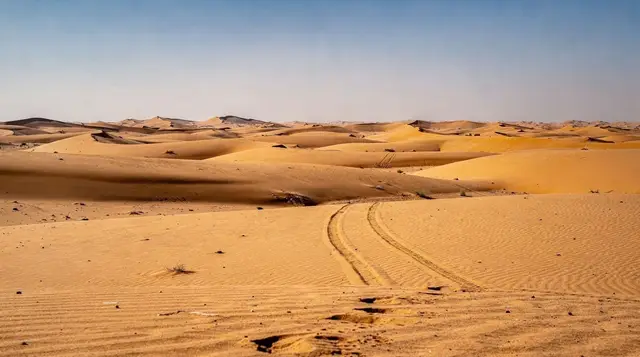
What’s not in dispute is the tower itself. Borj El Baroud is an old fortified structure, now half-buried in drifting dunes, its remaining walls rising out of the sand at odd angles. It photographs well, and reaching it involves a short, genuinely pleasant walk across open dune and scrub that feels a world away from Essaouira’s medina just a few kilometres north.
| Where | A short drive or a low-tide walk south of Essaouira, across the oued Ksob |
| Cost | Free to visit; horse and camel rides typically 150-350 MAD (14-32 €) for an hour |
| Time needed | Half a day, usually combined with an Essaouira visit |
| Getting there | Taxi or organised transfer from Essaouira, or on foot at low tide via the estuary crossing |
| Best time | Any season; check tide times if planning to cross the oued on foot |
Why Diabat suits a slower kind of traveller
Most visitors to the coast spend their time inside Essaouira’s ramparts, among the blue boats, the market stalls and the gulls. Diabat answers a different mood. It rewards people who like open ground, unhurried walking and a bit of silence, and it makes a natural counterweight to the intensity of the city you probably left behind. If your days in Marrakech were packed with the souks and the crowds of Jemaa el-Fna, this corner of the coast is where the pace drops without any effort on your part.
It also suits people who travel with a camera. The mix of pale sand, weathered stone and Atlantic light gives photographers plenty to work with, and the half-buried tower gives a focal point that few places on this coast can match. Our photography guide has general advice on light and composition that applies just as well out here as in the medina.
What to bring and how to dress
Diabat has very little in the way of shops or cafés, so treat the outing as a small expedition and carry what you need. Water comes first. A hat, sunglasses and sun protection matter on open dunes where there is little shade, and a light windproof layer is worth having because the Atlantic breeze can turn cool even on a bright day. Closed shoes that cope with sand are far more comfortable than sandals if you plan to climb around the tower or walk the beach for any distance.
If you intend to cross the oued on foot, wear something you don’t mind getting wet, and keep your camera and phone in a bag you can lift out of the water. For general advice on clothing choices in Morocco, see what to wear in Marrakech; the same common sense about modest, practical clothing applies here, particularly if you pass through the village itself. Our weather guide is a useful companion when you’re deciding which season suits you, though keep in mind that the coast behaves differently from the inland city.
The Jimi Hendrix story, honestly told
It’s worth separating what’s documented from what’s repeated. Hendrix’s 1969 trip to Morocco is real and well recorded, and he did spend time around Essaouira during it. The specific claims that grew from that visit — that he bought land in Diabat, that “Castles Made of Sand” was written about the Borj El Baroud tower — are not supported by reliable sources, and most biographers treat them as embellishment that took hold after his death rather than events that actually happened.
None of that makes a visit to Diabat pointless. The tower is a genuinely atmospheric ruin regardless of who did or didn’t write a song about it, and the walk across the dunes to reach it is worthwhile on its own terms. Just don’t expect a guide to hand you verified facts rather than a well-worn local story.
The Borj El Baroud tower
The tower itself is the actual reason to make the trip. What remains of its walls rises unevenly from the surrounding dunes, sand piled against one side almost to roof height while the opposite wall stands more fully exposed — the kind of slow, ongoing erosion that makes a ruin feel genuinely abandoned rather than curated for visitors. There’s no ticket booth, no signage, no set path; you simply walk out across the dunes from the village and find it.
The surrounding dune landscape is worth the visit even without the tower, a small-scale echo of the bigger Sahara dune fields much further south, reachable here in a twenty-minute walk rather than a multi-day drive.
Walking the dunes without a guide
Because there is no ticket booth and no marked path, the visit has a pleasantly improvised feel. You head out from the village, keep the tower in sight and let the terrain decide your route. The sand shifts constantly, so the tower can look different from one visit to the next, with a wall exposed one season and buried the next. That unfinished, changing quality is part of the appeal.
Go slowly and give yourself time to stop. The best moments here tend to be unplanned: a view back toward Essaouira’s skyline across the water, the pattern of wind ripples on a dune face, a horse and rider appearing along the shoreline. If you travel with children, the dunes make a natural playground, and the tower is easy enough to explore with a little care. Our guide to Marrakech with kids has more ideas for keeping younger travellers engaged on a trip like this.
Do respect the ruin. Walls that have stood through centuries of wind are fragile, so avoid climbing on the weakest sections and take your rubbish with you.
Horse and camel rides
Diabat and the stretch of coast around it is one of the more popular spots for horseback riding near Essaouira, taking advantage of the wide beach and the estuary crossing for a genuinely varied route rather than a simple there-and-back gallop. Essaouira 3-hour horse ride with a Berber tent stop typically follows the coast down toward Diabat and the oued, with a break at a Berber-style tent partway through — a good option if you want more than a short beach trot.
Shorter options exist too. Essaouira 1-hour horse ride suits anyone without much riding experience or limited time, covering a shorter stretch of the same coastline. Camel rides run alongside the horse routes on the same beach — Essaouira camel ride on the beach is the equivalent option for travellers who’d rather ride a camel than a horse, or want to alternate between the two on a longer visit.
If you are choosing between the two animals, think about what you want from the ride. A horse gives you pace and a feeling of freedom along the open beach, and suits anyone with at least a little confidence in the saddle. A camel is slower and steadier, and many travellers find it the easier choice for a first experience or for a group with mixed abilities. Our dedicated camel ride guide explains what to expect, and the wider adventure sports guide shows where riding sits among the other outdoor options in the region.
Whichever you pick, tell the operator honestly about your experience. A good stable matches the horse to the rider, and nobody will think less of you for saying you are a beginner.
Birdwatching on the oued
The estuary where the oued Ksob meets the Atlantic, right at the edge of Diabat, is a genuinely good spot for birdwatching, part of a wetland system that draws migratory species heading along the West African flyway. Flamingos, herons and various wading birds are commonly seen in the shallow water and reed beds at low tide, particularly in the cooler months when migration traffic through Morocco’s coast picks up.
It’s an easy, unstructured activity — no boat or guide is strictly necessary, just patience and a pair of binoculars if you have them, walking the estuary edge at low tide when the exposed mudflats draw the most birds. Serious birdwatchers sometimes combine a Diabat visit with the wider Essaouira lagoon system slightly to the south, which has a similar profile of resident and migratory species on a larger scale.
Early morning offers the best combination of light and bird activity, before the day’s wind picks up and before any horse or camel groups start crossing the same stretch of sand. It’s a genuinely peaceful hour, and one of the few times Diabat feels entirely separate from Essaouira’s tourist rhythm just across the water, with only the sound of the tide and the birds themselves for company.
Getting there and the tide
The most atmospheric way to reach Diabat is on foot from Essaouira, crossing the oued Ksob where it meets the sea — straightforward at low tide, potentially impassable at high tide, so check tide times before setting out or you’ll be turned back at the water’s edge. A taxi from Essaouira takes the inland road bridge instead and removes the tide problem entirely, at the cost of some of the walk’s charm.
Tide tables are posted at some Essaouira hotels and available from most tour desks in the medina; if in doubt, ask before you set out rather than guessing, since the crossing point can go from ankle-deep to genuinely difficult within an hour or two either side of high water. The walk itself, when conditions allow it, takes roughly 30-40 minutes each way along the open beach, with the Diabat headland and its marabout visible for most of the route.
Essaouira 3-hour horseback ride is another way to reach the area without worrying about tides, since routes are timed by the operator and generally use the inland crossing regardless of water levels.
Fitting Diabat into your Marrakech trip
Diabat only makes sense as part of a wider Essaouira plan, so start by deciding how you will get to the coast. The Marrakech to Essaouira transport guide compares the options, and getting around Marrakech helps with the city end of the journey. If you have only a single day, the best day trips from Marrakech page shows how the coast compares with the mountains and the desert, and you will probably find that Diabat is a bonus rather than the main event.
With a night or two on the coast you can take things more calmly. The Marrakech and Essaouira in 2 days itinerary gives a ready-made structure, and a slower stay leaves room to cross to Diabat at the right tide, ride in the soft morning light and still enjoy Essaouira’s evenings. Travellers who are drawn to the water may also like the Essaouira surf guide, since the same wind that shapes the dunes here makes this coast popular with surfers.
Who will enjoy it, and who might not
Diabat is a good match for walkers, photographers, riders, birdwatchers and anyone curious about the Hendrix story who is happy to treat it as a legend. It is less suited to travellers who need a packed programme, comfortable facilities or a guide to narrate every stop. If that sounds like you, spend the time in Essaouira’s medina instead and consider Diabat only if a spare hour opens up.
Those hungry for more dramatic dune scenery should know that this is a modest, small-scale landscape. For the real thing, look at Agafay near Marrakech or the larger dunes of Merzouga; Diabat is a gentle taste, not a substitute.
Diabat is best treated as an extension of an Essaouira visit rather than a destination in its own right, and it sits roughly between Essaouira and Sidi Kaouki if you’re stringing a full coastal day together. For more on the horseback options along this stretch, see horse riding around Marrakech, and for planning the wider trip out from the city, the Essaouira day trip guide and Essaouira, the antidote to Marrakech both cover how the coast fits into a Marrakech itinerary.