Marrakech to Essaouira: How to Get There
What's the best way to get from Marrakech to Essaouira?
Supratours or CTM buses (2h45-3h, 80-100 MAD) are the reliable, comfortable option for most travellers, and reservations are worth making a day or two ahead in summer. A private transfer (60-90 € one-way) suits groups, families or anyone wanting door-to-door timing rather than a fixed departure.
Essaouira sits roughly 190 km west of Marrakech on the Atlantic coast, and unlike most of the destinations in this region, there’s no train option — the route runs entirely by road. That narrows the real choice to four: Supratours, CTM, a shared grand taxi, or a private transfer, each with a different balance of price, comfort and flexibility.
| Where | Marrakech to Essaouira, ~190 km, Atlantic coast |
| Cost | Bus 80-100 MAD; private transfer 60-90 € one-way |
| Time needed | 2h45-3h by road, any method |
| Getting there | Supratours/CTM terminals, grand taxi stand, or hotel pickup for private transfer |
| Best time | Book bus seats a day or two ahead in summer (June-September) |
Supratours and CTM: the reliable middle option
Supratours and CTM are Morocco’s two main intercity bus operators, and both run multiple daily departures on the Marrakech-Essaouira route at similar prices, roughly 80-100 MAD one-way. The buses are comfortable, air-conditioned, and run to a fixed schedule, which makes planning the rest of your day straightforward. The journey takes about 2 hours 45 minutes to 3 hours depending on traffic through Chichaoua, a town roughly at the route’s midpoint.
Reservations are worth making a day or two in advance during the summer peak (June-September) and around Moroccan public holidays, when popular departure times can sell out. Outside those periods, buying a same-day ticket at the terminal is usually fine, though arriving with some buffer before departure is still sensible given how full Moroccan bus terminals can get.
Grand taxi: fast if you catch one filling up
A shared grand taxi from the designated stand can be the quickest option of all, since it leaves as soon as it has six passengers rather than waiting for a scheduled departure — on a good day, that might mean leaving within minutes of arriving at the stand. The trade-off is unpredictability: if the stand is quiet, you could wait considerably longer than a scheduled bus would take. Pricing is per seat and generally comparable to or slightly above the bus fare; buying multiple seats speeds up departure and adds privacy if that matters to you.
Private transfer: door to door, on your schedule
A private transfer removes the schedule question entirely: pickup at your riad or hotel, drop-off at your Essaouira accommodation, at whatever time suits your flight or plans. A private transfer to Essaouira typically runs 60-90 € one-way depending on vehicle size, which becomes competitive with bus fares once split across three or four people, and it’s the most comfortable option for anyone travelling with young children, a lot of luggage, or simply wanting to stop for photos along the way.
A private transfer specifically timed around your own schedule works the same way, and for the return leg, a shared transfer back to Marrakech is a lower-cost alternative to a fully private return if your group is more budget-conscious on the way back.
Day trip versus overnight
Because the round trip alone takes 5.5-6 hours, a same-day return visit to Essaouira is a genuinely long day once you add sightseeing time — workable, but tiring. A day trip to Essaouira with transfers included handles the logistics for you and typically includes a few hours of guided or free time in the medina and port before the return drive, and a coastal day trip with hotel pickup covers similar ground.
For the fuller case for staying overnight instead — and what there is to do beyond a rushed afternoon — see the Essaouira day trip guide, which weighs both formats directly.
Booking practicalities
Supratours tickets can be bought at the terminal or, for popular routes, through third-party booking platforms that add a small convenience fee; CTM operates similarly. Bring your passport or ID for the booking process, since Moroccan bus operators generally ask for identification at ticket purchase. If you’re catching an early departure, allow extra time for Marrakech’s morning traffic between the medina and the bus terminals, which sit outside the old city walls.
Arriving in Essaouira
Both Supratours and CTM drop passengers at terminals a short walk or petit taxi ride from Essaouira’s own walled medina, considerably smaller and easier to navigate on arrival than Marrakech’s. A private transfer, by contrast, can usually drop you directly at or very near your riad door, since Essaouira’s medina — while also pedestrian at its core — has a more compact layout with car access closer to most accommodation than Marrakech’s does. If you’re arriving by bus with luggage, a short petit taxi hop from the terminal into the medina is inexpensive and saves the walk in the coastal wind, which picks up noticeably by mid-morning most days.
Combining the trip with an overnight stay or a longer coastal add-on
Many visitors treat Essaouira as more than a single day trip, given how different its pace and Atlantic climate are from Marrakech — see the Essaouira day trip guide for the case for staying two or three nights rather than rushing back the same day. If you’re combining the coast with more of the south, some operators run onward private transfers from Essaouira toward Agadir or Taghazout rather than doubling back to Marrakech, worth asking about directly if your route continues south. For itinerary planning that already builds in an Essaouira stop, the Marrakech and Essaouira in 2 days itinerary lays out a workable structure for the coastal add-on specifically.
What the drive itself is like
The road between Marrakech and Essaouira runs through increasingly open, arid countryside dotted with argan trees — look out for goats climbing them near Chichaoua, a genuinely local sight rather than a staged photo opportunity, though a few roadside stops do exist purely for tourist photos and small tips. The route is entirely paved and well-maintained, a comfortable drive or bus ride without the switchback intensity of the Atlas routes further south. Most buses and private transfers make no scheduled stop, though a private driver will often accommodate a short photo or bathroom stop if asked in advance.
Weather and what to pack for the transition
Essaouira’s Atlantic climate is genuinely different from Marrakech’s, often 10-15°C cooler with a near-constant wind that gives the town its longstanding windsurfing reputation. Pack a light jacket or windbreaker even if you’ve been in shorts and t-shirts in Marrakech — many visitors are caught out by how quickly the temperature drops once the bus crosses into the coastal air, sometimes within the final 30-40 minutes of the drive. This temperature swing is also one of the better reasons to consider the trip in summer specifically, when Marrakech’s heat is at its most oppressive and Essaouira’s coastal breeze offers real relief.
If you’re continuing south instead of returning to Marrakech
Not every visitor loops back through Marrakech after Essaouira — some continue down the coast toward Agadir or Taghazout, or inland toward Marrakech only as a connecting point for a flight home. Private transfer operators on this corridor generally also cover the Essaouira-Agadir leg, worth booking as part of the same arrangement if your route continues that way, since coordinating one operator for a multi-leg coastal trip is simpler than switching between bus companies partway through. Bus connections exist too, but with less frequency than the well-served Marrakech corridor, so check specific departure times in advance if this is your plan rather than assuming the same frequency applies.
Choosing by traveller type
The right option depends less on the route, which is the same for everyone, than on who is travelling and what the rest of the trip looks like. A solo traveller on a tight budget will usually be happiest on a bus: the fare is modest, the schedule is fixed, and there is no negotiation involved. If budget is the main driver of your whole trip, the Marrakech budget guide shows where a bus fare sits against other daily costs, and the five-day budget itinerary builds the coast into a plan that stays frugal.
Families and groups of three or more should look hard at a private car. Once the fare is divided, the gap with the bus narrows, and you gain pickup at your door, room for luggage and the freedom to stop if a child needs a break. If you are travelling with little ones, the guide to Marrakech with kids covers the wider logistics, and a family riad makes the morning departure far less stressful than hauling bags across the medina.
Couples who want the journey to feel like part of the holiday rather than a chore often prefer a private driver as well, particularly when the coast is a highlight of a romantic stay. The five-day honeymoon itinerary shows how a coastal stop can slot into that kind of trip.
Getting from your riad to the departure point
Whichever option you choose, the first leg of the journey happens inside Marrakech, and it is easy to underestimate. Narrow medina lanes cannot take cars, so you will walk or use a porter to reach the nearest road where a taxi can pick you up. Our guide to getting around Marrakech explains how the different local transport options work, and the Marrakech taxi guide is worth reading before you hail a petit taxi to the terminal: agree how the fare will be calculated before you set off, and leave a comfortable margin before your departure time.
If your riad is deep in the old city, ask your hosts the evening before whether they can arrange a porter or a taxi for the early morning. This small piece of planning is often the difference between a calm start and a rushed one. If you have not yet chosen where to stay, the guide to staying in a riad explains what to ask about luggage help and early departures.
Leaving Marrakech by air or arriving late
Many travellers link the Essaouira trip to a flight, either arriving in Marrakech and heading straight to the coast or returning to the city for a departure. In that case a private transfer is the safest choice, because a fixed bus timetable leaves no slack if a flight is delayed. For the Marrakech end of the journey, the airport transfer guide covers how to get between the airport and the city, and it pays to build a generous gap between the Essaouira return and any flight home rather than trusting a tight connection.
If you are tempted by the idea of driving yourself, read the driving in Morocco guide first. The road itself is straightforward, but parking in Essaouira and unfamiliar local driving habits are worth thinking about before you commit to a rental car for a short coastal trip.
What to do once you arrive
Essaouira rewards unhurried exploring: the ramparts, the fishing port, the blue boats and the wind-scoured beach all sit within easy reach of one another. If the town appeals as more than a quick stop, the Essaouira destination page gives an overview of the place itself, and the blog piece Essaouira, the antidote captures why so many visitors find it a relief after the intensity of Marrakech. Surfers and wind sports fans can start with the Essaouira surf guide, and those who want a slower beach day a little further along the coast can look at Sidi Kaouki.
Plan your return transport before you settle in. Whether you have booked a seat on a bus or arranged a pickup, confirm the time the evening before and leave a margin for the walk or petit taxi back to the terminal. If you are building the whole trip from scratch, the guide to the best day trips from Marrakech puts the coast alongside the mountain and desert options so you can decide how much of your time it deserves.
A short checklist before you travel
- Decide early whether this is a day trip or an overnight, since it changes which transport makes sense.
- Choose bus, taxi or private car according to group size, luggage and how fixed your timings are.
- Book ahead in the busy summer months and around public holidays.
- Carry identification for bus tickets and keep small change for the petit taxi at either end.
- Pack a layer for the coastal wind, and keep valuables and tickets in a bag you hold rather than stow.
- Arrange your riad’s early departure help the evening before, and confirm your return leg on arrival.
However you make the trip, the Marrakech-Essaouira corridor is one of the most straightforward routes in the region — well-paved, well-served by transport, and short enough that even the bus option doesn’t eat into your day too much. For the wider comparison of intercity travel across Morocco, trains and buses in Morocco covers how this route fits alongside the ONCF rail network.
Transport passes and transfers on GetYourGuide
Verified deep-linked GetYourGuide tours. Book through these links and we earn a small commission at no cost to you.
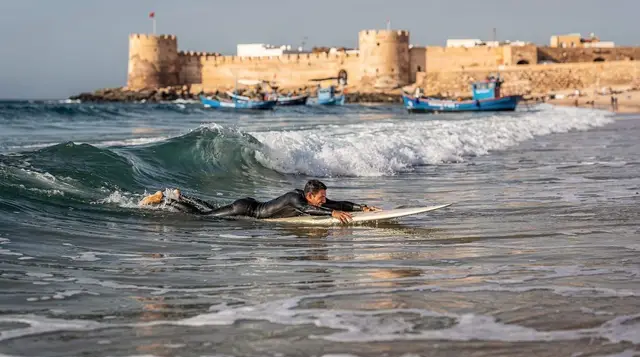
Photo: our own image of the location, not the operator’s product photo.